Hierholzers algoritme for rettet graf
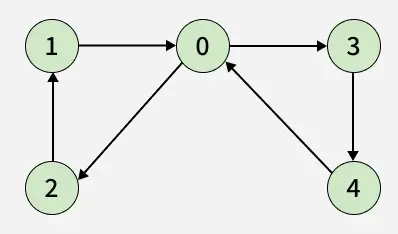
Gitt en rettet Eulersk graf er oppgaven å skrive ut en Euler krets . En Euler-krets er en bane som krysser hver kant av en graf nøyaktig én gang, og banen ender på startpunktet.
Note: Den gitte grafen inneholder en Euler-krets.
Eksempel:
Inngang : Rettet graf

Produksjon: 0 3 4 0 2 1 0
Forutsetninger:
- Vi har diskutert problem med å finne ut om en gitt graf er Eulerian eller ikke for en urettet graf
- Betingelser for Eulerisk krets i en rettet Grpag: (1) Alle toppunkter tilhører en enkelt sterkt tilkoblet komponent. (2) Alle toppunkter har samme inn-grad og ut-grad. Merk at for en urettet graf er betingelsen forskjellig (alle toppunkter har jevn grad)
Nærme:
- Velg et hvilket som helst startpunkt v og følg et spor av kanter fra det toppunktet til du går tilbake til v. Det er ikke mulig å bli sittende fast ved noe annet toppunkt enn v fordi indegree og outdegree for hvert toppunkt må være det samme når stien går inn i et annet toppunkt w det må være en ubrukt kant som forlater w. Turen dannet på denne måten er en lukket tur, men dekker kanskje ikke alle toppunktene og kantene på den første grafen.
- Så lenge det eksisterer et toppunkt u som tilhører den nåværende turen, men som har tilstøtende kanter som ikke er en del av turen, starter du en annen sti fra u følger ubrukte kanter til du går tilbake til u og blir med på turen dannet på denne måten til forrige tur.
Illustrasjon:
Ta eksempel på grafen ovenfor med 5 noder: adj = {{2 3} {0} {1} {4} {0}}.
- Start ved toppunktet 0 :
- Gjeldende bane: [0]
- Krets: []
- Toppunkt 0 → 3 :
- Nåværende bane: [0 3]
- Krets: []
- Toppunkt 3 → 4 :
- Nåværende bane: [0 3 4]
- Krets: []
- Toppunkt 4 → 0 :
- Nåværende bane: [0 3 4 0]
- Krets: []
- Toppunkt 0 → 2 :
- Nåværende bane: [0 3 4 0 2]
- Krets: []
- Toppunkt 2 → 1 :
- Gjeldende bane: [0 3 4 0 2 1]
- Krets: []
- Toppunkt 1 → 0 :
- Gjeldende bane: [0 3 4 0 2 1 0]
- Krets: []
- Gå tilbake til toppunkt 0 : Legg til 0 til kretsen.
- Gjeldende bane: [0 3 4 0 2 1]
- Krets: [0]
- Gå tilbake til toppunkt 1 : Legg til 1 til kretsen.
- Nåværende bane: [0 3 4 0 2]
- Krets: [0 1]
- Gå tilbake til toppunkt 2 : Legg til 2 til kretsen.
- Nåværende bane: [0 3 4 0]
- Krets: [0 1 2]
- Gå tilbake til toppunkt 0 : Legg til 0 til kretsen.
- Nåværende bane: [0 3 4]
- Krets: [0 1 2 0]
- Gå tilbake til toppunkt 4 : Legg til 4 til kretsen.
- Nåværende bane: [0 3]
- Krets: [0 1 2 0 4]
- Gå tilbake til toppunkt 3 : Legg til 3 til kretsen.
- Gjeldende bane: [0]
- Krets: [0 1 2 0 4 3]
- Gå tilbake til toppunkt 0 : Legg til 0 til kretsen.
- Gjeldende bane: []
- Krets: [0 1 2 0 4 3 0]
Nedenfor er implementeringen for tilnærmingen ovenfor:
C++ // C++ program to print Eulerian circuit in given // directed graph using Hierholzer algorithm #include using namespace std ; // Function to print Eulerian circuit vector < int > printCircuit ( vector < vector < int >> & adj ) { int n = adj . size (); if ( n == 0 ) return {}; // Maintain a stack to keep vertices // We can start from any vertex here we start with 0 vector < int > currPath ; currPath . push_back ( 0 ); // list to store final circuit vector < int > circuit ; while ( currPath . size () > 0 ) { int currNode = currPath [ currPath . size () - 1 ]; // If there's remaining edge in adjacency list // of the current vertex if ( adj [ currNode ]. size () > 0 ) { // Find and remove the next vertex that is // adjacent to the current vertex int nextNode = adj [ currNode ]. back (); adj [ currNode ]. pop_back (); // Push the new vertex to the stack currPath . push_back ( nextNode ); } // back-track to find remaining circuit else { // Remove the current vertex and // put it in the circuit circuit . push_back ( currPath . back ()); currPath . pop_back (); } } // reverse the result vector reverse ( circuit . begin () circuit . end ()); return circuit ; } int main () { vector < vector < int >> adj = {{ 2 3 } { 0 } { 1 } { 4 } { 0 }}; vector < int > ans = printCircuit ( adj ); for ( auto v : ans ) cout < < v < < ' ' ; cout < < endl ; return 0 ; }
Java // Java program to print Eulerian circuit in given // directed graph using Hierholzer algorithm import java.util.* ; class GfG { // Function to print Eulerian circuit static List < Integer > printCircuit ( List < List < Integer >> adj ) { int n = adj . size (); if ( n == 0 ) return new ArrayList <> (); // Maintain a stack to keep vertices // We can start from any vertex here we start with 0 List < Integer > currPath = new ArrayList <> (); currPath . add ( 0 ); // list to store final circuit List < Integer > circuit = new ArrayList <> (); while ( currPath . size () > 0 ) { int currNode = currPath . get ( currPath . size () - 1 ); // If there's remaining edge in adjacency list // of the current vertex if ( adj . get ( currNode ). size () > 0 ) { // Find and remove the next vertex that is // adjacent to the current vertex int nextNode = adj . get ( currNode ). get ( adj . get ( currNode ). size () - 1 ); adj . get ( currNode ). remove ( adj . get ( currNode ). size () - 1 ); // Push the new vertex to the stack currPath . add ( nextNode ); } // back-track to find remaining circuit else { // Remove the current vertex and // put it in the circuit circuit . add ( currPath . get ( currPath . size () - 1 )); currPath . remove ( currPath . size () - 1 ); } } // reverse the result vector Collections . reverse ( circuit ); return circuit ; } public static void main ( String [] args ) { List < List < Integer >> adj = new ArrayList <> (); adj . add ( new ArrayList <> ( Arrays . asList ( 2 3 ))); adj . add ( new ArrayList <> ( Arrays . asList ( 0 ))); adj . add ( new ArrayList <> ( Arrays . asList ( 1 ))); adj . add ( new ArrayList <> ( Arrays . asList ( 4 ))); adj . add ( new ArrayList <> ( Arrays . asList ( 0 ))); List < Integer > ans = printCircuit ( adj ); for ( int v : ans ) System . out . print ( v + ' ' ); System . out . println (); } }
Python # Python program to print Eulerian circuit in given # directed graph using Hierholzer algorithm # Function to print Eulerian circuit def printCircuit ( adj ): n = len ( adj ) if n == 0 : return [] # Maintain a stack to keep vertices # We can start from any vertex here we start with 0 currPath = [ 0 ] # list to store final circuit circuit = [] while len ( currPath ) > 0 : currNode = currPath [ - 1 ] # If there's remaining edge in adjacency list # of the current vertex if len ( adj [ currNode ]) > 0 : # Find and remove the next vertex that is # adjacent to the current vertex nextNode = adj [ currNode ] . pop () # Push the new vertex to the stack currPath . append ( nextNode ) # back-track to find remaining circuit else : # Remove the current vertex and # put it in the circuit circuit . append ( currPath . pop ()) # reverse the result vector circuit . reverse () return circuit if __name__ == '__main__' : adj = [[ 2 3 ] [ 0 ] [ 1 ] [ 4 ] [ 0 ]] ans = printCircuit ( adj ) for v in ans : print ( v end = ' ' ) print ()
C# // C# program to print Eulerian circuit in given // directed graph using Hierholzer algorithm using System ; using System.Collections.Generic ; class GfG { // Function to print Eulerian circuit static List < int > printCircuit ( List < List < int >> adj ) { int n = adj . Count ; if ( n == 0 ) return new List < int > (); // Maintain a stack to keep vertices // We can start from any vertex here we start with 0 List < int > currPath = new List < int > { 0 }; // list to store final circuit List < int > circuit = new List < int > (); while ( currPath . Count > 0 ) { int currNode = currPath [ currPath . Count - 1 ]; // If there's remaining edge in adjacency list // of the current vertex if ( adj [ currNode ]. Count > 0 ) { // Find and remove the next vertex that is // adjacent to the current vertex int nextNode = adj [ currNode ][ adj [ currNode ]. Count - 1 ]; adj [ currNode ]. RemoveAt ( adj [ currNode ]. Count - 1 ); // Push the new vertex to the stack currPath . Add ( nextNode ); } // back-track to find remaining circuit else { // Remove the current vertex and // put it in the circuit circuit . Add ( currPath [ currPath . Count - 1 ]); currPath . RemoveAt ( currPath . Count - 1 ); } } // reverse the result vector circuit . Reverse (); return circuit ; } static void Main ( string [] args ) { List < List < int >> adj = new List < List < int >> { new List < int > { 2 3 } new List < int > { 0 } new List < int > { 1 } new List < int > { 4 } new List < int > { 0 } }; List < int > ans = printCircuit ( adj ); foreach ( int v in ans ) { Console . Write ( v + ' ' ); } Console . WriteLine (); } }
JavaScript // JavaScript program to print Eulerian circuit in given // directed graph using Hierholzer algorithm // Function to print Eulerian circuit function printCircuit ( adj ) { let n = adj . length ; if ( n === 0 ) return []; // Maintain a stack to keep vertices // We can start from any vertex here we start with 0 let currPath = [ 0 ]; // list to store final circuit let circuit = []; while ( currPath . length > 0 ) { let currNode = currPath [ currPath . length - 1 ]; // If there's remaining edge in adjacency list // of the current vertex if ( adj [ currNode ]. length > 0 ) { // Find and remove the next vertex that is // adjacent to the current vertex let nextNode = adj [ currNode ]. pop (); // Push the new vertex to the stack currPath . push ( nextNode ); } // back-track to find remaining circuit else { // Remove the current vertex and // put it in the circuit circuit . push ( currPath . pop ()); } } // reverse the result vector circuit . reverse (); return circuit ; } let adj = [[ 2 3 ] [ 0 ] [ 1 ] [ 4 ] [ 0 ]]; let ans = printCircuit ( adj ); for ( let v of ans ) { console . log ( v ' ' ); }
Produksjon
0 3 4 0 2 1 0
Tidskompleksitet: O(V + E) hvor V er antall toppunkter og E er antall kanter i grafen. Grunnen til dette er fordi algoritmen utfører et dybde-først-søk (DFS) og besøker hvert toppunkt og hver kant nøyaktig én gang. Så for hvert toppunkt tar det O(1) tid å besøke det, og for hver kant tar det O(1) tid å krysse det.
Romkompleksitet: O(V + E) som algoritmen bruker en stabel for å lagre gjeldende bane og en liste for å lagre den endelige kretsen. Maksimal størrelse på stabelen kan i verste fall være V + E, så plasskompleksiteten er O(V + E).
Lag quiz