Program dla algorytmu najgorszego dopasowania w zarządzaniu pamięcią
Warunek wstępny: Metody alokacji partycji
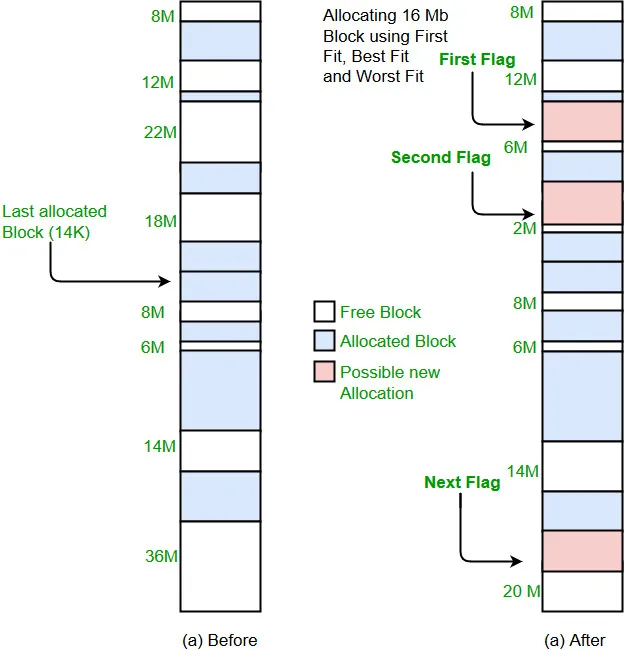
Worst Fit przydziela proces do partycji, która jest największa spośród swobodnie dostępnych partycji dostępnych w pamięci głównej. Jeśli duży proces nastąpi na późniejszym etapie, w pamięci nie będzie już miejsca, aby go pomieścić.
Przykład:
Input : blockSize[] = {100 500 200 300 600}; processSize[] = {212 417 112 426}; Output: Process No. Process Size Block no. 1 212 5 2 417 2 3 112 5 4 426 Not Allocated
Implementation: 1- Input memory blocks and processes with sizes. 2- Initialize all memory blocks as free. 3- Start by picking each process and find the maximum block size that can be assigned to current process i.e. find max(bockSize[1] blockSize[2].....blockSize[n]) > processSize[current] if found then assign it to the current process. 5- If not then leave that process and keep checking the further processes.
Poniżej znajduje się realizacja powyższych kroków.
C++ // C++ implementation of worst - Fit algorithm #include using namespace std ; // Function to allocate memory to blocks as per worst fit // algorithm void worstFit ( int blockSize [] int m int processSize [] int n ) { // Stores block id of the block allocated to a // process int allocation [ n ]; // Initially no block is assigned to any process memset ( allocation -1 sizeof ( allocation )); // pick each process and find suitable blocks // according to its size ad assign to it for ( int i = 0 ; i < n ; i ++ ) { // Find the best fit block for current process int wstIdx = -1 ; for ( int j = 0 ; j < m ; j ++ ) { if ( blockSize [ j ] >= processSize [ i ]) { if ( wstIdx == -1 ) wstIdx = j ; else if ( blockSize [ wstIdx ] < blockSize [ j ]) wstIdx = j ; } } // If we could find a block for current process if ( wstIdx != -1 ) { // allocate block j to p[i] process allocation [ i ] = wstIdx ; // Reduce available memory in this block. blockSize [ wstIdx ] -= processSize [ i ]; } } cout < < ' n Process No. t Process Size t Block no. n ' ; for ( int i = 0 ; i < n ; i ++ ) { cout < < ' ' < < i + 1 < < ' tt ' < < processSize [ i ] < < ' tt ' ; if ( allocation [ i ] != -1 ) cout < < allocation [ i ] + 1 ; else cout < < 'Not Allocated' ; cout < < endl ; } } // Driver code int main () { int blockSize [] = { 100 500 200 300 600 }; int processSize [] = { 212 417 112 426 }; int m = sizeof ( blockSize ) / sizeof ( blockSize [ 0 ]); int n = sizeof ( processSize ) / sizeof ( processSize [ 0 ]); worstFit ( blockSize m processSize n ); return 0 ; }
Java // Java implementation of worst - Fit algorithm public class GFG { // Method to allocate memory to blocks as per worst fit // algorithm static void worstFit ( int blockSize [] int m int processSize [] int n ) { // Stores block id of the block allocated to a // process int allocation [] = new int [ n ] ; // Initially no block is assigned to any process for ( int i = 0 ; i < allocation . length ; i ++ ) allocation [ i ] = - 1 ; // pick each process and find suitable blocks // according to its size ad assign to it for ( int i = 0 ; i < n ; i ++ ) { // Find the best fit block for current process int wstIdx = - 1 ; for ( int j = 0 ; j < m ; j ++ ) { if ( blockSize [ j ] >= processSize [ i ] ) { if ( wstIdx == - 1 ) wstIdx = j ; else if ( blockSize [ wstIdx ] < blockSize [ j ] ) wstIdx = j ; } } // If we could find a block for current process if ( wstIdx != - 1 ) { // allocate block j to p[i] process allocation [ i ] = wstIdx ; // Reduce available memory in this block. blockSize [ wstIdx ] -= processSize [ i ] ; } } System . out . println ( 'nProcess No.tProcess SizetBlock no.' ); for ( int i = 0 ; i < n ; i ++ ) { System . out . print ( ' ' + ( i + 1 ) + 'tt' + processSize [ i ] + 'tt' ); if ( allocation [ i ] != - 1 ) System . out . print ( allocation [ i ] + 1 ); else System . out . print ( 'Not Allocated' ); System . out . println (); } } // Driver Method public static void main ( String [] args ) { int blockSize [] = { 100 500 200 300 600 }; int processSize [] = { 212 417 112 426 }; int m = blockSize . length ; int n = processSize . length ; worstFit ( blockSize m processSize n ); } }
Python3 # Python3 implementation of worst - Fit algorithm # Function to allocate memory to blocks as # per worst fit algorithm def worstFit ( blockSize m processSize n ): # Stores block id of the block # allocated to a process # Initially no block is assigned # to any process allocation = [ - 1 ] * n # pick each process and find suitable blocks # according to its size ad assign to it for i in range ( n ): # Find the best fit block for # current process wstIdx = - 1 for j in range ( m ): if blockSize [ j ] >= processSize [ i ]: if wstIdx == - 1 : wstIdx = j elif blockSize [ wstIdx ] < blockSize [ j ]: wstIdx = j # If we could find a block for # current process if wstIdx != - 1 : # allocate block j to p[i] process allocation [ i ] = wstIdx # Reduce available memory in this block. blockSize [ wstIdx ] -= processSize [ i ] print ( 'Process No. Process Size Block no.' ) for i in range ( n ): print ( i + 1 ' ' processSize [ i ] end = ' ' ) if allocation [ i ] != - 1 : print ( allocation [ i ] + 1 ) else : print ( 'Not Allocated' ) # Driver code if __name__ == '__main__' : blockSize = [ 100 500 200 300 600 ] processSize = [ 212 417 112 426 ] m = len ( blockSize ) n = len ( processSize ) worstFit ( blockSize m processSize n ) # This code is contributed by PranchalK
C# // C# implementation of worst - Fit algorithm using System ; class GFG { // Method to allocate memory to blocks // as per worst fit algorithm static void worstFit ( int [] blockSize int m int [] processSize int n ) { // Stores block id of the block allocated to a // process int [] allocation = new int [ n ]; // Initially no block is assigned to any process for ( int i = 0 ; i < allocation . Length ; i ++ ) allocation [ i ] = - 1 ; // pick each process and find suitable blocks // according to its size ad assign to it for ( int i = 0 ; i < n ; i ++ ) { // Find the best fit block for current process int wstIdx = - 1 ; for ( int j = 0 ; j < m ; j ++ ) { if ( blockSize [ j ] >= processSize [ i ]) { if ( wstIdx == - 1 ) wstIdx = j ; else if ( blockSize [ wstIdx ] < blockSize [ j ]) wstIdx = j ; } } // If we could find a block for current process if ( wstIdx != - 1 ) { // allocate block j to p[i] process allocation [ i ] = wstIdx ; // Reduce available memory in this block. blockSize [ wstIdx ] -= processSize [ i ]; } } Console . WriteLine ( 'nProcess No.tProcess SizetBlock no.' ); for ( int i = 0 ; i < n ; i ++ ) { Console . Write ( ' ' + ( i + 1 ) + 'ttt' + processSize [ i ] + 'ttt' ); if ( allocation [ i ] != - 1 ) Console . Write ( allocation [ i ] + 1 ); else Console . Write ( 'Not Allocated' ); Console . WriteLine (); } } // Driver code public static void Main ( String [] args ) { int [] blockSize = { 100 500 200 300 600 }; int [] processSize = { 212 417 112 426 }; int m = blockSize . Length ; int n = processSize . Length ; worstFit ( blockSize m processSize n ); } } // This code has been contributed by 29AjayKumar
JavaScript < script > // Javascript implementation of // worst - Fit algorithm // Method to allocate memory to // blocks as per worst fit // algorithm function worstFit ( blockSize m processSize n ) { // Stores block id of the block allocated // to a process let allocation = new Array ( n ); // Initially no block is assigned // to any process for ( let i = 0 ; i < allocation . length ; i ++ ) allocation [ i ] = - 1 ; // Pick each process and find suitable blocks // according to its size ad assign to it for ( let i = 0 ; i < n ; i ++ ) { // Find the best fit block // for current process let wstIdx = - 1 ; for ( let j = 0 ; j < m ; j ++ ) { if ( blockSize [ j ] >= processSize [ i ]) { if ( wstIdx == - 1 ) wstIdx = j ; else if ( blockSize [ wstIdx ] < blockSize [ j ]) wstIdx = j ; } } // If we could find a block for // current process if ( wstIdx != - 1 ) { // Allocate block j to p[i] process allocation [ i ] = wstIdx ; // Reduce available memory in this block. blockSize [ wstIdx ] -= processSize [ i ]; } } document . write ( '
Process No. ' + ' Process Size ' + ' Block no.
' ); for ( let i = 0 ; i < n ; i ++ ) { document . write ( ' ' + ( i + 1 ) + ' ' + ' ' + processSize [ i ] + ' ' ); if ( allocation [ i ] != - 1 ) document . write ( allocation [ i ] + 1 ); else document . write ( 'Not Allocated' ); document . write ( '
' ); } } // Driver code let blockSize = [ 100 500 200 300 600 ]; let processSize = [ 212 417 112 426 ]; let m = blockSize . length ; let n = processSize . length ; worstFit ( blockSize m processSize n ); // This code is contributed by rag2127 < /script>
Wyjście
Process No. Process Size Block no. 1 212 5 2 417 2 3 112 5 4 426 Not Allocated
Złożoność czasowa: O(N*M) gdzie N to długość ProcessSize, a M to długość blockSize.
Przestrzeń pomocnicza: NA)