Atvirkštinis ištrynimo algoritmas, skirtas minimaliam medžiui

 #practiceLinkDiv { display: none !important; }
 Atvirkštinio ištrynimo algoritmas yra glaudžiai susijęs su Kruskal algoritmas . Pagal Kruskal algoritmą mes darome: rūšiuojame briaunas didinant jų svorio tvarką. Surūšiavus vienas po kito renkame kraštus didėjančia tvarka. Įtraukiame esamą pasirinktą briauną, jei įtraukus tai į tęstinį medį nesudaromas joks ciklas, kol tęsiančiame medyje nėra V-1 briaunų, kur V = viršūnių skaičius.
Atvirkštinio ištrynimo algoritme mes surūšiuojame visus kraštus mažėja jų svorio tvarka. Po surūšiavimo po vieną renkame kraštus mažėjimo tvarka. Mes įtraukti dabartinį pasirinktą kraštą, jei neįtraukus dabartinės briaunos atsiranda atjungimas dabartiniame grafike . Pagrindinė idėja yra ištrinti kraštą, jei jo ištrynimas nesukelia grafiko atjungimo.
Algoritmas:
- Rūšiuoti visas grafiko briaunas kraštų svorio nedidėjimo tvarka.
- Inicijuokite MST kaip pradinį grafiką ir pašalinkite papildomus kraštus atlikdami 3 veiksmą.
- Pasirinkite didžiausią svorio kraštą iš likusių kraštų ir patikrinkite, ar ištrynus kraštą, grafikas atjungiamas , ar ne .
Jei atsijungia, krašto neištriname.
Kitu atveju ištriname kraštą ir tęsiame.
Iliustracija:
Leiskite mums suprasti šį pavyzdį:
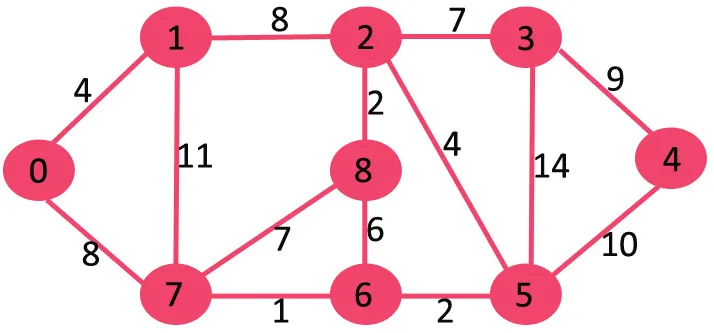
Jei ištrinsime didžiausią svorio kraštą, 14 grafikas neatsijungia, todėl jį pašaliname.
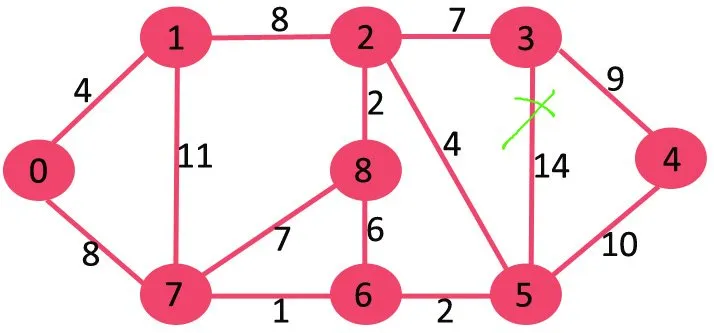
Tada ištriname 11, nes jį ištrynus grafikas neatjungiamas.
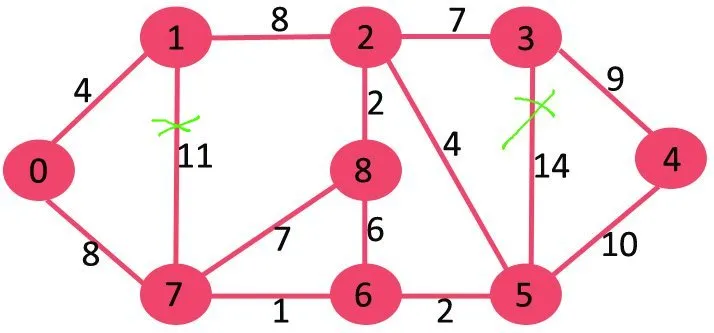
Tada ištriname 10, nes jį ištrynus grafikas neatjungiamas.

Kitas yra 9. Negalime ištrinti 9, nes jį ištrynus nutrūksta ryšys.

Mes tęsiame taip, o kitos briaunos lieka galutiniame MST.
Edges in MST
(3 4)
(0 7)
(2 3)
(2 5)
(0 1)
(5 6)
(2 8)
(6 7)
Pastaba: Esant vienodo svorio briaunoms, galime pasirinkti bet kurį to paties svorio kraštų kraštą.
Rekomenduojama praktika Atvirkštinis ištrynimo algoritmas minimaliam medžiui Išbandykite!Įgyvendinimas:
C++Java// C++ program to find Minimum Spanning Tree // of a graph using Reverse Delete Algorithm #includeusing namespace std ; // Creating shortcut for an integer pair typedef pair < int int > iPair ; // Graph class represents a directed graph // using adjacency list representation class Graph { int V ; // No. of vertices list < int > * adj ; vector < pair < int iPair > > edges ; void DFS ( int v bool visited []); public : Graph ( int V ); // Constructor // function to add an edge to graph void addEdge ( int u int v int w ); // Returns true if graph is connected bool isConnected (); void reverseDeleteMST (); }; Graph :: Graph ( int V ) { this -> V = V ; adj = new list < int > [ V ]; } void Graph :: addEdge ( int u int v int w ) { adj [ u ]. push_back ( v ); // Add w to v’s list. adj [ v ]. push_back ( u ); // Add w to v’s list. edges . push_back ({ w { u v }}); } void Graph :: DFS ( int v bool visited []) { // Mark the current node as visited and print it visited [ v ] = true ; // Recur for all the vertices adjacent to // this vertex list < int >:: iterator i ; for ( i = adj [ v ]. begin (); i != adj [ v ]. end (); ++ i ) if ( ! visited [ * i ]) DFS ( * i visited ); } // Returns true if given graph is connected else false bool Graph :: isConnected () { bool visited [ V ]; memset ( visited false sizeof ( visited )); // Find all reachable vertices from first vertex DFS ( 0 visited ); // If set of reachable vertices includes all // return true. for ( int i = 1 ; i < V ; i ++ ) if ( visited [ i ] == false ) return false ; return true ; } // This function assumes that edge (u v) // exists in graph or not void Graph :: reverseDeleteMST () { // Sort edges in increasing order on basis of cost sort ( edges . begin () edges . end ()); int mst_wt = 0 ; // Initialize weight of MST cout < < 'Edges in MST n ' ; // Iterate through all sorted edges in // decreasing order of weights for ( int i = edges . size () -1 ; i >= 0 ; i -- ) { int u = edges [ i ]. second . first ; int v = edges [ i ]. second . second ; // Remove edge from undirected graph adj [ u ]. remove ( v ); adj [ v ]. remove ( u ); // Adding the edge back if removing it // causes disconnection. In this case this // edge becomes part of MST. if ( isConnected () == false ) { adj [ u ]. push_back ( v ); adj [ v ]. push_back ( u ); // This edge is part of MST cout < < '(' < < u < < ' ' < < v < < ') n ' ; mst_wt += edges [ i ]. first ; } } cout < < 'Total weight of MST is ' < < mst_wt ; } // Driver code int main () { // create the graph given in above figure int V = 9 ; Graph g ( V ); // making above shown graph g . addEdge ( 0 1 4 ); g . addEdge ( 0 7 8 ); g . addEdge ( 1 2 8 ); g . addEdge ( 1 7 11 ); g . addEdge ( 2 3 7 ); g . addEdge ( 2 8 2 ); g . addEdge ( 2 5 4 ); g . addEdge ( 3 4 9 ); g . addEdge ( 3 5 14 ); g . addEdge ( 4 5 10 ); g . addEdge ( 5 6 2 ); g . addEdge ( 6 7 1 ); g . addEdge ( 6 8 6 ); g . addEdge ( 7 8 7 ); g . reverseDeleteMST (); return 0 ; } Python3// Java program to find Minimum Spanning Tree // of a graph using Reverse Delete Algorithm import java.util.* ; // class to represent an edge class Edge implements Comparable < Edge > { int u v w ; Edge ( int u int v int w ) { this . u = u ; this . w = w ; this . v = v ; } public int compareTo ( Edge other ) { return ( this . w - other . w ); } } // Class to represent a graph using adjacency list // representation public class GFG { private int V ; // No. of vertices private List < Integer >[] adj ; private List < Edge > edges ; @SuppressWarnings ({ 'unchecked' 'deprecated' }) public GFG ( int v ) // Constructor { V = v ; adj = new ArrayList [ v ] ; for ( int i = 0 ; i < v ; i ++ ) adj [ i ] = new ArrayList < Integer > (); edges = new ArrayList < Edge > (); } // function to Add an edge public void AddEdge ( int u int v int w ) { adj [ u ] . add ( v ); // Add w to v’s list. adj [ v ] . add ( u ); // Add w to v’s list. edges . add ( new Edge ( u v w )); } // function to perform dfs private void DFS ( int v boolean [] visited ) { // Mark the current node as visited and print it visited [ v ] = true ; // Recur for all the vertices adjacent to // this vertex for ( int i : adj [ v ] ) { if ( ! visited [ i ] ) DFS ( i visited ); } } // Returns true if given graph is connected else false private boolean IsConnected () { boolean [] visited = new boolean [ V ] ; // Find all reachable vertices from first vertex DFS ( 0 visited ); // If set of reachable vertices includes all // return true. for ( int i = 1 ; i < V ; i ++ ) { if ( visited [ i ] == false ) return false ; } return true ; } // This function assumes that edge (u v) // exists in graph or not public void ReverseDeleteMST () { // Sort edges in increasing order on basis of cost Collections . sort ( edges ); int mst_wt = 0 ; // Initialize weight of MST System . out . println ( 'Edges in MST' ); // Iterate through all sorted edges in // decreasing order of weights for ( int i = edges . size () - 1 ; i >= 0 ; i -- ) { int u = edges . get ( i ). u ; int v = edges . get ( i ). v ; // Remove edge from undirected graph adj [ u ] . remove ( adj [ u ] . indexOf ( v )); adj [ v ] . remove ( adj [ v ] . indexOf ( u )); // Adding the edge back if removing it // causes disconnection. In this case this // edge becomes part of MST. if ( IsConnected () == false ) { adj [ u ] . add ( v ); adj [ v ] . add ( u ); // This edge is part of MST System . out . println ( '(' + u + ' ' + v + ')' ); mst_wt += edges . get ( i ). w ; } } System . out . println ( 'Total weight of MST is ' + mst_wt ); } // Driver code public static void main ( String [] args ) { // create the graph given in above figure int V = 9 ; GFG g = new GFG ( V ); // making above shown graph g . AddEdge ( 0 1 4 ); g . AddEdge ( 0 7 8 ); g . AddEdge ( 1 2 8 ); g . AddEdge ( 1 7 11 ); g . AddEdge ( 2 3 7 ); g . AddEdge ( 2 8 2 ); g . AddEdge ( 2 5 4 ); g . AddEdge ( 3 4 9 ); g . AddEdge ( 3 5 14 ); g . AddEdge ( 4 5 10 ); g . AddEdge ( 5 6 2 ); g . AddEdge ( 6 7 1 ); g . AddEdge ( 6 8 6 ); g . AddEdge ( 7 8 7 ); g . ReverseDeleteMST (); } } // This code is contributed by Prithi_DeyC## Python3 program to find Minimum Spanning Tree # of a graph using Reverse Delete Algorithm # Graph class represents a directed graph # using adjacency list representation class Graph : def __init__ ( self v ): # No. of vertices self . v = v self . adj = [ 0 ] * v self . edges = [] for i in range ( v ): self . adj [ i ] = [] # function to add an edge to graph def addEdge ( self u : int v : int w : int ): self . adj [ u ] . append ( v ) # Add w to v’s list. self . adj [ v ] . append ( u ) # Add w to v’s list. self . edges . append (( w ( u v ))) def dfs ( self v : int visited : list ): # Mark the current node as visited and print it visited [ v ] = True # Recur for all the vertices adjacent to # this vertex for i in self . adj [ v ]: if not visited [ i ]: self . dfs ( i visited ) # Returns true if graph is connected # Returns true if given graph is connected else false def connected ( self ): visited = [ False ] * self . v # Find all reachable vertices from first vertex self . dfs ( 0 visited ) # If set of reachable vertices includes all # return true. for i in range ( 1 self . v ): if not visited [ i ]: return False return True # This function assumes that edge (u v) # exists in graph or not def reverseDeleteMST ( self ): # Sort edges in increasing order on basis of cost self . edges . sort ( key = lambda a : a [ 0 ]) mst_wt = 0 # Initialize weight of MST print ( 'Edges in MST' ) # Iterate through all sorted edges in # decreasing order of weights for i in range ( len ( self . edges ) - 1 - 1 - 1 ): u = self . edges [ i ][ 1 ][ 0 ] v = self . edges [ i ][ 1 ][ 1 ] # Remove edge from undirected graph self . adj [ u ] . remove ( v ) self . adj [ v ] . remove ( u ) # Adding the edge back if removing it # causes disconnection. In this case this # edge becomes part of MST. if self . connected () == False : self . adj [ u ] . append ( v ) self . adj [ v ] . append ( u ) # This edge is part of MST print ( '( %d %d )' % ( u v )) mst_wt += self . edges [ i ][ 0 ] print ( 'Total weight of MST is' mst_wt ) # Driver Code if __name__ == '__main__' : # create the graph given in above figure V = 9 g = Graph ( V ) # making above shown graph g . addEdge ( 0 1 4 ) g . addEdge ( 0 7 8 ) g . addEdge ( 1 2 8 ) g . addEdge ( 1 7 11 ) g . addEdge ( 2 3 7 ) g . addEdge ( 2 8 2 ) g . addEdge ( 2 5 4 ) g . addEdge ( 3 4 9 ) g . addEdge ( 3 5 14 ) g . addEdge ( 4 5 10 ) g . addEdge ( 5 6 2 ) g . addEdge ( 6 7 1 ) g . addEdge ( 6 8 6 ) g . addEdge ( 7 8 7 ) g . reverseDeleteMST () # This code is contributed by # sanjeev2552JavaScript// C# program to find Minimum Spanning Tree // of a graph using Reverse Delete Algorithm using System ; using System.Collections.Generic ; // class to represent an edge public class Edge : IComparable < Edge > { public int u v w ; public Edge ( int u int v int w ) { this . u = u ; this . v = v ; this . w = w ; } public int CompareTo ( Edge other ) { return this . w . CompareTo ( other . w ); } } // Graph class represents a directed graph // using adjacency list representation public class Graph { private int V ; // No. of vertices private List < int > [] adj ; private List < Edge > edges ; public Graph ( int v ) // Constructor { V = v ; adj = new List < int > [ v ]; for ( int i = 0 ; i < v ; i ++ ) adj [ i ] = new List < int > (); edges = new List < Edge > (); } // function to Add an edge public void AddEdge ( int u int v int w ) { adj [ u ]. Add ( v ); // Add w to v’s list. adj [ v ]. Add ( u ); // Add w to v’s list. edges . Add ( new Edge ( u v w )); } // function to perform dfs private void DFS ( int v bool [] visited ) { // Mark the current node as visited and print it visited [ v ] = true ; // Recur for all the vertices adjacent to // this vertex foreach ( int i in adj [ v ]) { if ( ! visited [ i ]) DFS ( i visited ); } } // Returns true if given graph is connected else false private bool IsConnected () { bool [] visited = new bool [ V ]; // Find all reachable vertices from first vertex DFS ( 0 visited ); // If set of reachable vertices includes all // return true. for ( int i = 1 ; i < V ; i ++ ) { if ( visited [ i ] == false ) return false ; } return true ; } // This function assumes that edge (u v) // exists in graph or not public void ReverseDeleteMST () { // Sort edges in increasing order on basis of cost edges . Sort (); int mst_wt = 0 ; // Initialize weight of MST Console . WriteLine ( 'Edges in MST' ); // Iterate through all sorted edges in // decreasing order of weights for ( int i = edges . Count - 1 ; i >= 0 ; i -- ) { int u = edges [ i ]. u ; int v = edges [ i ]. v ; // Remove edge from undirected graph adj [ u ]. Remove ( v ); adj [ v ]. Remove ( u ); // Adding the edge back if removing it // causes disconnection. In this case this // edge becomes part of MST. if ( IsConnected () == false ) { adj [ u ]. Add ( v ); adj [ v ]. Add ( u ); // This edge is part of MST Console . WriteLine ( '({0} {1})' u v ); mst_wt += edges [ i ]. w ; } } Console . WriteLine ( 'Total weight of MST is {0}' mst_wt ); } } class GFG { // Driver code static void Main ( string [] args ) { // create the graph given in above figure int V = 9 ; Graph g = new Graph ( V ); // making above shown graph g . AddEdge ( 0 1 4 ); g . AddEdge ( 0 7 8 ); g . AddEdge ( 1 2 8 ); g . AddEdge ( 1 7 11 ); g . AddEdge ( 2 3 7 ); g . AddEdge ( 2 8 2 ); g . AddEdge ( 2 5 4 ); g . AddEdge ( 3 4 9 ); g . AddEdge ( 3 5 14 ); g . AddEdge ( 4 5 10 ); g . AddEdge ( 5 6 2 ); g . AddEdge ( 6 7 1 ); g . AddEdge ( 6 8 6 ); g . AddEdge ( 7 8 7 ); g . ReverseDeleteMST (); } } // This code is contributed by cavi4762
IšvestisEdges in MST (3 4) (0 7) (2 3) (2 5) (0 1) (5 6) (2 8) (6 7) Total weight of MST is 37Laiko sudėtingumas: O((E*(V+E)) + E log E) kur E yra briaunų skaičius.
Erdvės sudėtingumas: O(V+E) kur V yra viršūnių skaičius, o E yra briaunų skaičius. Grafui saugoti naudojame gretimų vietų sąrašą, todėl mums reikia erdvės, proporcingos O(V+E).
Pastabos:
- Aukščiau pateiktas įgyvendinimas yra paprastas / naivus atvirkštinio ištrynimo algoritmo įgyvendinimas ir gali būti optimizuotas į O (E log V (log log V) 3 ) [Šaltinis : Savaitė ]. Tačiau šis optimizuotas laiko sudėtingumas vis tiek yra mažesnis nei Prim ir Kruskal MST algoritmai.
- Aukščiau pateiktas įgyvendinimas pakeičia pradinį grafiką. Galime sukurti grafiko kopiją, jei reikia išlaikyti originalų grafiką.
Sukurti viktoriną