Petersono abipusio atskirties algoritmas | 2 rinkinys (CPU ciklai ir atminties tvora)
Problema: Atsižvelgiant į 2 procesą I ir J, turite parašyti programą, kuri galėtų garantuoti abipusį atskirtį tarp dviejų be jokios papildomos aparatinės įrangos palaikymo.
CPU laikrodžio ciklų švaistymas
Layman požiūriu, kai gija laukė savo ruožtu, jis pasibaigė ilgą laiką, kol kilpa, kuri maždaug milijonus kartų per sekundę išbandė sąlygą, taigi atlikdamas nereikalingą skaičiavimą. Yra geresnis būdas laukti ir jis yra žinomas kaip „Derling“ .
Norėdami suprasti, ką tai daro, turime gilintis į tai, kaip proceso planavimo priemonė veikia „Linux“. Čia paminėta idėja yra supaprastinta planavimo priemonės versija. Tikrasis diegimas turi daug komplikacijų.
Apsvarstykite šį pavyzdį
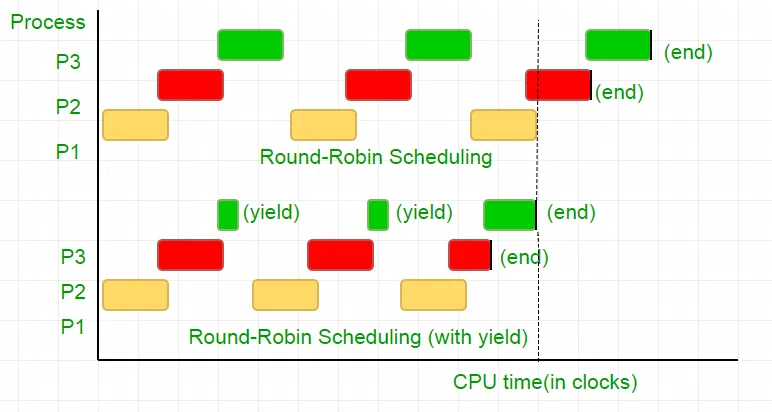
Yra trys procesai P1 P2 ir P3. Procesas P3 yra toks, kad jis turi šiek tiek kilpą, panašią į mūsų kodą, atliekant ne tokį naudingą skaičiavimą, ir iš kilpos egzistuoja tik tada, kai P2 baigia vykdyti. Tvarkaraštis visus juos sudeda į apvalią Robino eilę. Dabar sakykite, kad procesoriaus laikrodžio greitis yra 1000000/sek. Ir kiekvienam iteracijai jis skiria 100 laikrodžių kiekvienam procesui. Tada pirmasis P1 bus paleistas 100 laikrodžių (0,0001 sekundės), tada P2 (0,0001 sekundė), po to p3 (0,0001 sekundė) dabar, nes daugiau procesų nėra šio ciklo kartojimo, kol P2 pasibaigs, o po to atliks P3 vykdymą ir galiausiai jo nutraukimą.
Tai yra visiškas 100 CPU laikrodžio ciklų švaistymas. Norėdami to išvengti, mes abipusiai atsisakome procesoriaus laiko pjūvio, t. Y. Derlingumo, kuris iš esmės baigiasi šį laiko pjūvį, o planuoklis pasirinks kitą procesą, kurį reikia paleisti. Dabar mes tikriname savo būklę, tada atsisakome procesoriaus. Atsižvelgiant į tai, kad mūsų testas trunka 25 laikrodžio ciklus, mes sutaupome 75% savo skaičiavimo per tam tikrą laiką. Norėdami tai įdėti grafiškai
Atsižvelgiant į procesoriaus laikrodžio greitį kaip 1MHz, tai yra daug taupymo!.
Skirtingi paskirstymai suteikia skirtingas funkcijas šiam funkcionalumui pasiekti. „Linux“ teikia „sched_yield“ () .
void lock ( int self ) { flag [ self ] = 1 ; turn = 1 - self ; while ( flag [ 1 - self ] == 1 && turn == 1 - self ) // Only change is the addition of // sched_yield() call sched_yield (); }
Atminties tvora.
Ankstesnio vadovo kodas galėjo veikti daugelyje sistemų, tačiau jis nebuvo 100% teisingas. Logika buvo tobula, tačiau moderniausi „CPUS“ naudoja našumo optimizavimą, dėl kurio gali būti vykdoma ne pagal užsakymą. Šis atminties operacijų (apkrovų ir parduotuvių) pertvarkymas paprastai būna nepastebėtas per vieną vykdymo giją, tačiau gali sukelti nenuspėjamą elgesį kartu su tuo pačiu metu.
Apsvarstykite šį pavyzdį
while ( f == 0 ); // Memory fence required here print x ;
Aukščiau pateiktame pavyzdyje kompiliatorius mano, kad 2 teiginiai yra nepriklausomi vienas nuo kito ir taip bando padidinti kodo efektyvumą iš naujo užsisakydamas juos, o tai gali sukelti problemų dėl lygiagrečių programų. Norėdami to išvengti, mes pateikiame atminties tvorą, kad kompiliatoriui būtų užuomina apie galimą ryšį tarp teiginių per barjerą.
Taigi teiginių tvarka
vėliava [aš] = 1;
posūkis = 1-savęs;
tuo tarpu (posūkio būklės patikrinimas)
derlius ();
turi būti visiškai tas pats, kad užraktas veiktų, nes kitaip jis pasibaigs aklavietėje.
Norėdami užtikrinti, kad šie kompiliatoriai pateiktų instrukciją, kuri neleidžia nurodyti teiginių per šią barjerą. Pabuošlinio pulto atveju __sync_synchronize () .
Taigi modifikuotas kodas tampa
Visas įgyvendinimas C:
// Filename: peterson_yieldlock_memoryfence.cpp // Use below command to compile: // g++ -pthread peterson_yieldlock_memoryfence.cpp -o peterson_yieldlock_memoryfence #include #include #include std :: atomic < int > flag [ 2 ]; std :: atomic < int > turn ; const int MAX = 1e9 ; int ans = 0 ; void lock_init () { // Initialize lock by resetting the desire of // both the threads to acquire the locks. // And giving turn to one of them. flag [ 0 ] = flag [ 1 ] = 0 ; turn = 0 ; } // Executed before entering critical section void lock ( int self ) { // Set flag[self] = 1 saying you want // to acquire lock flag [ self ] = 1 ; // But first give the other thread the // chance to acquire lock turn = 1 - self ; // Memory fence to prevent the reordering // of instructions beyond this barrier. std :: atomic_thread_fence ( std :: memory_order_seq_cst ); // Wait until the other thread loses the // desire to acquire lock or it is your // turn to get the lock. while ( flag [ 1 - self ] == 1 && turn == 1 - self ) // Yield to avoid wastage of resources. std :: this_thread :: yield (); } // Executed after leaving critical section void unlock ( int self ) { // You do not desire to acquire lock in future. // This will allow the other thread to acquire // the lock. flag [ self ] = 0 ; } // A Sample function run by two threads created // in main() void func ( int s ) { int i = 0 ; int self = s ; std :: cout < < 'Thread Entered: ' < < self < < std :: endl ; lock ( self ); // Critical section (Only one thread // can enter here at a time) for ( i = 0 ; i < MAX ; i ++ ) ans ++ ; unlock ( self ); } // Driver code int main () { // Initialize the lock lock_init (); // Create two threads (both run func) std :: thread t1 ( func 0 ); std :: thread t2 ( func 1 ); // Wait for the threads to end. t1 . join (); t2 . join (); std :: cout < < 'Actual Count: ' < < ans < < ' | Expected Count: ' < < MAX * 2 < < std :: endl ; return 0 ; }
C // Filename: peterson_yieldlock_memoryfence.c // Use below command to compile: // gcc -pthread peterson_yieldlock_memoryfence.c -o peterson_yieldlock_memoryfence #include #include #include 'mythreads.h' int flag [ 2 ]; int turn ; const int MAX = 1e9 ; int ans = 0 ; void lock_init () { // Initialize lock by resetting the desire of // both the threads to acquire the locks. // And giving turn to one of them. flag [ 0 ] = flag [ 1 ] = 0 ; turn = 0 ; } // Executed before entering critical section void lock ( int self ) { // Set flag[self] = 1 saying you want // to acquire lock flag [ self ] = 1 ; // But first give the other thread the // chance to acquire lock turn = 1 - self ; // Memory fence to prevent the reordering // of instructions beyond this barrier. __sync_synchronize (); // Wait until the other thread loses the // desire to acquire lock or it is your // turn to get the lock. while ( flag [ 1 - self ] == 1 && turn == 1 - self ) // Yield to avoid wastage of resources. sched_yield (); } // Executed after leaving critical section void unlock ( int self ) { // You do not desire to acquire lock in future. // This will allow the other thread to acquire // the lock. flag [ self ] = 0 ; } // A Sample function run by two threads created // in main() void * func ( void * s ) { int i = 0 ; int self = ( int * ) s ; printf ( 'Thread Entered: %d n ' self ); lock ( self ); // Critical section (Only one thread // can enter here at a time) for ( i = 0 ; i < MAX ; i ++ ) ans ++ ; unlock ( self ); } // Driver code int main () { pthread_t p1 p2 ; // Initialize the lock lock_init (); // Create two threads (both run func) Pthread_create ( & p1 NULL func ( void * ) 0 ); Pthread_create ( & p2 NULL func ( void * ) 1 ); // Wait for the threads to end. Pthread_join ( p1 NULL ); Pthread_join ( p2 NULL ); printf ( 'Actual Count: %d | Expected Count:' ' %d n ' ans MAX * 2 ); return 0 ; }
Java import java.util.concurrent.atomic.AtomicInteger ; public class PetersonYieldLockMemoryFence { static AtomicInteger [] flag = new AtomicInteger [ 2 ] ; static AtomicInteger turn = new AtomicInteger (); static final int MAX = 1000000000 ; static int ans = 0 ; static void lockInit () { flag [ 0 ] = new AtomicInteger (); flag [ 1 ] = new AtomicInteger (); flag [ 0 ] . set ( 0 ); flag [ 1 ] . set ( 0 ); turn . set ( 0 ); } static void lock ( int self ) { flag [ self ] . set ( 1 ); turn . set ( 1 - self ); // Memory fence to prevent the reordering of instructions beyond this barrier. // In Java volatile variables provide this guarantee implicitly. // No direct equivalent to atomic_thread_fence is needed. while ( flag [ 1 - self ] . get () == 1 && turn . get () == 1 - self ) Thread . yield (); } static void unlock ( int self ) { flag [ self ] . set ( 0 ); } static void func ( int s ) { int i = 0 ; int self = s ; System . out . println ( 'Thread Entered: ' + self ); lock ( self ); // Critical section (Only one thread can enter here at a time) for ( i = 0 ; i < MAX ; i ++ ) ans ++ ; unlock ( self ); } public static void main ( String [] args ) { // Initialize the lock lockInit (); // Create two threads (both run func) Thread t1 = new Thread (() -> func ( 0 )); Thread t2 = new Thread (() -> func ( 1 )); // Start the threads t1 . start (); t2 . start (); try { // Wait for the threads to end. t1 . join (); t2 . join (); } catch ( InterruptedException e ) { e . printStackTrace (); } System . out . println ( 'Actual Count: ' + ans + ' | Expected Count: ' + MAX * 2 ); } }
Python import threading flag = [ 0 0 ] turn = 0 MAX = 10 ** 9 ans = 0 def lock_init (): # This function initializes the lock by resetting the flags and turn. global flag turn flag = [ 0 0 ] turn = 0 def lock ( self ): # This function is executed before entering the critical section. It sets the flag for the current thread and gives the turn to the other thread. global flag turn flag [ self ] = 1 turn = 1 - self while flag [ 1 - self ] == 1 and turn == 1 - self : pass def unlock ( self ): # This function is executed after leaving the critical section. It resets the flag for the current thread. global flag flag [ self ] = 0 def func ( s ): # This function is executed by each thread. It locks the critical section increments the shared variable and then unlocks the critical section. global ans self = s print ( f 'Thread Entered: { self } ' ) lock ( self ) for _ in range ( MAX ): ans += 1 unlock ( self ) def main (): # This is the main function where the threads are created and started. lock_init () t1 = threading . Thread ( target = func args = ( 0 )) t2 = threading . Thread ( target = func args = ( 1 )) t1 . start () t2 . start () t1 . join () t2 . join () print ( f 'Actual Count: { ans } | Expected Count: { MAX * 2 } ' ) if __name__ == '__main__' : main ()
JavaScript class PetersonYieldLockMemoryFence { static flag = [ 0 0 ]; static turn = 0 ; static MAX = 1000000000 ; static ans = 0 ; // Function to acquire the lock static async lock ( self ) { PetersonYieldLockMemoryFence . flag [ self ] = 1 ; PetersonYieldLockMemoryFence . turn = 1 - self ; // Asynchronous loop with a small delay to yield while ( PetersonYieldLockMemoryFence . flag [ 1 - self ] == 1 && PetersonYieldLockMemoryFence . turn == 1 - self ) { await new Promise ( resolve => setTimeout ( resolve 0 )); } } // Function to release the lock static unlock ( self ) { PetersonYieldLockMemoryFence . flag [ self ] = 0 ; } // Function representing the critical section static func ( s ) { let i = 0 ; let self = s ; console . log ( 'Thread Entered: ' + self ); // Lock the critical section PetersonYieldLockMemoryFence . lock ( self ). then (() => { // Critical section (Only one thread can enter here at a time) for ( i = 0 ; i < PetersonYieldLockMemoryFence . MAX ; i ++ ) { PetersonYieldLockMemoryFence . ans ++ ; } // Release the lock PetersonYieldLockMemoryFence . unlock ( self ); }); } // Main function static main () { // Create two threads (both run func) const t1 = new Thread (() => PetersonYieldLockMemoryFence . func ( 0 )); const t2 = new Thread (() => PetersonYieldLockMemoryFence . func ( 1 )); // Start the threads t1 . start (); t2 . start (); // Wait for the threads to end. setTimeout (() => { console . log ( 'Actual Count: ' + PetersonYieldLockMemoryFence . ans + ' | Expected Count: ' + PetersonYieldLockMemoryFence . MAX * 2 ); } 1000 ); // Delay for a while to ensure threads finish } } // Define a simple Thread class for simulation class Thread { constructor ( func ) { this . func = func ; } start () { this . func (); } } // Run the main function PetersonYieldLockMemoryFence . main ();
C++ // mythread.h (A wrapper header file with assert statements) #ifndef __MYTHREADS_h__ #define __MYTHREADS_h__ #include #include #include // Function to lock a pthread mutex void Pthread_mutex_lock ( pthread_mutex_t * m ) { int rc = pthread_mutex_lock ( m ); assert ( rc == 0 ); // Assert that the mutex was locked successfully } // Function to unlock a pthread mutex void Pthread_mutex_unlock ( pthread_mutex_t * m ) { int rc = pthread_mutex_unlock ( m ); assert ( rc == 0 ); // Assert that the mutex was unlocked successfully } // Function to create a pthread void Pthread_create ( pthread_t * thread const pthread_attr_t * attr void * ( * start_routine )( void * ) void * arg ) { int rc = pthread_create ( thread attr start_routine arg ); assert ( rc == 0 ); // Assert that the thread was created successfully } // Function to join a pthread void Pthread_join ( pthread_t thread void ** value_ptr ) { int rc = pthread_join ( thread value_ptr ); assert ( rc == 0 ); // Assert that the thread was joined successfully } #endif // __MYTHREADS_h__
C // mythread.h (A wrapper header file with assert // statements) #ifndef __MYTHREADS_h__ #define __MYTHREADS_h__ #include #include #include void Pthread_mutex_lock ( pthread_mutex_t * m ) { int rc = pthread_mutex_lock ( m ); assert ( rc == 0 ); } void Pthread_mutex_unlock ( pthread_mutex_t * m ) { int rc = pthread_mutex_unlock ( m ); assert ( rc == 0 ); } void Pthread_create ( pthread_t * thread const pthread_attr_t * attr void * ( * start_routine )( void * ) void * arg ) { int rc = pthread_create ( thread attr start_routine arg ); assert ( rc == 0 ); } void Pthread_join ( pthread_t thread void ** value_ptr ) { int rc = pthread_join ( thread value_ptr ); assert ( rc == 0 ); } #endif // __MYTHREADS_h__
Python import threading import ctypes # Function to lock a thread lock def Thread_lock ( lock ): lock . acquire () # Acquire the lock # No need for assert in Python acquire will raise an exception if it fails # Function to unlock a thread lock def Thread_unlock ( lock ): lock . release () # Release the lock # No need for assert in Python release will raise an exception if it fails # Function to create a thread def Thread_create ( target args = ()): thread = threading . Thread ( target = target args = args ) thread . start () # Start the thread # No need for assert in Python thread.start() will raise an exception if it fails # Function to join a thread def Thread_join ( thread ): thread . join () # Wait for the thread to finish # No need for assert in Python thread.join() will raise an exception if it fails
Išvestis:
 Thread Entered: 1
 Thread Entered: 0
 Actual Count: 2000000000 | Expected Count: 2000000000