범위 LCM 쿼리
크기 N의 정수 배열 arr[]과 Q 쿼리 배열 query[]가 주어지면 각 쿼리는 인덱스 L에서 인덱스 R까지의 범위를 나타내는 [L R] 유형이며, 작업은 모든 쿼리에 대한 범위의 모든 숫자에 대한 LCM을 찾는 것입니다.
예:
입력: 도착[] = {5 7 5 2 10 12 11 17 14 1 44}
쿼리[] = {{2 5} {5 10} {0 10}}
산출: 6015708 78540
설명: 첫 번째 쿼리에서 LCM(5 2 10 12) = 60
두 번째 쿼리에서 LCM(12 11 17 14 1 44) = 15708
마지막 쿼리에서 LCM(5 7 5 2 10 12 11 17 14 1 44) = 78540입력: arr[] = {2 4 8 16} 쿼리[] = {{2 3} {0 1}}
산출: 16 4
순진한 접근 방식: 이 접근 방식은 다음과 같은 수학적 아이디어를 기반으로 합니다.
수학적으로 LCM(l r) = LCM(arr[l] arr[l+1] . . . arr[r-1] arr[r]) 및
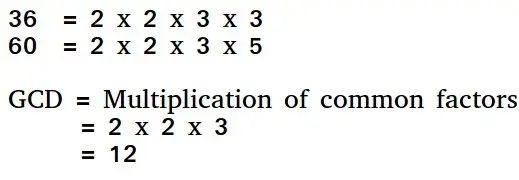
LCM(a b) = (a*b) / GCD(ab)
따라서 모든 쿼리에 대해 배열을 탐색하고 위의 LCM 공식을 사용하여 답을 계산합니다.
시간 복잡도: O(N * Q)
보조 공간: 오(1)
RangeLCM 쿼리 사용 세그먼트 트리 :
쿼리 수가 많을 수 있으므로 순진한 솔루션은 실용적이지 않습니다. 이 시간을 줄일 수 있습니다
이 문제에는 업데이트 작업이 없습니다. 따라서 처음에 세그먼트 트리를 구축하고 이를 사용하여 로그 시간에 쿼리에 응답할 수 있습니다.
트리의 각 노드는 해당 특정 세그먼트에 대한 LCM 값을 저장해야 하며 위와 동일한 공식을 사용하여 세그먼트를 결합할 수 있습니다.
아이디어를 구현하려면 아래에 언급된 단계를 따르세요.
- 주어진 배열에서 세그먼트 트리를 만듭니다.
- 쿼리를 탐색합니다. 각 쿼리에 대해 다음을 수행합니다.
- 세그먼트 트리에서 특정 범위를 찾으십시오.
- 위에서 언급한 공식을 사용하여 세그먼트를 결합하고 해당 범위의 LCM을 계산합니다.
- 해당 부분에 대한 답을 인쇄하세요.
아래는 위의 접근 방식을 구현한 것입니다.
C++ // LCM of given range queries using Segment Tree #include using namespace std ; #define MAX 1000 // allocate space for tree int tree [ 4 * MAX ]; // declaring the array globally int arr [ MAX ]; // Function to return gcd of a and b int gcd ( int a int b ) { if ( a == 0 ) return b ; return gcd ( b % a a ); } // utility function to find lcm int lcm ( int a int b ) { return a * b / gcd ( a b ); } // Function to build the segment tree // Node starts beginning index of current subtree. // start and end are indexes in arr[] which is global void build ( int node int start int end ) { // If there is only one element in current subarray if ( start == end ) { tree [ node ] = arr [ start ]; return ; } int mid = ( start + end ) / 2 ; // build left and right segments build ( 2 * node start mid ); build ( 2 * node + 1 mid + 1 end ); // build the parent int left_lcm = tree [ 2 * node ]; int right_lcm = tree [ 2 * node + 1 ]; tree [ node ] = lcm ( left_lcm right_lcm ); } // Function to make queries for array range )l r). // Node is index of root of current segment in segment // tree (Note that indexes in segment tree begin with 1 // for simplicity). // start and end are indexes of subarray covered by root // of current segment. int query ( int node int start int end int l int r ) { // Completely outside the segment returning // 1 will not affect the lcm; if ( end < l || start > r ) return 1 ; // completely inside the segment if ( l <= start && r >= end ) return tree [ node ]; // partially inside int mid = ( start + end ) / 2 ; int left_lcm = query ( 2 * node start mid l r ); int right_lcm = query ( 2 * node + 1 mid + 1 end l r ); return lcm ( left_lcm right_lcm ); } // driver function to check the above program int main () { // initialize the array arr [ 0 ] = 5 ; arr [ 1 ] = 7 ; arr [ 2 ] = 5 ; arr [ 3 ] = 2 ; arr [ 4 ] = 10 ; arr [ 5 ] = 12 ; arr [ 6 ] = 11 ; arr [ 7 ] = 17 ; arr [ 8 ] = 14 ; arr [ 9 ] = 1 ; arr [ 10 ] = 44 ; // build the segment tree build ( 1 0 10 ); // Now we can answer each query efficiently // Print LCM of (2 5) cout < < query ( 1 0 10 2 5 ) < < endl ; // Print LCM of (5 10) cout < < query ( 1 0 10 5 10 ) < < endl ; // Print LCM of (0 10) cout < < query ( 1 0 10 0 10 ) < < endl ; return 0 ; }
Java // LCM of given range queries // using Segment Tree class GFG { static final int MAX = 1000 ; // allocate space for tree static int tree [] = new int [ 4 * MAX ] ; // declaring the array globally static int arr [] = new int [ MAX ] ; // Function to return gcd of a and b static int gcd ( int a int b ) { if ( a == 0 ) { return b ; } return gcd ( b % a a ); } // utility function to find lcm static int lcm ( int a int b ) { return a * b / gcd ( a b ); } // Function to build the segment tree // Node starts beginning index // of current subtree. start and end // are indexes in arr[] which is global static void build ( int node int start int end ) { // If there is only one element // in current subarray if ( start == end ) { tree [ node ] = arr [ start ] ; return ; } int mid = ( start + end ) / 2 ; // build left and right segments build ( 2 * node start mid ); build ( 2 * node + 1 mid + 1 end ); // build the parent int left_lcm = tree [ 2 * node ] ; int right_lcm = tree [ 2 * node + 1 ] ; tree [ node ] = lcm ( left_lcm right_lcm ); } // Function to make queries for // array range )l r). Node is index // of root of current segment in segment // tree (Note that indexes in segment // tree begin with 1 for simplicity). // start and end are indexes of subarray // covered by root of current segment. static int query ( int node int start int end int l int r ) { // Completely outside the segment returning // 1 will not affect the lcm; if ( end < l || start > r ) { return 1 ; } // completely inside the segment if ( l <= start && r >= end ) { return tree [ node ] ; } // partially inside int mid = ( start + end ) / 2 ; int left_lcm = query ( 2 * node start mid l r ); int right_lcm = query ( 2 * node + 1 mid + 1 end l r ); return lcm ( left_lcm right_lcm ); } // Driver code public static void main ( String [] args ) { // initialize the array arr [ 0 ] = 5 ; arr [ 1 ] = 7 ; arr [ 2 ] = 5 ; arr [ 3 ] = 2 ; arr [ 4 ] = 10 ; arr [ 5 ] = 12 ; arr [ 6 ] = 11 ; arr [ 7 ] = 17 ; arr [ 8 ] = 14 ; arr [ 9 ] = 1 ; arr [ 10 ] = 44 ; // build the segment tree build ( 1 0 10 ); // Now we can answer each query efficiently // Print LCM of (2 5) System . out . println ( query ( 1 0 10 2 5 )); // Print LCM of (5 10) System . out . println ( query ( 1 0 10 5 10 )); // Print LCM of (0 10) System . out . println ( query ( 1 0 10 0 10 )); } } // This code is contributed by 29AjayKumar
Python # LCM of given range queries using Segment Tree MAX = 1000 # allocate space for tree tree = [ 0 ] * ( 4 * MAX ) # declaring the array globally arr = [ 0 ] * MAX # Function to return gcd of a and b def gcd ( a : int b : int ): if a == 0 : return b return gcd ( b % a a ) # utility function to find lcm def lcm ( a : int b : int ): return ( a * b ) // gcd ( a b ) # Function to build the segment tree # Node starts beginning index of current subtree. # start and end are indexes in arr[] which is global def build ( node : int start : int end : int ): # If there is only one element # in current subarray if start == end : tree [ node ] = arr [ start ] return mid = ( start + end ) // 2 # build left and right segments build ( 2 * node start mid ) build ( 2 * node + 1 mid + 1 end ) # build the parent left_lcm = tree [ 2 * node ] right_lcm = tree [ 2 * node + 1 ] tree [ node ] = lcm ( left_lcm right_lcm ) # Function to make queries for array range )l r). # Node is index of root of current segment in segment # tree (Note that indexes in segment tree begin with 1 # for simplicity). # start and end are indexes of subarray covered by root # of current segment. def query ( node : int start : int end : int l : int r : int ): # Completely outside the segment # returning 1 will not affect the lcm; if end < l or start > r : return 1 # completely inside the segment if l <= start and r >= end : return tree [ node ] # partially inside mid = ( start + end ) // 2 left_lcm = query ( 2 * node start mid l r ) right_lcm = query ( 2 * node + 1 mid + 1 end l r ) return lcm ( left_lcm right_lcm ) # Driver Code if __name__ == '__main__' : # initialize the array arr [ 0 ] = 5 arr [ 1 ] = 7 arr [ 2 ] = 5 arr [ 3 ] = 2 arr [ 4 ] = 10 arr [ 5 ] = 12 arr [ 6 ] = 11 arr [ 7 ] = 17 arr [ 8 ] = 14 arr [ 9 ] = 1 arr [ 10 ] = 44 # build the segment tree build ( 1 0 10 ) # Now we can answer each query efficiently # Print LCM of (2 5) print ( query ( 1 0 10 2 5 )) # Print LCM of (5 10) print ( query ( 1 0 10 5 10 )) # Print LCM of (0 10) print ( query ( 1 0 10 0 10 )) # This code is contributed by # sanjeev2552
C# // LCM of given range queries // using Segment Tree using System ; using System.Collections.Generic ; class GFG { static readonly int MAX = 1000 ; // allocate space for tree static int [] tree = new int [ 4 * MAX ]; // declaring the array globally static int [] arr = new int [ MAX ]; // Function to return gcd of a and b static int gcd ( int a int b ) { if ( a == 0 ) { return b ; } return gcd ( b % a a ); } // utility function to find lcm static int lcm ( int a int b ) { return a * b / gcd ( a b ); } // Function to build the segment tree // Node starts beginning index // of current subtree. start and end // are indexes in []arr which is global static void build ( int node int start int end ) { // If there is only one element // in current subarray if ( start == end ) { tree [ node ] = arr [ start ]; return ; } int mid = ( start + end ) / 2 ; // build left and right segments build ( 2 * node start mid ); build ( 2 * node + 1 mid + 1 end ); // build the parent int left_lcm = tree [ 2 * node ]; int right_lcm = tree [ 2 * node + 1 ]; tree [ node ] = lcm ( left_lcm right_lcm ); } // Function to make queries for // array range )l r). Node is index // of root of current segment in segment // tree (Note that indexes in segment // tree begin with 1 for simplicity). // start and end are indexes of subarray // covered by root of current segment. static int query ( int node int start int end int l int r ) { // Completely outside the segment // returning 1 will not affect the lcm; if ( end < l || start > r ) { return 1 ; } // completely inside the segment if ( l <= start && r >= end ) { return tree [ node ]; } // partially inside int mid = ( start + end ) / 2 ; int left_lcm = query ( 2 * node start mid l r ); int right_lcm = query ( 2 * node + 1 mid + 1 end l r ); return lcm ( left_lcm right_lcm ); } // Driver code public static void Main ( String [] args ) { // initialize the array arr [ 0 ] = 5 ; arr [ 1 ] = 7 ; arr [ 2 ] = 5 ; arr [ 3 ] = 2 ; arr [ 4 ] = 10 ; arr [ 5 ] = 12 ; arr [ 6 ] = 11 ; arr [ 7 ] = 17 ; arr [ 8 ] = 14 ; arr [ 9 ] = 1 ; arr [ 10 ] = 44 ; // build the segment tree build ( 1 0 10 ); // Now we can answer each query efficiently // Print LCM of (2 5) Console . WriteLine ( query ( 1 0 10 2 5 )); // Print LCM of (5 10) Console . WriteLine ( query ( 1 0 10 5 10 )); // Print LCM of (0 10) Console . WriteLine ( query ( 1 0 10 0 10 )); } } // This code is contributed by Rajput-Ji
JavaScript < script > // LCM of given range queries using Segment Tree const MAX = 1000 // allocate space for tree var tree = new Array ( 4 * MAX ); // declaring the array globally var arr = new Array ( MAX ); // Function to return gcd of a and b function gcd ( a b ) { if ( a == 0 ) return b ; return gcd ( b % a a ); } //utility function to find lcm function lcm ( a b ) { return Math . floor ( a * b / gcd ( a b )); } // Function to build the segment tree // Node starts beginning index of current subtree. // start and end are indexes in arr[] which is global function build ( node start end ) { // If there is only one element in current subarray if ( start == end ) { tree [ node ] = arr [ start ]; return ; } let mid = Math . floor (( start + end ) / 2 ); // build left and right segments build ( 2 * node start mid ); build ( 2 * node + 1 mid + 1 end ); // build the parent let left_lcm = tree [ 2 * node ]; let right_lcm = tree [ 2 * node + 1 ]; tree [ node ] = lcm ( left_lcm right_lcm ); } // Function to make queries for array range )l r). // Node is index of root of current segment in segment // tree (Note that indexes in segment tree begin with 1 // for simplicity). // start and end are indexes of subarray covered by root // of current segment. function query ( node start end l r ) { // Completely outside the segment returning // 1 will not affect the lcm; if ( end < l || start > r ) return 1 ; // completely inside the segment if ( l <= start && r >= end ) return tree [ node ]; // partially inside let mid = Math . floor (( start + end ) / 2 ); let left_lcm = query ( 2 * node start mid l r ); let right_lcm = query ( 2 * node + 1 mid + 1 end l r ); return lcm ( left_lcm right_lcm ); } //driver function to check the above program //initialize the array arr [ 0 ] = 5 ; arr [ 1 ] = 7 ; arr [ 2 ] = 5 ; arr [ 3 ] = 2 ; arr [ 4 ] = 10 ; arr [ 5 ] = 12 ; arr [ 6 ] = 11 ; arr [ 7 ] = 17 ; arr [ 8 ] = 14 ; arr [ 9 ] = 1 ; arr [ 10 ] = 44 ; // build the segment tree build ( 1 0 10 ); // Now we can answer each query efficiently // Print LCM of (2 5) document . write ( query ( 1 0 10 2 5 ) + '
' ); // Print LCM of (5 10) document . write ( query ( 1 0 10 5 10 ) + '
' ); // Print LCM of (0 10) document . write ( query ( 1 0 10 0 10 ) + '
' ); // This code is contributed by Manoj. < /script>
산출
60 15708 78540
시간 복잡도: O(Log N * Log n) 여기서 N은 배열의 요소 수입니다. 다른 로그 n은 LCM을 찾는 데 필요한 시간을 나타냅니다. 이 시간 복잡도는 각 쿼리에 적용됩니다. 총 시간 복잡도는 O(N + Q*Log N*log n)입니다. 이는 트리를 구축한 다음 쿼리에 응답하는 데 O(N) 시간이 필요하기 때문입니다.
보조 공간: O(N) 여기서 N은 배열의 요소 수입니다. 세그먼트 트리를 저장하기 위해 필요한 공간입니다.
관련 주제: 세그먼트 트리
접근법#2: 수학 사용
먼저 두 숫자의 최소 공배수를 계산하는 도우미 함수 lcm()을 정의합니다. 그런 다음 각 쿼리에 대해 쿼리 범위로 정의된 arr의 하위 배열을 반복하고 lcm() 함수를 사용하여 LCM을 계산합니다. LCM 값은 최종 결과로 반환되는 목록에 저장됩니다.
세그먼트 트리
접근법#2: 수학 사용
연산
세그먼트 트리
접근법#2: 수학 사용
1. 두 숫자의 최소 공배수를 계산하는 도우미 함수 lcm(a b)를 정의합니다.
2. 배열 arr 및 쿼리 범위 쿼리 목록을 입력으로 사용하는 range_lcm_queries(arr 쿼리) 함수를 정의합니다.
3. 각 쿼리에 대한 LCM 값을 저장할 빈 목록 결과를 만듭니다.
4. 쿼리의 각 쿼리에 대해 왼쪽 및 오른쪽 인덱스 l과 r을 추출합니다.
5. lcm_val을 arr[l] 값으로 설정합니다.
6. l+1 ~ r 범위의 각 인덱스 i에 대해 lcm() 함수를 사용하여 lcm_val을 lcm_val 및 arr[i]의 LCM으로 업데이트합니다.
7. 결과 목록에 lcm_val을 추가합니다.
8. 결과 목록을 반환합니다.
접근법#2: 수학 사용
C++ Java #include
Python /*package whatever //do not write package name here */ import java.util.ArrayList ; import java.util.List ; public class GFG { public static int gcd ( int a int b ) { if ( b == 0 ) return a ; return gcd ( b a % b ); } public static int lcm ( int a int b ) { return a * b / gcd ( a b ); } public static List < Integer > rangeLcmQueries ( List < Integer > arr List < int []> queries ) { List < Integer > results = new ArrayList <> (); for ( int [] query : queries ) { int l = query [ 0 ] ; int r = query [ 1 ] ; int lcmVal = arr . get ( l ); for ( int i = l + 1 ; i <= r ; i ++ ) { lcmVal = lcm ( lcmVal arr . get ( i )); } results . add ( lcmVal ); } return results ; } public static void main ( String [] args ) { List < Integer > arr = List . of ( 5 7 5 2 10 12 11 17 14 1 44 ); List < int []> queries = List . of ( new int [] { 2 5 } new int [] { 5 10 } new int [] { 0 10 }); List < Integer > results = rangeLcmQueries ( arr queries ); for ( int result : results ) { System . out . print ( result + ' ' ); } System . out . println (); } }
C# from math import gcd def lcm ( a b ): return a * b // gcd ( a b ) def range_lcm_queries ( arr queries ): results = [] for query in queries : l r = query lcm_val = arr [ l ] for i in range ( l + 1 r + 1 ): lcm_val = lcm ( lcm_val arr [ i ]) results . append ( lcm_val ) return results # example usage arr = [ 5 7 5 2 10 12 11 17 14 1 44 ] queries = [( 2 5 ) ( 5 10 ) ( 0 10 )] print ( range_lcm_queries ( arr queries )) # output: [60 15708 78540]
JavaScript using System ; using System.Collections.Generic ; class GFG { // Function to calculate the greatest common divisor (GCD) // using Euclidean algorithm static int GCD ( int a int b ) { if ( b == 0 ) return a ; return GCD ( b a % b ); } // Function to calculate the least common multiple (LCM) // using GCD static int LCM ( int a int b ) { return a * b / GCD ( a b ); } static List < int > RangeLcmQueries ( List < int > arr List < Tuple < int int >> queries ) { List < int > results = new List < int > (); foreach ( var query in queries ) { int l = query . Item1 ; int r = query . Item2 ; int lcmVal = arr [ l ]; for ( int i = l + 1 ; i <= r ; i ++ ) { lcmVal = LCM ( lcmVal arr [ i ]); } results . Add ( lcmVal ); } return results ; } static void Main () { List < int > arr = new List < int > { 5 7 5 2 10 12 11 17 14 1 44 }; List < Tuple < int int >> queries = new List < Tuple < int int >> { Tuple . Create ( 2 5 ) Tuple . Create ( 5 10 ) Tuple . Create ( 0 10 ) }; List < int > results = RangeLcmQueries ( arr queries ); foreach ( var result in results ) { Console . Write ( result + ' ' ); } Console . WriteLine (); } }
// JavaScript Program for the above approach // function to find out gcd function gcd ( a b ) { if ( b === 0 ) { return a ; } return gcd ( b a % b ); } // function to find out lcm function lcm ( a b ) { return ( a * b ) / gcd ( a b ); } function rangeLcmQueries ( arr queries ) { const results = []; for ( const query of queries ) { const l = query [ 0 ]; const r = query [ 1 ]; let lcmVal = arr [ l ]; for ( let i = l + 1 ; i <= r ; i ++ ) { lcmVal = lcm ( lcmVal arr [ i ]); } results . push ( lcmVal ); } return results ; } // Driver code to test above function const arr = [ 5 7 5 2 10 12 11 17 14 1 44 ]; const queries = [[ 2 5 ] [ 5 10 ] [ 0 10 ]]; const results = rangeLcmQueries ( arr queries ); for ( const result of results ) { console . log ( result + ' ' ); } console . log (); // THIS CODE IS CONTRIBUTED BY PIYUSH AGARWAL
산출
[60 15708 78540]
시간 복잡도: O(로그(최소(ab))). 각 쿼리 범위에 대해 크기가 O(n)인 하위 배열을 반복합니다. 여기서 n은 arr의 길이입니다. 따라서 전체 함수의 시간 복잡도는 O(qn log(min(a_i)))입니다. 여기서 q는 쿼리 수이고 a_i는 arr의 i번째 요소입니다.
공간 복잡도: O(1) 한 번에 몇 개의 정수만 저장하기 때문입니다. 입력 arr 및 쿼리에 사용되는 공간은 고려되지 않습니다.