Classe Java.io.PipedOutputStream in Java
Classe Java.io.PipedInputStream in Java
Tubi in IO forniscono un collegamento tra due thread in esecuzione in JVM contemporaneamente. Quindi i tubi vengono utilizzati sia come origine che come destinazione.
- PipedInputStream viene inoltre reindirizzato a PipedOutputStream. Pertanto i dati possono essere scritti utilizzando PipedOutputStream e possono essere scritti utilizzando PipedInputStream. Ma l'utilizzo di entrambi i thread contemporaneamente creerà un deadlock per i thread.
- PipedOutputStream sta inviando l'estremità della pipe. I dati vengono scritti in PipedOutputStream. Si dice che la pipe sia rotta se il PipedInputStream che stava leggendo i dati non c'è più.
Dichiarazione:
 public class PipedOutputStream
  extends OutputStream
     Costruttore:
- PipedOutputStream() : crea un PipedOutputStream a cui non è connesso.
- PipedOutputStream(PipedOutputStream inStream): crea un PipedOutputStream che esso
è connesso a PipedInputStream - 'inStream'.
Metodi:
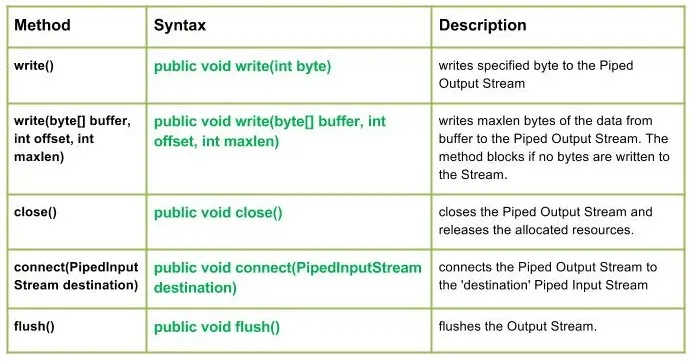
write(): java.io.PipedOutputStream.write(int byte) scrive un byte specificato nel flusso di output convogliato.
Sintassi:
public void write(int byte)
Parameters :
byte : byte to be written
Return : void
Exception :
-> IOException : if in case IO error occurs.write(byte[] buffer int offset int maxlen): java.io.PipedOutputStream.write(byte[] buffer int offset int maxlen) scrive maxlen byte di dati dal buffer al flusso di output convogliato. Il metodo si blocca se non vengono scritti byte nello Stream.
Sintassi:
public void write(byte[] buffer int offset int maxlen)
Parameters :
buffer : data of the buffer
offset : starting in the destination array - 'buffer'.
maxlen : maximum length of array to be read
Return : void
Exception :
-> IOException : if in case IO error occurs. JavaProduzione:
Use of write(buffer offset maxlen) : J A V A
- close(): java.io.PipedOutputStream.close() chiude il flusso di output convogliato e rilascia le risorse allocate.
Sintassi:
 public void close()
    Parameters :
 --------------
    Return :
 void
    Exception :
 ->      IOException :     if in case IO error occurs.
- connect(destinazione PipedInputStream): java.io.PipedOutputStream.connect(destinazione PipedInputStream collega il flusso di output convogliato al flusso di input convogliato di "destinazione" e nel caso in cui la "destinazione" sia convogliata con qualche altro flusso viene generata un'eccezione IO
Sintassi:
 public void connect(PipedInputStream destination)
    Parameters :
 destination : the Piped Input Stream to be connected to
    Return :
 void
    Exception :
 ->      IOException :     if in case IO error occurs.
- flush(): java.io.PipedOutputStream.flush() scarica il flusso di output.
Sintassi:
public void flush()
Parameters :
------------
Return :
void
Exception :
-> IOException : if in case IO error occurs.
Codice Java che illustra il funzionamento dei metodi della classe PipedOutputStream:
JavaProduzione:
Use of flush() method :
G E E K S
Closing the Output stream
Crea quiz