 Trubky
 in IO poskytuje spojení mezi dvěma vlákny běžícími v JVM současně. Potrubí se tedy používá jako zdroj nebo cíl.
- PipedInputStream je také přenášen pomocí PipedOutputStream. Data tedy mohou být zapsána pomocí PipedOutputStream a mohou být zapsána pomocí PipedInputStream. Ale použití obou vláken současně vytvoří pro vlákna uváznutí.
- O potrubí se říká, že je přerušeno, pokud vlákno, které poskytovalo datové bajty do připojeného výstupního proudu potrubím, již není aktivní.
Prohlášení: public class PipedInputStream extends InputStream
Konstruktor: | PipedInputStream() : | vytvoří PipedInputStream, který není připojen.
| PipedInputStream(int pSize) : | vytvoří PipedInputStream, který není spojen se zadanou velikostí potrubí.
| PipedInputStream(PipedOutputStream outStream) : | vytvoří PipedInputStream, který je připojen k PipedOutputStream - 'outStream'.
| PipedInputStream(PipedOutputStream outStream int pSize) : | vytvoří Piped Input Stream, který je připojen k Piped Output Stream se zadanou velikostí potrubí. Metody: | int read(): | Reads the next byte of data from this piped input stream.The value byte is returned as an int in the range 0 to 255. This method blocks until input data is available the end of the stream is detected or an exception is thrown. Java // Java program illustrating the working of read() method import java.io.* ; public class NewClass { public static void main ( String [] args ) throws IOException { PipedInputStream geek_input = new PipedInputStream (); PipedOutputStream geek_output = new PipedOutputStream (); try { // Use of connect() : connecting geek_input with geek_output geek_input . connect ( geek_output ); // Use of read() method : geek_output . write ( 71 ); System . out . println ( 'using read() : ' + ( char ) geek_input . read ()); geek_output . write ( 69 ); System . out . println ( 'using read() : ' + ( char ) geek_input . read ()); geek_output . write ( 75 ); System . out . println ( 'using read() : ' + ( char ) geek_input . read ()); } catch ( IOException except ) { except . printStackTrace (); } } } výstup: using read() : G using read() : E using read() : K
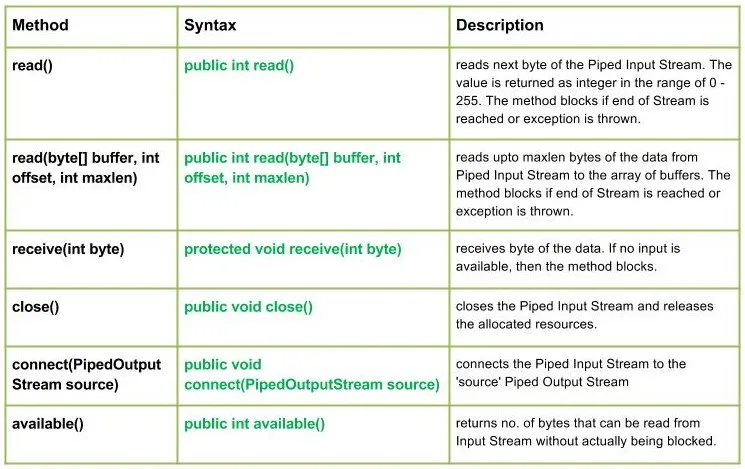
| read(byte[] buffer int offset int maxlen) : | java.io.PipedInputStream.read(byte[] buffer int offset int maxlen) čte až maxlen bajtů dat z Piped Input Stream do pole vyrovnávacích pamětí. Metoda se zablokuje, pokud je dosaženo konce streamu nebo je vyvolána výjimka. Syntaxe: public int read(byte[] buffer int offset int maxlen) Parameters : buffer : the destination buffer into which the data is to be read offset : starting in the destination array - 'buffer'. maxlen : maximum length of array to be read Return : next 'maxlen' bytes of the data as an integer value return -1 is end of stream is reached Exception : -> IOException : if in case IO error occurs. -> NullPointerException : if buffer is null. -> IndexOutOfBoundsException : if offset is -ve or maxlen is -ve or maxlen > buffer.length - offset.
| příjem (int byte): | java.io.PipedInputStream.receive(int byte) přijímá bajt dat. Pokud není k dispozici žádný vstup, metoda se zablokuje. Syntaxe: protected void receive(int byte) Parameters : byte : the bytes of the data received Return : void Exception : -> IOException : if in case IO error occurs or pipe is broken.
| zavřít(): | java.io.PipedInputStream.close() zavře Piped Input Stream a uvolní přidělené zdroje. Syntaxe: public void close() Parameters : -------------- Return : void Exception : -> IOException : if in case IO error occurs.
| připojit (zdroj PipedOutputStream) : | java.io.PipedInputStream.connect (zdroj PipedOutputStream) připojí zřetězený vstupní tok ke „zdrojovému“ zřetězenému výstupnímu toku a v případě, že „zdroj“ jsou roury s nějakým jiným tokem, je vyvolána IO výjimka Syntaxe: public void connect(PipedOutputStream source) Parameters : source : the Piped Output Stream to be connected to Return : void Exception : -> IOException : if in case IO error occurs.
| k dispozici(): | java.io.PipedInputStream.available() vrací ne. bajtů, které lze číst ze vstupního toku, aniž by byly ve skutečnosti blokovány. Syntaxe: public int available() Parameters : ------------- Return : no. of bytes that can be read from Input Stream without actually being blocked. 0 if the stream is already closed but by invoking close() method Exception : -> IOException : if in case IO error occurs.
Java program vysvětlující fungování metod třídy PipedInputStream: Java // Java program illustrating the working of PipedInputStream // connect() read(byte[] buffer int offset int maxlen) // close() available() import java.io.* ; public class NewClass { public static void main ( String [] args ) throws IOException { PipedInputStream geek_input = new PipedInputStream (); PipedOutputStream geek_output = new PipedOutputStream (); try { // Use of connect() : connecting geek_input with geek_output geek_input . connect ( geek_output ); geek_output . write ( 71 ); geek_output . write ( 69 ); geek_output . write ( 69 ); geek_output . write ( 75 ); geek_output . write ( 83 ); // Use of available() : System . out . println ( 'Use of available() : ' + geek_input . available ()); // Use of read(byte[] buffer int offset int maxlen) : byte [] buffer = new byte [ 5 ] ; // destination 'buffer' geek_input . read ( buffer 0 5 ); String str = new String ( buffer ); System . out . println ( 'Using read(buffer offset maxlen) : ' + str ); // USe of close() method : System . out . println ( 'Closing the stream' ); geek_input . close (); } catch ( IOException except ) { except . printStackTrace (); } } } výstup: Use of available() : 5 Using read(buffer offset maxlen) : GEEKS Closing the stream
Next Article: Třída Java.io.PipedOutputStream v Javě Vytvořit kvíz
Nejlepší Články
Kategorie


 Trubky in IO poskytuje spojení mezi dvěma vlákny běžícími v JVM současně. Potrubí se tedy používá jako zdroj nebo cíl.