خوارزمية هيرهولزر للرسم البياني الموجه
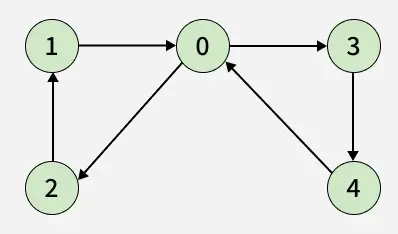
بالنظر إلى الرسم البياني الأويليري الموجه، فإن المهمة هي طباعة رسم بياني دائرة أويلر . دائرة أويلر هي مسار يجتاز كل حافة الرسم البياني مرة واحدة بالضبط وينتهي المسار عند قمة البداية.
ملحوظة: يحتوي الرسم البياني المعطى على دائرة أويلر.
مثال:
الإدخال: الرسم البياني الموجه

الإخراج: 0 3 4 0 2 1 0
المتطلبات الأساسية:
- لقد ناقشنا مشكلة معرفة ما إذا كان الرسم البياني المعطى هو أويلريان أم لا للحصول على رسم بياني غير موجه
- شروط دارة أويلريان في Grpag الموجه: (1) تنتمي جميع القمم إلى مكون واحد متصل بقوة. (2) جميع القمم لها نفس الدرجة الداخلية والخارجية. لاحظ أنه بالنسبة للرسم البياني غير الموجه، فإن الحالة مختلفة (جميع القمم لها درجة زوجية)
يقترب:
- اختر أي قمة بداية v واتبع مسارًا من الحواف من ذلك الرأس حتى العودة إلى v. ليس من الممكن أن تتعثر في أي قمة بخلاف v لأن الدرجة الداخلية والدرجة الخارجية لكل قمة يجب أن تكون نفسها عندما يدخل المسار إلى قمة أخرى w يجب أن تكون هناك حافة غير مستخدمة تترك w. الجولة التي تم تشكيلها بهذه الطريقة هي جولة مغلقة ولكنها قد لا تغطي جميع القمم والحواف في الرسم البياني الأولي.
- طالما أن هناك قمة u تنتمي إلى الجولة الحالية ولكن لها حواف مجاورة ليست جزءًا من الجولة، فابدأ مسارًا آخر منك متبعًا الحواف غير المستخدمة حتى العودة إليك وانضم إلى الجولة التي تم تشكيلها بهذه الطريقة إلى الجولة السابقة.
توضيح:
بأخذ مثال على الرسم البياني أعلاه مع 5 عقد: adj = {{2 3} {0} {1} {4} {0}}.
- ابدأ عند القمة 0 :
- المسار الحالي: [0]
- الدائرة: []
- قمة الرأس 0 → 3 :
- المسار الحالي: [0 3]
- الدائرة: []
- قمة الرأس 3 → 4 :
- المسار الحالي: [0 3 4]
- الدائرة: []
- قمة الرأس 4 → 0 :
- المسار الحالي: [0 3 4 0]
- الدائرة: []
- قمة الرأس 0 → 2 :
- المسار الحالي: [0 3 4 0 2]
- الدائرة: []
- قمة الرأس 2 → 1 :
- المسار الحالي: [0 3 4 0 2 1]
- الدائرة: []
- قمة الرأس 1 → 0 :
- المسار الحالي: [0 3 4 0 2 1 0]
- الدائرة: []
- العودة إلى قمة 0 : أضف 0 إلى الدائرة.
- المسار الحالي: [0 3 4 0 2 1]
- الدائرة: [0]
- العودة إلى قمة 1 : أضف 1 إلى الدائرة.
- المسار الحالي: [0 3 4 0 2]
- الدائرة: [0 1]
- العودة إلى قمة 2 : أضف 2 إلى الدائرة.
- المسار الحالي: [0 3 4 0]
- الدائرة: [0 1 2]
- العودة إلى قمة 0 : أضف 0 إلى الدائرة.
- المسار الحالي: [0 3 4]
- الدائرة: [0 1 2 0]
- العودة إلى قمة الرأس 4 : أضف 4 إلى الدائرة.
- المسار الحالي: [0 3]
- الدائرة: [0 1 2 0 4]
- العودة إلى قمة 3 : أضف 3 إلى الدائرة.
- المسار الحالي: [0]
- الدائرة: [0 1 2 0 4 3]
- العودة إلى قمة 0 : أضف 0 إلى الدائرة.
- المسار الحالي: []
- الدائرة: [0 1 2 0 4 3 0]
وفيما يلي تنفيذ النهج المذكور أعلاه:
C++ // C++ program to print Eulerian circuit in given // directed graph using Hierholzer algorithm #include using namespace std ; // Function to print Eulerian circuit vector < int > printCircuit ( vector < vector < int >> & adj ) { int n = adj . size (); if ( n == 0 ) return {}; // Maintain a stack to keep vertices // We can start from any vertex here we start with 0 vector < int > currPath ; currPath . push_back ( 0 ); // list to store final circuit vector < int > circuit ; while ( currPath . size () > 0 ) { int currNode = currPath [ currPath . size () - 1 ]; // If there's remaining edge in adjacency list // of the current vertex if ( adj [ currNode ]. size () > 0 ) { // Find and remove the next vertex that is // adjacent to the current vertex int nextNode = adj [ currNode ]. back (); adj [ currNode ]. pop_back (); // Push the new vertex to the stack currPath . push_back ( nextNode ); } // back-track to find remaining circuit else { // Remove the current vertex and // put it in the circuit circuit . push_back ( currPath . back ()); currPath . pop_back (); } } // reverse the result vector reverse ( circuit . begin () circuit . end ()); return circuit ; } int main () { vector < vector < int >> adj = {{ 2 3 } { 0 } { 1 } { 4 } { 0 }}; vector < int > ans = printCircuit ( adj ); for ( auto v : ans ) cout < < v < < ' ' ; cout < < endl ; return 0 ; }
Java // Java program to print Eulerian circuit in given // directed graph using Hierholzer algorithm import java.util.* ; class GfG { // Function to print Eulerian circuit static List < Integer > printCircuit ( List < List < Integer >> adj ) { int n = adj . size (); if ( n == 0 ) return new ArrayList <> (); // Maintain a stack to keep vertices // We can start from any vertex here we start with 0 List < Integer > currPath = new ArrayList <> (); currPath . add ( 0 ); // list to store final circuit List < Integer > circuit = new ArrayList <> (); while ( currPath . size () > 0 ) { int currNode = currPath . get ( currPath . size () - 1 ); // If there's remaining edge in adjacency list // of the current vertex if ( adj . get ( currNode ). size () > 0 ) { // Find and remove the next vertex that is // adjacent to the current vertex int nextNode = adj . get ( currNode ). get ( adj . get ( currNode ). size () - 1 ); adj . get ( currNode ). remove ( adj . get ( currNode ). size () - 1 ); // Push the new vertex to the stack currPath . add ( nextNode ); } // back-track to find remaining circuit else { // Remove the current vertex and // put it in the circuit circuit . add ( currPath . get ( currPath . size () - 1 )); currPath . remove ( currPath . size () - 1 ); } } // reverse the result vector Collections . reverse ( circuit ); return circuit ; } public static void main ( String [] args ) { List < List < Integer >> adj = new ArrayList <> (); adj . add ( new ArrayList <> ( Arrays . asList ( 2 3 ))); adj . add ( new ArrayList <> ( Arrays . asList ( 0 ))); adj . add ( new ArrayList <> ( Arrays . asList ( 1 ))); adj . add ( new ArrayList <> ( Arrays . asList ( 4 ))); adj . add ( new ArrayList <> ( Arrays . asList ( 0 ))); List < Integer > ans = printCircuit ( adj ); for ( int v : ans ) System . out . print ( v + ' ' ); System . out . println (); } }
Python # Python program to print Eulerian circuit in given # directed graph using Hierholzer algorithm # Function to print Eulerian circuit def printCircuit ( adj ): n = len ( adj ) if n == 0 : return [] # Maintain a stack to keep vertices # We can start from any vertex here we start with 0 currPath = [ 0 ] # list to store final circuit circuit = [] while len ( currPath ) > 0 : currNode = currPath [ - 1 ] # If there's remaining edge in adjacency list # of the current vertex if len ( adj [ currNode ]) > 0 : # Find and remove the next vertex that is # adjacent to the current vertex nextNode = adj [ currNode ] . pop () # Push the new vertex to the stack currPath . append ( nextNode ) # back-track to find remaining circuit else : # Remove the current vertex and # put it in the circuit circuit . append ( currPath . pop ()) # reverse the result vector circuit . reverse () return circuit if __name__ == '__main__' : adj = [[ 2 3 ] [ 0 ] [ 1 ] [ 4 ] [ 0 ]] ans = printCircuit ( adj ) for v in ans : print ( v end = ' ' ) print ()
C# // C# program to print Eulerian circuit in given // directed graph using Hierholzer algorithm using System ; using System.Collections.Generic ; class GfG { // Function to print Eulerian circuit static List < int > printCircuit ( List < List < int >> adj ) { int n = adj . Count ; if ( n == 0 ) return new List < int > (); // Maintain a stack to keep vertices // We can start from any vertex here we start with 0 List < int > currPath = new List < int > { 0 }; // list to store final circuit List < int > circuit = new List < int > (); while ( currPath . Count > 0 ) { int currNode = currPath [ currPath . Count - 1 ]; // If there's remaining edge in adjacency list // of the current vertex if ( adj [ currNode ]. Count > 0 ) { // Find and remove the next vertex that is // adjacent to the current vertex int nextNode = adj [ currNode ][ adj [ currNode ]. Count - 1 ]; adj [ currNode ]. RemoveAt ( adj [ currNode ]. Count - 1 ); // Push the new vertex to the stack currPath . Add ( nextNode ); } // back-track to find remaining circuit else { // Remove the current vertex and // put it in the circuit circuit . Add ( currPath [ currPath . Count - 1 ]); currPath . RemoveAt ( currPath . Count - 1 ); } } // reverse the result vector circuit . Reverse (); return circuit ; } static void Main ( string [] args ) { List < List < int >> adj = new List < List < int >> { new List < int > { 2 3 } new List < int > { 0 } new List < int > { 1 } new List < int > { 4 } new List < int > { 0 } }; List < int > ans = printCircuit ( adj ); foreach ( int v in ans ) { Console . Write ( v + ' ' ); } Console . WriteLine (); } }
JavaScript // JavaScript program to print Eulerian circuit in given // directed graph using Hierholzer algorithm // Function to print Eulerian circuit function printCircuit ( adj ) { let n = adj . length ; if ( n === 0 ) return []; // Maintain a stack to keep vertices // We can start from any vertex here we start with 0 let currPath = [ 0 ]; // list to store final circuit let circuit = []; while ( currPath . length > 0 ) { let currNode = currPath [ currPath . length - 1 ]; // If there's remaining edge in adjacency list // of the current vertex if ( adj [ currNode ]. length > 0 ) { // Find and remove the next vertex that is // adjacent to the current vertex let nextNode = adj [ currNode ]. pop (); // Push the new vertex to the stack currPath . push ( nextNode ); } // back-track to find remaining circuit else { // Remove the current vertex and // put it in the circuit circuit . push ( currPath . pop ()); } } // reverse the result vector circuit . reverse (); return circuit ; } let adj = [[ 2 3 ] [ 0 ] [ 1 ] [ 4 ] [ 0 ]]; let ans = printCircuit ( adj ); for ( let v of ans ) { console . log ( v ' ' ); }
الإخراج
0 3 4 0 2 1 0
تعقيد الوقت : O(V + E) حيث V هو عدد القمم وE هو عدد الحواف في الرسم البياني. والسبب في ذلك هو أن الخوارزمية تقوم بإجراء بحث العمق الأول (DFS) وتزور كل قمة وكل حافة مرة واحدة بالضبط. لذا، فإن كل قمة تستغرق O(1) وقتًا لزيارتها، وتستغرق كل حافة وقتًا O(1) لاجتيازها.
تعقيد المساحة : O(V + E) حيث تستخدم الخوارزمية مكدسًا لتخزين المسار الحالي وقائمة لتخزين الدائرة النهائية. يمكن أن يكون الحد الأقصى لحجم المكدس V + E في أسوأ الأحوال، وبالتالي يكون تعقيد المساحة هو O(V + E).
إنشاء اختبار