Вступ до Max-Heap – навчальні посібники зі структури даних і алгоритмів
А Макс-Хіп визначається як вид Структура даних купи — це тип двійкового дерева, який зазвичай використовується в інформатиці для різних цілей, включаючи сортування, пошук і впорядкування даних.
Вступ до структури даних Max-Heap
Призначення та випадки використання Max-Heap:
- Пріоритетна черга: Одним із основних застосувань структури даних купи є реалізація пріоритетних черг.
- Сортування купи: Структура даних купи також використовується в алгоритмах сортування.
- Керування пам'яттю: Структура даних купи також використовується в управлінні пам'яттю. Коли програмі потрібно динамічно розподіляти пам’ять, вона використовує структуру даних купи, щоб відстежувати доступну пам’ять.
- Алгоритм найкоротшого шляху Дейкстри використовує структуру даних купи для відстеження вершин із найкоротшим шляхом від вихідної вершини.
Структура даних Max-Heap на різних мовах:
1. Max-Heap в C++
Максимальна купа може бути реалізована за допомогою priority_queue контейнер від ст Стандартна бібліотека шаблонів (STL) . The priority_queue контейнер — це тип адаптера контейнера, який забезпечує спосіб зберігання елементів у структурі даних, подібній до черги, у якій кожен елемент має пов’язаний з ним пріоритет.
Synt ax: priority_queuemaxH;2. Max-Heap в Java
У Java максимальну купу можна реалізувати за допомогою PriorityQueue клас від пакет java.util . Клас PriorityQueue — це пріоритетна черга, яка забезпечує спосіб зберігання елементів у структурі даних, подібній до черги, у якій кожен елемент має пов’язаний з ним пріоритет.
Syntax : PriorityQueue maxHeap= new PriorityQueue(Comparator.reverseOrder());3. Max-Heap в Python
У Python максимальну купу можна реалізувати за допомогою heapq модуль, який надає функції для реалізації куп. Зокрема, модуль heapq забезпечує спосіб створення та керування структурами даних купи.
Synt ax: heap = [] heapify(heap)4. Max-Heap в C#
У C# максимальну купу можна реалізувати за допомогою класу PriorityQueue з System.Collections.Generic простір імен . Клас PriorityQueue — це пріоритетна черга, яка забезпечує спосіб зберігання елементів у структурі даних, подібній до черги, у якій кожен елемент має пов’язаний з ним пріоритет.
Syntax: var maxHeap = new PriorityQueue((a, b) =>б - а);5. Max-Heap у JavaScript
Максимальна купа — це бінарне дерево, у якому кожен вузол має значення, що перевищує або дорівнює його дочірнім вузлам. У JavaScript ви можете реалізувати максимальну купу за допомогою масиву, де перший елемент представляє кореневий вузол, а дочірні елементи вузла за індексом i розташовані за індексами 2і+1 і 2і+2.
Syntax: const miaxHeap = new MaxHeap();Різниця між максимальною та мінімальною купою
Мінімальна купа Макс Хіп 1. У Min-Heap ключ, присутній у кореневому вузлі, має бути меншим або дорівнювати ключам, присутнім у всіх його дочірніх вузлах. У Max-Heap ключ, присутній у кореневому вузлі, повинен бути більшим або дорівнювати ключам, присутнім у всіх його дочірніх вузлах. 2. У Min-Heap мінімальний ключовий елемент, присутній у корені. У Max-Heap максимальний ключовий елемент, присутній у корені. 3. Min-Heap використовує зростаючий пріоритет. Max-Heap використовує низхідний пріоритет. 4. При побудові Min-Heap найменший елемент має пріоритет. При побудові Max-Heap найбільший елемент має пріоритет. 5. У Min-Heap найменший елемент є першим, який виривається з купи. У Max-Heap найбільший елемент є першим, який виривається з купи. Внутрішня реалізація структури даних Max-Heap:
А Мінімальна купа зазвичай представляється у вигляді масиву .
- Кореневий елемент буде at Прибуток[0] .
- Для будь-якого i-го вузла Arr[i].
- лівий дочірній елемент зберігається за індексом 2і+1
- Правий дочірній елемент зберігається в індексі 2і+2
- Батьківський елемент зберігається на рівні індексу ((i-1)/2)
Внутрішня реалізація Max-Heap вимагає 3 основних кроків:
- Вставка : щоб вставити новий елемент у купу, він додається в кінець масиву, а потім з’являється вгору, доки не задовольнить властивість купи.
- Видалення : Щоб видалити максимальний елемент (корінь купи), останній елемент у масиві міняється коренем, а новий корінь з’являється в спливаючому вигляді, доки він не задовольнить властивість купи.
- Heapify : операцію heapify можна використовувати для створення максимальної купи з несортованого масиву.
Операції над структурою даних максимальної купи та їх реалізація:
Ось деякі звичайні операції, які можна виконати над структурою даних Heap Data Structure,
1. Вставка в структуру даних Max-Heap :
Елементи можна вставляти в купу, дотримуючись подібного підходу, як описано вище для видалення. Ідея полягає в тому, щоб:
- Спочатку збільште розмір купи на 1, щоб вона могла зберігати новий елемент.
- Вставте новий елемент у кінець купи.
- Цей нещодавно вставлений елемент може спотворити властивості Heap для своїх батьків. Отже, щоб зберегти властивості Heap, heapify цей щойно вставлений елемент за підходом знизу вгору.
Ілюстрація:
Припустимо, що купа є максимальною купою, як:
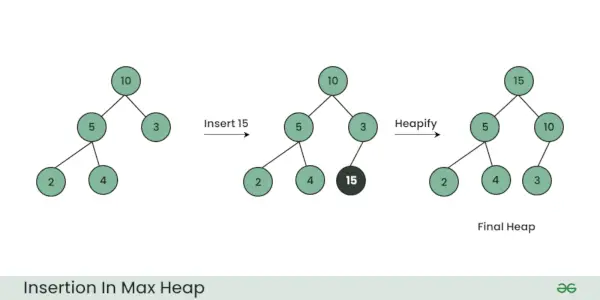
Вставка в максимальну купу
Реалізація операції вставки в Max-Heap:
C++
// C++ program to insert new element to Heap>#include>using>namespace>std;>#define MAX 1000 // Max size of Heap>// Function to heapify ith node in a Heap>// of size n following a Bottom-up approach>void>heapify(>int>arr[],>int>n,>int>i)>{>>// Find parent>>int>parent = (i - 1) / 2;>>if>(arr[parent]>0) {>>// For Max-Heap>>// If current node is greater than its parent>>// Swap both of them and call heapify again>>// for the parent>>if>(arr[i]>arr[батьківський]) {>>swap(arr[i], arr[parent]);>>// Recursively heapify the parent node>>heapify(arr, n, parent);>>}>>}>}>// Function to insert a new node to the Heap>void>insertNode(>int>arr[],>int>& n,>int>Key)>{>>// Increase the size of Heap by 1>>n = n + 1;>>// Insert the element at end of Heap>>arr[n - 1] = Key;>>// Heapify the new node following a>>// Bottom-up approach>>heapify(arr, n, n - 1);>}>// A utility function to print array of size n>void>printArray(>int>arr[],>int>n)>{>>for>(>int>i = 0; i cout < < arr[i] < < ' '; cout < < ' '; } // Driver Code int main() { // Array representation of Max-Heap // 10 // / // 5 3 // / // 2 4 int arr[MAX] = { 10, 5, 3, 2, 4 }; int n = 5; int key = 15; insertNode(arr, n, key); printArray(arr, n); // Final Heap will be: // 15 // / // 5 10 // / / // 2 4 3 return 0; }>
Java
// Java program for implementing insertion in Heaps>public>class>insertionHeap {>>// Function to heapify ith node in a Heap>>// of size n following a Bottom-up approach>>static>void>heapify(>int>[] arr,>int>n,>int>i)>>{>>// Find parent>>int>parent = (i ->1>) />2>;>>>if>(arr[parent]>>0>) {>>// For Max-Heap>>// If current node is greater than its parent>>// Swap both of them and call heapify again>>// for the parent>>if>(arr[i]>arr[батьківський]) {>>>// swap arr[i] and arr[parent]>>int>temp = arr[i];>>arr[i] = arr[parent];>>arr[parent] = temp;>>>// Recursively heapify the parent node>>heapify(arr, n, parent);>>}>>}>>}>>// Function to insert a new node to the heap.>>static>int>insertNode(>int>[] arr,>int>n,>int>Key)>>{>>// Increase the size of Heap by 1>>n = n +>1>;>>>// Insert the element at end of Heap>>arr[n ->1>] = Key;>>>// Heapify the new node following a>>// Bottom-up approach>>heapify(arr, n, n ->1>);>>>// return new size of Heap>>return>n;>>}>>/* A utility function to print array of size n */>>static>void>printArray(>int>[] arr,>int>n)>>{>>for>(>int>i =>0>; i System.out.println(arr[i] + ' '); System.out.println(); } // Driver Code public static void main(String args[]) { // Array representation of Max-Heap // 10 // / // 5 3 // / // 2 4 // maximum size of the array int MAX = 1000; int[] arr = new int[MAX]; // initializing some values arr[0] = 10; arr[1] = 5; arr[2] = 3; arr[3] = 2; arr[4] = 4; // Current size of the array int n = 5; // the element to be inserted int Key = 15; // The function inserts the new element to the heap and // returns the new size of the array n = insertNode(arr, n, Key); printArray(arr, n); // Final Heap will be: // 15 // / // 5 10 // / / // 2 4 3 } } // The code is contributed by Gautam goel>
C#
// C# program for implementing insertion in Heaps>using>System;>public>class>insertionHeap {>>// Function to heapify ith node in a Heap of size n following a Bottom-up approach>>static>void>heapify(>int>[] arr,>int>n,>int>i) {>>// Find parent>>int>parent = (i - 1) / 2;>>if>(arr[parent]>0) {>>// For Max-Heap>>// If current node is greater than its parent>>// Swap both of them and call heapify again>>// for the parent>>if>(arr[i]>arr[батьківський]) {>>// swap arr[i] and arr[parent]>>int>temp = arr[i];>>arr[i] = arr[parent];>>arr[parent] = temp;>>// Recursively heapify the parent node>>heapify(arr, n, parent);>>}>>}>>}>>// Function to insert a new node to the heap.>>static>int>insertNode(>int>[] arr,>int>n,>int>Key) {>>// Increase the size of Heap by 1>>n = n + 1;>>// Insert the element at end of Heap>>arr[n - 1] = Key;>>// Heapify the new node following a>>// Bottom-up approach>>heapify(arr, n, n - 1);>>// return new size of Heap>>return>n;>>}>>/* A utility function to print array of size n */>>static>void>printArray(>int>[] arr,>int>n) {>>for>(>int>i = 0; i Console.WriteLine(arr[i] + ' '); Console.WriteLine(''); } public static void Main(string[] args) { // Array representation of Max-Heap // 10 // / // 5 3 // / // 2 4 // maximum size of the array int MAX = 1000; int[] arr = new int[MAX]; // initializing some values arr[0] = 10; arr[1] = 5; arr[2] = 3; arr[3] = 2; arr[4] = 4; // Current size of the array int n = 5; // the element to be inserted int Key = 15; // The function inserts the new element to the heap and // returns the new size of the array n = insertNode(arr, n, Key); printArray(arr, n); // Final Heap will be: // 15 // / // 5 10 // / / // 2 4 3 } } // This code is contributed by ajaymakvana.>
Javascript
// Javascript program for implement insertion in Heaps>// To heapify a subtree rooted with node i which is>// an index in arr[].Nn is size of heap>let MAX = 1000;>// Function to heapify ith node in a Heap of size n following a Bottom-up approach>function>heapify(arr, n, i)>{>>// Find parent>>let parent = Math.floor((i-1)/2);>>if>(arr[parent]>= 0) {>>// For Max-Heap>>// If current node is greater than its parent>>// Swap both of them and call heapify again>>// for the parent>>if>(arr[i]>arr[батьківський]) {>>let temp = arr[i];>>arr[i] = arr[parent];>>arr[parent] = temp;>>// Recursively heapify the parent node>>heapify(arr, n, parent);>>}>>}>}>// Function to insert a new node to the Heap>function>insertNode(arr, n, Key)>{>>// Increase the size of Heap by 1>>n = n + 1;>>// Insert the element at end of Heap>>arr[n - 1] = Key;>>// Heapify the new node following a>>// Bottom-up approach>>heapify(arr, n, n - 1);>>>return>n;>}>/* A utility function to print array of size N */>function>printArray(arr, n)>{>>for>(let i = 0; i console.log(arr[i] + ' '); console.log(''); } let arr = [ 10, 5, 3, 2, 4 ]; let n = arr.length; let key = 15; n = insertNode(arr, n, key); printArray(arr, n); // This code is contributed by ajaymakvana>
Python3
# program to insert new element to Heap># Function to heapify ith node in a Heap># of size n following a Bottom-up approach>def>heapify(arr, n, i):>>parent>=>int>(((i>->1>)>/>2>))>># For Max-Heap>># If current node is greater than its parent>># Swap both of them and call heapify again>># for the parent>>if>arr[parent]>>0>:>>if>arr[i]>arr[батьківський]:>>arr[i], arr[parent]>=>arr[parent], arr[i]>># Recursively heapify the parent node>>heapify(arr, n, parent)># Function to insert a new node to the Heap>def>insertNode(arr, key):>>global>n>># Increase the size of Heap by 1>>n>+>=>1>># Insert the element at end of Heap>>arr.append(key)>># Heapify the new node following a>># Bottom-up approach>>heapify(arr, n, n>->1>)># A utility function to print array of size n>def>printArr(arr, n):>>for>i>in>range>(n):>>print>(arr[i], end>=>' '>)># Driver Code># Array representation of Max-Heap>'''>>10>>/>>5 3>>/>>2 4>'''>arr>=>[>10>,>5>,>3>,>2>,>4>,>1>,>7>]>n>=>7>key>=>15>insertNode(arr, key)>printArr(arr, n)># Final Heap will be:>'''>>15>>/>5 10>/ />2 4 3>Code is written by Rajat Kumar....>'''>
Вихід
15 5 10 2 4 3Часова складність: O(log(n)) ( де n – кількість елементів у купі )
Допоміжний простір: O(n)2. Видалення в структурі даних Max-Heap :
Видалення елемента в будь-якій проміжній позиції в купі може бути дорогим, тому ми можемо просто замінити елемент, який потрібно видалити, останнім елементом і видалити останній елемент купи.
- Замініть корінь або елемент, який потрібно видалити, на останній елемент.
- Видалити останній елемент із купи.
- Оскільки останній елемент тепер розміщено на позиції кореневого вузла. Отже, він може не відповідати властивості heap. Тому нагромаджуйте останній вузол, розміщений на місці кореня.
Ілюстрація :
Припустимо, що купа є максимальною купою, як:
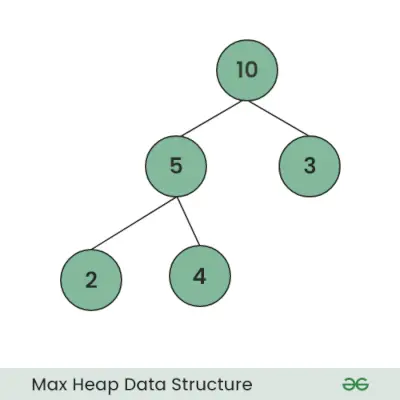
Максимальна структура даних купи
Елемент, який потрібно видалити, це root, тобто 10.
процес :
Останній елемент - 4.
Крок 1: Замініть останній елемент на root і видаліть його.
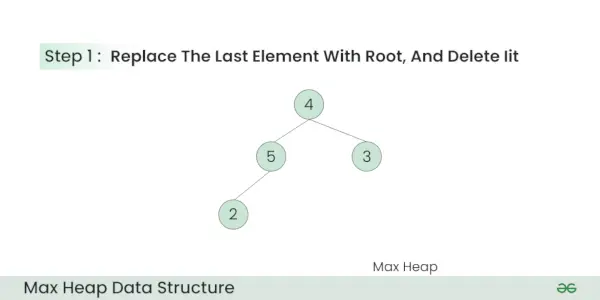
Макс Хіп
Крок 2 : Heapify корінь.
Остаточна купа:
Макс Хіп
Реалізація операції видалення в Max-Heap:
C++
// C++ program for implement deletion in Heaps>#include>using>namespace>std;>// To heapify a subtree rooted with node i which is>// an index of arr[] and n is the size of heap>void>heapify(>int>arr[],>int>n,>int>i)>{>>int>largest = i;>// Initialize largest as root>>int>l = 2 * i + 1;>// left = 2*i + 1>>int>r = 2 * i + 2;>// right = 2*i + 2>>// If left child is larger than root>>if>(l arr[largest])>>largest = l;>>// If right child is larger than largest so far>>if>(r arr[largest])>>largest = r;>>// If largest is not root>>if>(largest != i) {>>swap(arr[i], arr[largest]);>>// Recursively heapify the affected sub-tree>>heapify(arr, n, largest);>>}>}>// Function to delete the root from Heap>void>deleteRoot(>int>arr[],>int>& n)>{>>// Get the last element>>int>lastElement = arr[n - 1];>>// Replace root with last element>>arr[0] = lastElement;>>// Decrease size of heap by 1>>n = n - 1;>>// heapify the root node>>heapify(arr, n, 0);>}>/* A utility function to print array of size n */>void>printArray(>int>arr[],>int>n)>{>>for>(>int>i = 0; i cout < < arr[i] < < ' '; cout < < ' '; } // Driver Code int main() { // Array representation of Max-Heap // 10 // / // 5 3 // / // 2 4 int arr[] = { 10, 5, 3, 2, 4 }; int n = sizeof(arr) / sizeof(arr[0]); deleteRoot(arr, n); printArray(arr, n); return 0; }>
Java
// Java program for implement deletion in Heaps>public>class>deletionHeap {>>// To heapify a subtree rooted with node i which is>>// an index in arr[].Nn is size of heap>>static>void>heapify(>int>arr[],>int>n,>int>i)>>{>>int>largest = i;>// Initialize largest as root>>int>l =>2>* i +>1>;>// left = 2*i + 1>>int>r =>2>* i +>2>;>// right = 2*i + 2>>// If left child is larger than root>>if>(l arr[largest])>>largest = l;>>// If right child is larger than largest so far>>if>(r arr[largest])>>largest = r;>>// If largest is not root>>if>(largest != i) {>>int>swap = arr[i];>>arr[i] = arr[largest];>>arr[largest] = swap;>>// Recursively heapify the affected sub-tree>>heapify(arr, n, largest);>>}>>}>>// Function to delete the root from Heap>>static>int>deleteRoot(>int>arr[],>int>n)>>{>>// Get the last element>>int>lastElement = arr[n ->1>];>>// Replace root with first element>>arr[>0>] = lastElement;>>// Decrease size of heap by 1>>n = n ->1>;>>// heapify the root node>>heapify(arr, n,>0>);>>// return new size of Heap>>return>n;>>}>>/* A utility function to print array of size N */>>static>void>printArray(>int>arr[],>int>n)>>{>>for>(>int>i =>0>; i System.out.print(arr[i] + ' '); System.out.println(); } // Driver Code public static void main(String args[]) { // Array representation of Max-Heap // 10 // / // 5 3 // / // 2 4 int arr[] = { 10, 5, 3, 2, 4 }; int n = arr.length; n = deleteRoot(arr, n); printArray(arr, n); } }>
C#
// C# program for implement deletion in Heaps>using>System;>public>class>deletionHeap>{>>// To heapify a subtree rooted with node i which is>>// an index in arr[].Nn is size of heap>>static>void>heapify(>int>[]arr,>int>n,>int>i)>>{>>int>largest = i;>// Initialize largest as root>>int>l = 2 * i + 1;>// left = 2*i + 1>>int>r = 2 * i + 2;>// right = 2*i + 2>>// If left child is larger than root>>if>(l arr[largest])>>largest = l;>>// If right child is larger than largest so far>>if>(r arr[largest])>>largest = r;>>// If largest is not root>>if>(largest != i)>>{>>int>swap = arr[i];>>arr[i] = arr[largest];>>arr[largest] = swap;>>// Recursively heapify the affected sub-tree>>heapify(arr, n, largest);>>}>>}>>// Function to delete the root from Heap>>static>int>deleteRoot(>int>[]arr,>int>n)>>{>>// Get the last element>>int>lastElement = arr[n - 1];>>// Replace root with first element>>arr[0] = lastElement;>>// Decrease size of heap by 1>>n = n - 1;>>// heapify the root node>>heapify(arr, n, 0);>>// return new size of Heap>>return>n;>>}>>/* A utility function to print array of size N */>>static>void>printArray(>int>[]arr,>int>n)>>{>>for>(>int>i = 0; i Console.Write(arr[i] + ' '); Console.WriteLine(); } // Driver Code public static void Main() { // Array representation of Max-Heap // 10 // / // 5 3 // / // 2 4 int []arr = { 10, 5, 3, 2, 4 }; int n = arr.Length; n = deleteRoot(arr, n); printArray(arr, n); } } // This code is contributed by Ryuga>
Javascript
>>// Javascript program for implement deletion in Heaps>>>// To heapify a subtree rooted with node i which is>>// an index in arr[].Nn is size of heap>>function>heapify(arr, n, i)>>{>>let largest = i;>// Initialize largest as root>>let l = 2 * i + 1;>// left = 2*i + 1>>let r = 2 * i + 2;>// right = 2*i + 2>>// If left child is larger than root>>if>(l arr[largest])>>largest = l;>>// If right child is larger than largest so far>>if>(r arr[largest])>>largest = r;>>// If largest is not root>>if>(largest != i)>>{>>let swap = arr[i];>>arr[i] = arr[largest];>>arr[largest] = swap;>>// Recursively heapify the affected sub-tree>>heapify(arr, n, largest);>>}>>}>>// Function to delete the root from Heap>>function>deleteRoot(arr, n)>>{>>// Get the last element>>let lastElement = arr[n - 1];>>// Replace root with first element>>arr[0] = lastElement;>>// Decrease size of heap by 1>>n = n - 1;>>// heapify the root node>>heapify(arr, n, 0);>>// return new size of Heap>>return>n;>>}>>/* A utility function to print array of size N */>>function>printArray(arr, n)>>{>>for>(let i = 0; i document.write(arr[i] + ' '); document.write(''); } let arr = [ 10, 5, 3, 2, 4 ]; let n = arr.length; n = deleteRoot(arr, n); printArray(arr, n); // This code is contributed by divyeshrabdiya07.>
Python3
# Python 3 program for implement deletion in Heaps># To heapify a subtree rooted with node i which is># an index of arr[] and n is the size of heap>def>heapify(arr, n, i):>>largest>=>i>#Initialize largest as root>>l>=>2>*>i>+>1># left = 2*i + 1>>r>=>2>*>i>+>2># right = 2*i + 2>>#If left child is larger than root>>if>(l and arr[l]>arr[найбільший]): найбільший = l #Якщо правий дочірній елемент більший за найбільший if (r і arr[r]> arr[найбільший]): найбільший = r # Якщо найбільший не є коренем if (найбільший != i) : arr[i],arr[largest]=arr[largest],arr[i] #Рекурсивне heapify ураженого піддерева heapify(arr, n, larger) #Функція для видалення кореня з Heap def deleteRoot(arr): global n # Отримати останній елемент lastElement = arr[n - 1] # Замінити корінь на останній елемент arr[0] = lastElement # Зменшити розмір купи на 1 n = n - 1 # heapify кореневий вузол heapify(arr, n, 0) # Допоміжна функція для друку масиву розміром n def printArray(arr, n): for i in range(n): print(arr[i],end=' ') print() # Код драйвера if __name__ == '__main__': # Представлення масиву Max-Heap # 10 # / # 5 3 # / # 2 4 arr = [ 10, 5, 3, 2, 4 ] n = len(arr) deleteRoot( arr) printArray(arr, n) # Цей код створено Раджатом Кумаром.>
Вихід
5 4 3 2Часова складність : O(log n), де n – кількість елементів у купі
Допоміжний простір: O(n)3. Операція Peek у структурі даних Max-heap:
Щоб отримати доступ до максимального елемента (тобто кореня купи), повертається значення кореневого вузла. Часова складність перегляду в максимальній купі становить O(1).
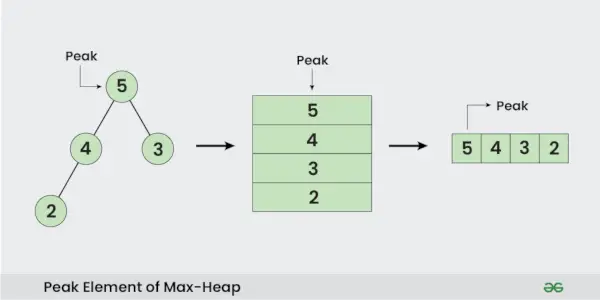
Піковий елемент максимальної купи
Реалізація операції Peek у Max-Heap:
C++
#include>#include>int>main() {>>// Create a max heap with some elements using a priority_queue>>std::priority_queue <>int>>maxHeap;>>maxHeap.push(9);>>maxHeap.push(8);>>maxHeap.push(7);>>maxHeap.push(6);>>maxHeap.push(5);>>maxHeap.push(4);>>maxHeap.push(3);>>maxHeap.push(2);>>maxHeap.push(1);>>// Get the peak element (i.e., the largest element)>>int>peakElement = maxHeap.top();>>// Print the peak element>>std::cout < <>'Peak element: '>< < peakElement < < std::endl;>>return>0;>}>
Java
import>java.util.PriorityQueue;>public>class>GFG {>>public>static>void>main(String[] args) {>>// Create a max heap with some elements using a PriorityQueue>>PriorityQueue maxHeap =>new>PriorityQueue((a, b) ->б - а);>>maxHeap.add(>9>);>>maxHeap.add(>8>);>>maxHeap.add(>7>);>>maxHeap.add(>6>);>>maxHeap.add(>5>);>>maxHeap.add(>4>);>>maxHeap.add(>3>);>>maxHeap.add(>2>);>>maxHeap.add(>1>);>>// Get the peak element (i.e., the largest element)>>int>peakElement = maxHeap.peek();>>// Print the peak element>>System.out.println(>'Peak element: '>+ peakElement);>>}>}>
C#
using>System;>using>System.Collections.Generic;>public>class>GFG {>>public>static>void>Main() {>>// Create a min heap with some elements using a PriorityQueue>>var>maxHeap =>new>PriorityQueue <>int>>();>>>maxHeap.Enqueue(9);>>maxHeap.Enqueue(8);>>maxHeap.Enqueue(7);>>maxHeap.Enqueue(6);>>maxHeap.Enqueue(5);>>maxHeap.Enqueue(4);>>maxHeap.Enqueue(3);>>maxHeap.Enqueue(2);>>maxHeap.Enqueue(1);>>// Get the peak element (i.e., the smallest element)>>int>peakElement = maxHeap.Peek();>>// Print the peak element>>Console.WriteLine(>'Peak element: '>+ peakElement);>>}>}>// Define a PriorityQueue class that uses a max heap>class>PriorityQueue>where>T : IComparable {>>private>List heap;>>public>PriorityQueue() {>>this>.heap =>new>List();>>}>>public>int>Count {>>get>{>return>this>.heap.Count; }>>}>>public>void>Enqueue(T item) {>>this>.heap.Add(item);>>this>.BubbleUp(>this>.heap.Count - 1);>>}>>public>T Dequeue() {>>T item =>this>.heap[0];>>int>lastIndex =>this>.heap.Count - 1;>>this>.heap[0] =>this>.heap[lastIndex];>>this>.heap.RemoveAt(lastIndex);>>this>.BubbleDown(0);>>return>item;>>}>>public>T Peek() {>>return>this>.heap[0];>>}>>private>void>BubbleUp(>int>index) {>>while>(index>0) {>>int>parentIndex = (index - 1) / 2;>>if>(>this>.heap[parentIndex].CompareTo(>this>.heap[index])>= 0) {>>break>;>>}>>Swap(parentIndex, index);>>index = parentIndex;>>}>>}>>private>void>BubbleDown(>int>index) {>>while>(index <>this>.heap.Count) {>>int>leftChildIndex = index * 2 + 1;>>int>rightChildIndex = index * 2 + 2;>>int>largestChildIndex = index;>>if>(leftChildIndex <>this>.heap.Count &&>this>.heap[leftChildIndex].CompareTo(>this>.heap[largestChildIndex])>0) {>>largestChildIndex = leftChildIndex;>>}>>if>(rightChildIndex <>this>.heap.Count &&>this>.heap[rightChildIndex].CompareTo(>this>.heap[largestChildIndex])>0) {>>largestChildIndex = rightChildIndex;>>}>>if>(largestChildIndex == index) {>>break>;>>}>>Swap(largestChildIndex, index);>>index = largestChildIndex;>>}>>}>>private>void>Swap(>int>i,>int>j) {>>T temp =>this>.heap[i];>>this>.heap[i] =>this>.heap[j];>>this>.heap[j] = temp;>>}>}>
Javascript
// Define a MaxHeap class that uses an array>class MaxHeap {>>constructor() {>>this>.heap = [];>>}>>push(item) {>>this>.heap.push(item);>>this>.bubbleUp(>this>.heap.length - 1);>>}>>pop() {>>let item =>this>.heap[0];>>let lastIndex =>this>.heap.length - 1;>>this>.heap[0] =>this>.heap[lastIndex];>>this>.heap.pop();>>this>.bubbleDown(0);>>return>item;>>}>>peak() {>>return>this>.heap[0];>>}>>bubbleUp(index) {>>while>(index>0) {>>let parentIndex = Math.floor((index - 1) / 2);>>if>(>this>.heap[parentIndex]>=>this>.heap[index]) {>>break>;>>}>>this>.swap(parentIndex, index);>>index = parentIndex;>>}>>}>>bubbleDown(index) {>>while>(index <>this>.heap.length) {>>let leftChildIndex = index * 2 + 1;>>let rightChildIndex = index * 2 + 2;>>let largestChildIndex = index;>>if>(leftChildIndex <>this>.heap.length &&>this>.heap[leftChildIndex]>>this>.heap[largestChildIndex]) {>>largestChildIndex = leftChildIndex;>>}>>if>(rightChildIndex <>this>.heap.length &&>this>.heap[rightChildIndex]>>this>.heap[largestChildIndex]) {>>largestChildIndex = rightChildIndex;>>}>>if>(largestChildIndex === index) {>>break>;>>}>>this>.swap(largestChildIndex, index);>>index = largestChildIndex;>>}>>}>>swap(i, j) {>>let temp =>this>.heap[i];>>this>.heap[i] =>this>.heap[j];>>this>.heap[j] = temp;>>}>}>// Create a max heap with some elements using an array>let maxHeap =>new>MaxHeap();>maxHeap.push(9);>maxHeap.push(8);>maxHeap.push(7);>maxHeap.push(6);>maxHeap.push(5);>maxHeap.push(4);>maxHeap.push(3);>maxHeap.push(2);>maxHeap.push(1);>// Get the peak element (i.e., the largest element)>let peakElement = maxHeap.peak();>// Print the peak element>console.log(>'Peak element: '>+ peakElement);>
Python3
import>heapq># Create a max heap with some elements using a list>max_heap>=>[>1>,>2>,>3>,>4>,>5>,>6>,>7>,>8>,>9>]>heapq.heapify(max_heap)># Get the peak element (i.e., the largest element)>peak_element>=>heapq.nlargest(>1>, max_heap)[>0>]># Print the peak element>print>(>'Peak element:'>, peak_element)>
Вихід
Peak element: 9Часова складність :
- У максимальній купі, реалізованій за допомогою an масив або список, піковий елемент може бути доступний у постійному часі, O(1), оскільки він завжди розташований у корені купи.
- У максимальній купі, реалізованій за допомогою a бінарне дерево , піковий елемент також можна отримати за час O(1), оскільки він завжди розташований у корені дерева.
Допоміжний простір: O(n)
4. Операція Heapify у структурі даних Max-heap :
Операцію heapify можна використовувати для створення максимальної купи з несортованого масиву. Це робиться, починаючи з останнього вузла, що не є листом, і багаторазово виконуючи операцію «спускання», поки всі вузли не задовольнять властивість купи. Часова складність heapify у максимальній купі становить O(n).
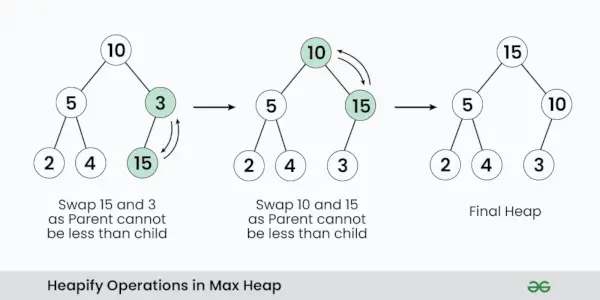
Операції Heapify у Max-Heap
5. Операція пошуку в структурі даних Max-heap :
Щоб знайти елемент у максимальній купі, можна виконати лінійний пошук по масиву, який представляє купу. Однак часова складність лінійного пошуку становить O(n), що не є ефективним. Тому пошук не є широко використовуваною операцією в максимальній купі.
Ось приклад коду, який показує, як шукати елемент у максимальній купі за допомогою std::find() :
C++
#include>#include // for std::priority_queue>using>namespace>std;>int>main() {>>std::priority_queue <>int>>max_heap;>>// example max heap>>>max_heap.push(10);>>max_heap.push(9);>>max_heap.push(8);>>max_heap.push(6);>>max_heap.push(4);>>int>element = 6;>// element to search for>>bool>found =>false>;>>// Copy the max heap to a temporary queue and search for the element>>std::priority_queue <>int>>temp = max_heap;>>while>(!temp.empty()) {>>if>(temp.top() == element) {>>found =>true>;>>break>;>>}>>temp.pop();>>}>>if>(found) {>>std::cout < <>'Element found in the max heap.'>< < std::endl;>>}>else>{>>std::cout < <>'Element not found in the max heap.'>< < std::endl;>>}>>return>0;>}>
Java
import>java.util.PriorityQueue;>public>class>GFG {>>public>static>void>main(String[] args) {>>PriorityQueue maxHeap =>new>PriorityQueue((a, b) ->б - а);>>maxHeap.add(>3>);>// insert elements into the priority queue>>maxHeap.offer(>1>);>>maxHeap.offer(>4>);>>maxHeap.offer(>1>);>>maxHeap.offer(>6>);>>int>element =>6>;>// element to search for>>boolean>found =>false>;>>// Copy the max heap to a temporary queue and search for the element>>PriorityQueue temp =>new>PriorityQueue(maxHeap);>>while>(!temp.isEmpty()) {>>if>(temp.poll() == element) {>>found =>true>;>>break>;>>}>>}>>if>(found) {>>System.out.println(>'Element found in the max heap.'>);>>}>else>{>>System.out.println(>'Element not found in the max heap.'>);>>}>>}>}>
C#
using>System;>using>System.Collections.Generic;>class>Program {>>static>void>Main(>string>[] args) {>>// Create a max heap with some elements using a PriorityQueue>>PriorityQueue <>int>>maxHeap =>new>PriorityQueue <>int>>();>>>maxHeap.Enqueue(10);>>maxHeap.Enqueue(9);>>maxHeap.Enqueue(8);>>maxHeap.Enqueue(6);>>maxHeap.Enqueue(4);>>int>element = 6;>// element to search for>>bool>found =>false>;>>// Copy the max heap to a temporary queue and search for the element>>PriorityQueue <>int>>температура =>new>PriorityQueue <>int>>(maxHeap);>>while>(temp.Count>0) {>>if>(temp.Peek() == element) {>>found =>true>;>>break>;>>}>>temp.Dequeue();>>}>>if>(found) {>>Console.WriteLine(>'Element found in the max heap.'>);>>}>else>{>>Console.WriteLine(>'Element not found in the max heap.'>);>>}>>}>}>// PriorityQueue class>class>PriorityQueue>where>T : IComparable {>>private>List heap =>new>List();>>public>void>Enqueue(T item) {>>heap.Add(item);>>int>child = heap.Count - 1;>>while>(child>0) {>>int>parent = (child - 1) / 2;>>if>(heap[child].CompareTo(heap[parent])>0) {>>T tmp = heap[child];>>heap[child] = heap[parent];>>heap[parent] = tmp;>>child = parent;>>}>else>{>>break>;>>}>>}>>}>>public>T Dequeue() {>>int>last = heap.Count - 1;>>T frontItem = heap[0];>>heap[0] = heap[last];>>heap.RemoveAt(last);>>last--;>>int>parent = 0;>>while>(>true>) {>>int>leftChild = parent * 2 + 1;>>if>(leftChild>останній) {>>break>;>>}>>int>rightChild = leftChild + 1;>>if>(rightChild <= last && heap[leftChild].CompareTo(heap[rightChild]) < 0) {>>leftChild = rightChild;>>}>>if>(heap[parent].CompareTo(heap[leftChild]) <0) {>>T tmp = heap[parent];>>heap[parent] = heap[leftChild];>>heap[leftChild] = tmp;>>parent = leftChild;>>}>else>{>>break>;>>}>>}>>return>frontItem;>>}>>public>T Peek() {>>return>heap[0];>>}>>public>int>Count {>>get>{>>return>heap.Count;>>}>>}>}>
Javascript
const maxHeap =>new>PriorityQueue((a, b) =>б - а);>maxHeap.add(3);>// insert elements into the priority queue>maxHeap.add(1);>maxHeap.add(4);>maxHeap.add(1);>maxHeap.add(6);>const element = 6;>// element to search for>let found =>false>;>// Copy the max heap to a temporary queue and search for the element>const temp =>new>PriorityQueue(maxHeap);>while>(!temp.isEmpty()) {>if>(temp.poll() === element) {>found =>true>;>break>;>}>}>if>(found) {>console.log(>'Element found in the max heap.'>);>}>else>{>console.log(>'Element not found in the max heap.'>);>}>
Python3
import>heapq>max_heap>=>[>10>,>8>,>7>,>6>,>5>,>3>,>2>,>1>]># example max heap>heapq._heapify_max(max_heap)>element>=>6># element to search for>found>=>False># Copy the max heap to a temporary list and search for the element>temp>=>list>(max_heap)>while>temp:>>if>heapq._heappop_max(temp)>=>=>element:>>found>=>True>>break>if>found:>>print>(>'Element found in the max heap.'>)>else>:>>print>(>'Element not found in the max heap.'>)>
Вихід
Element found in the max heap.Часова складність : O(n), де n — розмір купи.
Допоміжний простір : O(n),Застосування структури даних Max-Heap:
- Алгоритм Heapsort: Структура даних купи є основою для алгоритму heapsort, який є ефективним алгоритмом сортування з найгіршою часовою складністю O(n log n). Алгоритм Heapsort використовується в різних програмах, включаючи індексацію бази даних і числовий аналіз.
- Керування пам'яттю: Структура даних купи використовується в системах керування пам’яттю для динамічного розподілу та звільнення пам’яті. Купа використовується для зберігання блоків пам’яті, а структура даних купи використовується для ефективного керування блоками пам’яті та розподілу їх між програмами за потреби.
- Алгоритми графів: Структура даних купи використовується в різних графових алгоритмах, включаючи алгоритм Дейкстри, алгоритм Прима та алгоритм Крускала. Ці алгоритми вимагають ефективної реалізації пріоритетної черги, що може бути досягнуто за допомогою структури даних купи.
- Розклад роботи: Структура даних купи використовується в алгоритмах планування завдань, де завдання плануються на основі їх пріоритету або кінцевого терміну. Структура даних купи забезпечує ефективний доступ до завдання з найвищим пріоритетом, що робить її корисною структурою даних для програм планування завдань.
Переваги структури даних Max-Heap:
- Ефективно підтримувати максимальне значення: Максимальна купа забезпечує постійний доступ до максимального елемента в купі, що робить його корисним у програмах, де максимальний елемент потрібно знайти швидко.
- Ефективні операції вставки та видалення: Операції вставки та видалення в максимальній купі мають часову складність O(log n), що робить їх ефективними для великих колекцій елементів.
- Пріоритетні черги: Максимальна купа може бути використана для реалізації черги пріоритетів, яка корисна в багатьох програмах, таких як планування завдань, пріоритезація завдань і симуляція, керована подіями.
- Сортування: Максимальна купа може бути використана для реалізації heapsort, який є ефективним алгоритмом сортування, який має найгіршу часову складність O(n log n).
- Ефективність простору: Максимальна купа може бути реалізована як масив, який потребує менше пам’яті порівняно з іншими структурами даних, такими як бінарне дерево пошуку або зв’язаний список.
Структура даних максимальної купи є корисним і ефективним інструментом для підтримки та маніпулювання колекціями елементів, особливо коли потрібно отримати швидкий доступ до максимального елемента або коли елементи потрібно відсортувати чи визначити пріоритети.