Java.io.PipedOutputStream-klass i Java
Java.io.PipedInputStream-klass i Java
Rör i IO ger en länk mellan två trådar som körs i JVM samtidigt. Så Pipes används både som källa eller destination.
- PipedInputStream är också kopplad till PipedOutputStream. Så data kan skrivas med PipedOutputStream och kan skrivas med PipedInputStream. Men att använda båda trådarna samtidigt kommer att skapa ett dödläge för trådarna.
- PipedOutputStream skickar slutet av röret. Data skrivs till PipedOutputStream. Röret sägs vara trasigt om PipedInputStream som läste data inte finns längre.
Förklaring:
 public class PipedOutputStream
  extends OutputStream
     Konstruktör:
- PipedOutputStream() : skapar en PipedOutputStream som den inte är ansluten.
- PipedOutputStream(PipedOutputStream inStream) : skapar en PipedOutputStream som den
är ansluten till PipedInputStream - 'inStream'.
Metoder:
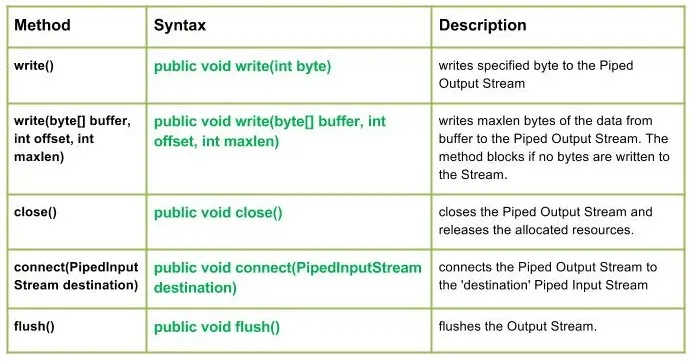
write() : java.io.PipedOutputStream.write(int byte) skriver en specificerad byte till Piped Output Stream.
Syntax :
public void write(int byte)
Parameters :
byte : byte to be written
Return : void
Exception :
-> IOException : if in case IO error occurs.write(byte[] buffert int offset int maxlen): java.io.PipedOutputStream.write(byte[] buffert int offset int maxlen) skriver maxlen-bytes av data från buffert till piped utgångsström. Metoden blockerar om inga byte skrivs till strömmen.
Syntax :
public void write(byte[] buffer int offset int maxlen)
Parameters :
buffer : data of the buffer
offset : starting in the destination array - 'buffer'.
maxlen : maximum length of array to be read
Return : void
Exception :
-> IOException : if in case IO error occurs. JavaProduktion:
Use of write(buffer offset maxlen) : J A V A
- close() : java.io.PipedOutputStream.close() stänger Piped Output Stream och frigör de tilldelade resurserna.
Syntax :
 public void close()
    Parameters :
 --------------
    Return :
 void
    Exception :
 ->      IOException :     if in case IO error occurs.
- connect(PipedInputStream destination) : java.io.PipedOutputStream.connect(PipedInputStream destination) ansluter Piped Output Stream till "destination" Piped Input Stream och om "destination" är rör med något annat stream IO-undantag kastas
Syntax :
 public void connect(PipedInputStream destination)
    Parameters :
 destination : the Piped Input Stream to be connected to
    Return :
 void
    Exception :
 ->      IOException :     if in case IO error occurs.
- flush(): java.io.PipedOutputStream.flush() spolar utströmmen.
Syntax :
public void flush()
Parameters :
------------
Return :
void
Exception :
-> IOException : if in case IO error occurs.
Java-kod som illustrerar hur PipedOutputStream-klassmetoderna fungerar:
JavaProduktion:
Use of flush() method :
G E E K S
Closing the Output stream
Skapa frågesport










![Hur man kontrollerar vem som såg Instagram-höjdpunkter [2024]](https://techcodeview.com/img/how/24/how-check-who-viewed-instagram-highlights.webp)