Antal parallellogram i ett plan
Givet några punkter på ett plan som är distinkta och inte tre av dem ligger på samma linje. Vi måste hitta antalet parallellogram med hörnen som givna punkter. Exempel:
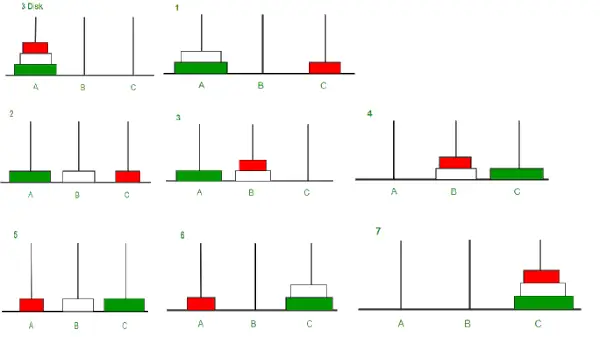
Input : points[] = {(0 0) (0 2) (2 2) (4 2) (1 4) (3 4)} Output : 2 Two Parallelograms are possible by choosing above given point as vertices which are shown in below diagram. Vi kan lösa detta problem genom att använda en speciell egenskap hos parallellogram att diagonaler i ett parallellogram skär varandra i mitten. Så om vi får en sådan mittpunkt som är mittpunkten på mer än ett linjesegment så kan vi dra slutsatsen att ett parallellogram existerar mer exakt om en mittpunkt förekommer x gånger så kan diagonaler av möjliga parallellogram väljas i x C 2 det kommer att finnas x*(x-1)/2 parallellogram som motsvarar just denna mittpunkt med en frekvens x. Så vi itererar över alla par av punkter och vi beräknar deras mittpunkt och ökar mittpunktens frekvens med 1. I slutet räknar vi antalet parallellogram enligt frekvensen för varje distinkt mittpunkt som förklarats ovan. Eftersom vi bara behöver frekvensen för mittpunktsdivision med 2 ignoreras när mittpunkten beräknas för enkelhetens skull.
CPP // C++ program to get number of Parallelograms we // can make by given points of the plane #include using namespace std ; // Returns count of Parallelograms possible // from given points int countOfParallelograms ( int x [] int y [] int N ) { // Map to store frequency of mid points map < pair < int int > int > cnt ; for ( int i = 0 ; i < N ; i ++ ) { for ( int j = i + 1 ; j < N ; j ++ ) { // division by 2 is ignored to get // rid of doubles int midX = x [ i ] + x [ j ]; int midY = y [ i ] + y [ j ]; // increase the frequency of mid point cnt [ make_pair ( midX midY )] ++ ; } } // Iterating through all mid points int res = 0 ; for ( auto it = cnt . begin (); it != cnt . end (); it ++ ) { int freq = it -> second ; // Increase the count of Parallelograms by // applying function on frequency of mid point res += freq * ( freq - 1 ) / 2 ; } return res ; } // Driver code to test above methods int main () { int x [] = { 0 0 2 4 1 3 }; int y [] = { 0 2 2 2 4 4 }; int N = sizeof ( x ) / sizeof ( int ); cout < < countOfParallelograms ( x y N ) < < endl ; return 0 ; }
Java /*package whatever //do not write package name here */ import java.io.* ; import java.util.* ; public class GFG { // Returns count of Parallelograms possible // from given points public static int countOfParallelograms ( int [] x int [] y int N ) { // Map to store frequency of mid points HashMap < String Integer > cnt = new HashMap <> (); for ( int i = 0 ; i < N ; i ++ ) { for ( int j = i + 1 ; j < N ; j ++ ) { // division by 2 is ignored to get // rid of doubles int midX = x [ i ] + x [ j ] ; int midY = y [ i ] + y [ j ] ; // increase the frequency of mid point String temp = String . join ( ' ' String . valueOf ( midX ) String . valueOf ( midY )); if ( cnt . containsKey ( temp )){ cnt . put ( temp cnt . get ( temp ) + 1 ); } else { cnt . put ( temp 1 ); } } } // Iterating through all mid points int res = 0 ; for ( Map . Entry < String Integer > it : cnt . entrySet ()) { int freq = it . getValue (); // Increase the count of Parallelograms by // applying function on frequency of mid point res = res + freq * ( freq - 1 ) / 2 ; } return res ; } public static void main ( String [] args ) { int [] x = { 0 0 2 4 1 3 }; int [] y = { 0 2 2 2 4 4 }; int N = x . length ; System . out . println ( countOfParallelograms ( x y N )); } } // The code is contributed by Nidhi goel.
Python3 # python program to get number of Parallelograms we # can make by given points of the plane # Returns count of Parallelograms possible # from given points def countOfParallelograms ( x y N ): # Map to store frequency of mid points cnt = {} for i in range ( N ): for j in range ( i + 1 N ): # division by 2 is ignored to get # rid of doubles midX = x [ i ] + x [ j ]; midY = y [ i ] + y [ j ]; # increase the frequency of mid point if (( midX midY ) in cnt ): cnt [( midX midY )] += 1 else : cnt [( midX midY )] = 1 # Iterating through all mid points res = 0 for key in cnt : freq = cnt [ key ] # Increase the count of Parallelograms by # applying function on frequency of mid point res += freq * ( freq - 1 ) / 2 return res # Driver code to test above methods x = [ 0 0 2 4 1 3 ] y = [ 0 2 2 2 4 4 ] N = len ( x ); print ( int ( countOfParallelograms ( x y N ))) # The code is contributed by Gautam goel.
C# using System ; using System.Collections.Generic ; public class GFG { // Returns count of Parallelograms possible // from given points public static int CountOfParallelograms ( int [] x int [] y int N ) { // Map to store frequency of mid points Dictionary < string int > cnt = new Dictionary < string int > (); for ( int i = 0 ; i < N ; i ++ ) { for ( int j = i + 1 ; j < N ; j ++ ) { // division by 2 is ignored to get // rid of doubles int midX = x [ i ] + x [ j ]; int midY = y [ i ] + y [ j ]; // increase the frequency of mid point string temp = string . Join ( ' ' midX . ToString () midY . ToString ()); if ( cnt . ContainsKey ( temp )) { cnt [ temp ] ++ ; } else { cnt . Add ( temp 1 ); } } } // Iterating through all mid points int res = 0 ; foreach ( KeyValuePair < string int > it in cnt ) { int freq = it . Value ; // Increase the count of Parallelograms by // applying function on frequency of mid point res += freq * ( freq - 1 ) / 2 ; } return res ; } public static void Main ( string [] args ) { int [] x = { 0 0 2 4 1 3 }; int [] y = { 0 2 2 2 4 4 }; int N = x . Length ; Console . WriteLine ( CountOfParallelograms ( x y N )); } }
JavaScript // JavaScript program to get number of Parallelograms we // can make by given points of the plane // Returns count of Parallelograms possible // from given points function countOfParallelograms ( x y N ) { // Map to store frequency of mid points // map int> cnt; let cnt = new Map (); for ( let i = 0 ; i < N ; i ++ ) { for ( let j = i + 1 ; j < N ; j ++ ) { // division by 2 is ignored to get // rid of doubles let midX = x [ i ] + x [ j ]; let midY = y [ i ] + y [ j ]; // increase the frequency of mid point let make_pair = [ midX midY ]; if ( cnt . has ( make_pair . join ( '' ))){ cnt . set ( make_pair . join ( '' ) cnt . get ( make_pair . join ( '' )) + 1 ); } else { cnt . set ( make_pair . join ( '' ) 1 ); } } } // Iterating through all mid points let res = 0 ; for ( const [ key value ] of cnt ) { let freq = value ; // Increase the count of Parallelograms by // applying function on frequency of mid point res = res + Math . floor ( freq * ( freq - 1 ) / 2 ); } return res ; } // Driver code to test above methods let x = [ 0 0 2 4 1 3 ]; let y = [ 0 2 2 2 4 4 ]; let N = x . length ; console . log ( countOfParallelograms ( x y N )); // The code is contributed by Gautam goel (gautamgoel962)
Produktion
2
Tidskomplexitet: På 2 logn) eftersom vi itererar genom två loopar upp till n och använder också en karta som tar logn.
Hjälputrymme: På)
Skapa frågesport