Najdaljša možna pot v matrici z ovirami


Podana je 2D binarna matrika skupaj z [][] kjer so nekatere celice ovire (označeno z 0 ), ostalo pa so proste celice (označene z 1 ) vaša naloga je najti dolžino najdaljše možne poti od izvorne celice (xs ys) v ciljno celico (xd yd) .
- Premaknete se lahko le v sosednje celice (gor dol levo desno).
- Diagonalni premiki niso dovoljeni.
- Enkrat obiskane celice na poti ni mogoče ponovno obiskati na isti poti.
- Če je nemogoče doseči cilj vrnitev
-1.
Primeri:
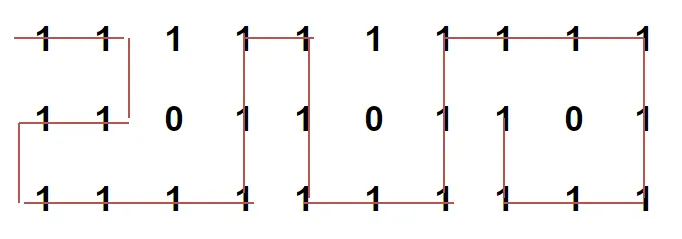
Vnos: xs = 0 ys = 0 xd = 1 yd = 7
z [][] = [ [1 1 1 1 1 1 1 1 1 1]
[1 1 0 1 1 0 1 1 0 1]
[1 1 1 1 1 1 1 1 1 1] ]
Izhod: 24
Pojasnilo:
Vnos: xs = 0 ys = 3 xd = 2 yd = 2
z [][] =[ [1 0 0 1 0]
[0 0 0 1 0]
[0 1 1 0 0] ]
Izhod: -1
Pojasnilo:
Vidimo, da je nemogoče
doseči celico (22) iz (03).
Kazalo vsebine
- [Pristop] Uporaba sledenja nazaj z obiskano matriko
- [Optimiziran pristop] Brez uporabe dodatnega prostora
[Pristop] Uporaba sledenja nazaj z obiskano matriko
CPPIdeja je uporaba Sledenje nazaj . Začnemo od izvorne celice matrike naprej v vse štiri dovoljene smeri in rekurzivno preverimo, ali vodijo do rešitve ali ne. Če je cilj najden, posodobimo vrednost najdaljše poti, sicer pa, če nobena od zgornjih rešitev ne deluje, iz naše funkcije vrnemo false.
#include #include #include #include using namespace std ; // Function to find the longest path using backtracking int dfs ( vector < vector < int >> & mat vector < vector < bool >> & visited int i int j int x int y ) { int m = mat . size (); int n = mat [ 0 ]. size (); // If destination is reached if ( i == x && j == y ) { return 0 ; } // If cell is invalid blocked or already visited if ( i < 0 || i >= m || j < 0 || j >= n || mat [ i ][ j ] == 0 || visited [ i ][ j ]) { return -1 ; } // Mark current cell as visited visited [ i ][ j ] = true ; int maxPath = -1 ; // Four possible moves: up down left right int row [] = { -1 1 0 0 }; int col [] = { 0 0 -1 1 }; for ( int k = 0 ; k < 4 ; k ++ ) { int ni = i + row [ k ]; int nj = j + col [ k ]; int pathLength = dfs ( mat visited ni nj x y ); // If a valid path is found from this direction if ( pathLength != -1 ) { maxPath = max ( maxPath 1 + pathLength ); } } // Backtrack - unmark current cell visited [ i ][ j ] = false ; return maxPath ; } int findLongestPath ( vector < vector < int >> & mat int xs int ys int xd int yd ) { int m = mat . size (); int n = mat [ 0 ]. size (); // Check if source or destination is blocked if ( mat [ xs ][ ys ] == 0 || mat [ xd ][ yd ] == 0 ) { return -1 ; } vector < vector < bool >> visited ( m vector < bool > ( n false )); return dfs ( mat visited xs ys xd yd ); } int main () { vector < vector < int >> mat = { { 1 1 1 1 1 1 1 1 1 1 } { 1 1 0 1 1 0 1 1 0 1 } { 1 1 1 1 1 1 1 1 1 1 } }; int xs = 0 ys = 0 ; int xd = 1 yd = 7 ; int result = findLongestPath ( mat xs ys xd yd ); if ( result != -1 ) cout < < result < < endl ; else cout < < -1 < < endl ; return 0 ; }
Java import java.util.Arrays ; public class GFG { // Function to find the longest path using backtracking public static int dfs ( int [][] mat boolean [][] visited int i int j int x int y ) { int m = mat . length ; int n = mat [ 0 ] . length ; // If destination is reached if ( i == x && j == y ) { return 0 ; } // If cell is invalid blocked or already visited if ( i < 0 || i >= m || j < 0 || j >= n || mat [ i ][ j ] == 0 || visited [ i ][ j ] ) { return - 1 ; // Invalid path } // Mark current cell as visited visited [ i ][ j ] = true ; int maxPath = - 1 ; // Four possible moves: up down left right int [] row = { - 1 1 0 0 }; int [] col = { 0 0 - 1 1 }; for ( int k = 0 ; k < 4 ; k ++ ) { int ni = i + row [ k ] ; int nj = j + col [ k ] ; int pathLength = dfs ( mat visited ni nj x y ); // If a valid path is found from this direction if ( pathLength != - 1 ) { maxPath = Math . max ( maxPath 1 + pathLength ); } } // Backtrack - unmark current cell visited [ i ][ j ] = false ; return maxPath ; } public static int findLongestPath ( int [][] mat int xs int ys int xd int yd ) { int m = mat . length ; int n = mat [ 0 ] . length ; // Check if source or destination is blocked if ( mat [ xs ][ ys ] == 0 || mat [ xd ][ yd ] == 0 ) { return - 1 ; } boolean [][] visited = new boolean [ m ][ n ] ; return dfs ( mat visited xs ys xd yd ); } public static void main ( String [] args ) { int [][] mat = { { 1 1 1 1 1 1 1 1 1 1 } { 1 1 0 1 1 0 1 1 0 1 } { 1 1 1 1 1 1 1 1 1 1 } }; int xs = 0 ys = 0 ; int xd = 1 yd = 7 ; int result = findLongestPath ( mat xs ys xd yd ); if ( result != - 1 ) System . out . println ( result ); else System . out . println ( - 1 ); } }
Python # Function to find the longest path using backtracking def dfs ( mat visited i j x y ): m = len ( mat ) n = len ( mat [ 0 ]) # If destination is reached if i == x and j == y : return 0 # If cell is invalid blocked or already visited if i < 0 or i >= m or j < 0 or j >= n or mat [ i ][ j ] == 0 or visited [ i ][ j ]: return - 1 # Invalid path # Mark current cell as visited visited [ i ][ j ] = True maxPath = - 1 # Four possible moves: up down left right row = [ - 1 1 0 0 ] col = [ 0 0 - 1 1 ] for k in range ( 4 ): ni = i + row [ k ] nj = j + col [ k ] pathLength = dfs ( mat visited ni nj x y ) # If a valid path is found from this direction if pathLength != - 1 : maxPath = max ( maxPath 1 + pathLength ) # Backtrack - unmark current cell visited [ i ][ j ] = False return maxPath def findLongestPath ( mat xs ys xd yd ): m = len ( mat ) n = len ( mat [ 0 ]) # Check if source or destination is blocked if mat [ xs ][ ys ] == 0 or mat [ xd ][ yd ] == 0 : return - 1 visited = [[ False for _ in range ( n )] for _ in range ( m )] return dfs ( mat visited xs ys xd yd ) def main (): mat = [ [ 1 1 1 1 1 1 1 1 1 1 ] [ 1 1 0 1 1 0 1 1 0 1 ] [ 1 1 1 1 1 1 1 1 1 1 ] ] xs ys = 0 0 xd yd = 1 7 result = findLongestPath ( mat xs ys xd yd ) if result != - 1 : print ( result ) else : print ( - 1 ) if __name__ == '__main__' : main ()
C# using System ; class GFG { // Function to find the longest path using backtracking static int dfs ( int [] mat bool [] visited int i int j int x int y ) { int m = mat . GetLength ( 0 ); int n = mat . GetLength ( 1 ); // If destination is reached if ( i == x && j == y ) { return 0 ; } // If cell is invalid blocked or already visited if ( i < 0 || i >= m || j < 0 || j >= n || mat [ i j ] == 0 || visited [ i j ]) { return - 1 ; // Invalid path } // Mark current cell as visited visited [ i j ] = true ; int maxPath = - 1 ; // Four possible moves: up down left right int [] row = { - 1 1 0 0 }; int [] col = { 0 0 - 1 1 }; for ( int k = 0 ; k < 4 ; k ++ ) { int ni = i + row [ k ]; int nj = j + col [ k ]; int pathLength = dfs ( mat visited ni nj x y ); // If a valid path is found from this direction if ( pathLength != - 1 ) { maxPath = Math . Max ( maxPath 1 + pathLength ); } } // Backtrack - unmark current cell visited [ i j ] = false ; return maxPath ; } static int FindLongestPath ( int [] mat int xs int ys int xd int yd ) { int m = mat . GetLength ( 0 ); int n = mat . GetLength ( 1 ); // Check if source or destination is blocked if ( mat [ xs ys ] == 0 || mat [ xd yd ] == 0 ) { return - 1 ; } bool [] visited = new bool [ m n ]; return dfs ( mat visited xs ys xd yd ); } static void Main () { int [] mat = { { 1 1 1 1 1 1 1 1 1 1 } { 1 1 0 1 1 0 1 1 0 1 } { 1 1 1 1 1 1 1 1 1 1 } }; int xs = 0 ys = 0 ; int xd = 1 yd = 7 ; int result = FindLongestPath ( mat xs ys xd yd ); if ( result != - 1 ) Console . WriteLine ( result ); else Console . WriteLine ( - 1 ); } }
JavaScript // Function to find the longest path using backtracking function dfs ( mat visited i j x y ) { const m = mat . length ; const n = mat [ 0 ]. length ; // If destination is reached if ( i === x && j === y ) { return 0 ; } // If cell is invalid blocked or already visited if ( i < 0 || i >= m || j < 0 || j >= n || mat [ i ][ j ] === 0 || visited [ i ][ j ]) { return - 1 ; } // Mark current cell as visited visited [ i ][ j ] = true ; let maxPath = - 1 ; // Four possible moves: up down left right const row = [ - 1 1 0 0 ]; const col = [ 0 0 - 1 1 ]; for ( let k = 0 ; k < 4 ; k ++ ) { const ni = i + row [ k ]; const nj = j + col [ k ]; const pathLength = dfs ( mat visited ni nj x y ); // If a valid path is found from this direction if ( pathLength !== - 1 ) { maxPath = Math . max ( maxPath 1 + pathLength ); } } // Backtrack - unmark current cell visited [ i ][ j ] = false ; return maxPath ; } function findLongestPath ( mat xs ys xd yd ) { const m = mat . length ; const n = mat [ 0 ]. length ; // Check if source or destination is blocked if ( mat [ xs ][ ys ] === 0 || mat [ xd ][ yd ] === 0 ) { return - 1 ; } const visited = Array ( m ). fill (). map (() => Array ( n ). fill ( false )); return dfs ( mat visited xs ys xd yd ); } const mat = [ [ 1 1 1 1 1 1 1 1 1 1 ] [ 1 1 0 1 1 0 1 1 0 1 ] [ 1 1 1 1 1 1 1 1 1 1 ] ]; const xs = 0 ys = 0 ; const xd = 1 yd = 7 ; const result = findLongestPath ( mat xs ys xd yd ); if ( result !== - 1 ) console . log ( result ); else console . log ( - 1 );
Izhod
24
Časovna zapletenost: O(4^(m*n)) Za vsako celico v matriki m x n algoritem razišče do štiri možne smeri (gor dol levo desno), ki vodijo do eksponentnega števila poti. V najslabšem primeru razišče vse možne poti, kar povzroči časovno kompleksnost 4^(m*n).
Pomožni prostor: O(m*n) Algoritem uporablja matriko obiskanih m x n za sledenje obiskanim celicam in rekurzijski sklad, ki lahko v najslabšem primeru raste do globine m * n (npr. pri raziskovanju poti, ki pokriva vse celice). Tako je pomožni prostor O(m*n).
[Optimiziran pristop] Brez uporabe dodatnega prostora
Namesto vzdrževanja ločene obiskane matrike lahko ponovno uporabite vhodno matriko za označevanje obiskanih celic med prečkanjem. To prihrani dodaten prostor in še vedno zagotavlja, da ne obiščemo iste celice na poti.
Spodaj je pristop po korakih:
- Začnite z izvorno celico
(xs ys). - Na vsakem koraku raziščite vse štiri možne smeri (desno navzdol levo navzgor).
- Za vsako veljavno potezo:
- Preverite meje in zagotovite, da ima celica vrednost
1(prosta celica). - Označite celico kot obiskano tako, da jo začasno nastavite na
0. - Vrnite se v naslednjo celico in povečajte dolžino poti.
- Preverite meje in zagotovite, da ima celica vrednost
- Če ciljna celica
(xd yd)je dosežena primerjajte trenutno dolžino poti z največjo do sedaj in posodobite odgovor. - Nazaj: obnovi prvotno vrednost celice (
1), preden se vrnete, da omogočite drugim potem, da ga raziščejo. - Nadaljujte z raziskovanjem, dokler ne obiščete vseh možnih poti.
- Vrni največjo dolžino poti. Če je cilj nedosegljiv vrnitev
-1
#include #include #include #include using namespace std ; // Function to find the longest path using backtracking without extra space int dfs ( vector < vector < int >> & mat int i int j int x int y ) { int m = mat . size (); int n = mat [ 0 ]. size (); // If destination is reached if ( i == x && j == y ) { return 0 ; } // If cell is invalid or blocked (0 means blocked or visited) if ( i < 0 || i >= m || j < 0 || j >= n || mat [ i ][ j ] == 0 ) { return -1 ; } // Mark current cell as visited by temporarily setting it to 0 mat [ i ][ j ] = 0 ; int maxPath = -1 ; // Four possible moves: up down left right int row [] = { -1 1 0 0 }; int col [] = { 0 0 -1 1 }; for ( int k = 0 ; k < 4 ; k ++ ) { int ni = i + row [ k ]; int nj = j + col [ k ]; int pathLength = dfs ( mat ni nj x y ); // If a valid path is found from this direction if ( pathLength != -1 ) { maxPath = max ( maxPath 1 + pathLength ); } } // Backtrack - restore the cell's original value (1) mat [ i ][ j ] = 1 ; return maxPath ; } int findLongestPath ( vector < vector < int >> & mat int xs int ys int xd int yd ) { int m = mat . size (); int n = mat [ 0 ]. size (); // Check if source or destination is blocked if ( mat [ xs ][ ys ] == 0 || mat [ xd ][ yd ] == 0 ) { return -1 ; } return dfs ( mat xs ys xd yd ); } int main () { vector < vector < int >> mat = { { 1 1 1 1 1 1 1 1 1 1 } { 1 1 0 1 1 0 1 1 0 1 } { 1 1 1 1 1 1 1 1 1 1 } }; int xs = 0 ys = 0 ; int xd = 1 yd = 7 ; int result = findLongestPath ( mat xs ys xd yd ); if ( result != -1 ) cout < < result < < endl ; else cout < < -1 < < endl ; return 0 ; }
Java public class GFG { // Function to find the longest path using backtracking without extra space public static int dfs ( int [][] mat int i int j int x int y ) { int m = mat . length ; int n = mat [ 0 ] . length ; // If destination is reached if ( i == x && j == y ) { return 0 ; } // If cell is invalid or blocked (0 means blocked or visited) if ( i < 0 || i >= m || j < 0 || j >= n || mat [ i ][ j ] == 0 ) { return - 1 ; } // Mark current cell as visited by temporarily setting it to 0 mat [ i ][ j ] = 0 ; int maxPath = - 1 ; // Four possible moves: up down left right int [] row = { - 1 1 0 0 }; int [] col = { 0 0 - 1 1 }; for ( int k = 0 ; k < 4 ; k ++ ) { int ni = i + row [ k ] ; int nj = j + col [ k ] ; int pathLength = dfs ( mat ni nj x y ); // If a valid path is found from this direction if ( pathLength != - 1 ) { maxPath = Math . max ( maxPath 1 + pathLength ); } } // Backtrack - restore the cell's original value (1) mat [ i ][ j ] = 1 ; return maxPath ; } public static int findLongestPath ( int [][] mat int xs int ys int xd int yd ) { int m = mat . length ; int n = mat [ 0 ] . length ; // Check if source or destination is blocked if ( mat [ xs ][ ys ] == 0 || mat [ xd ][ yd ] == 0 ) { return - 1 ; } return dfs ( mat xs ys xd yd ); } public static void main ( String [] args ) { int [][] mat = { { 1 1 1 1 1 1 1 1 1 1 } { 1 1 0 1 1 0 1 1 0 1 } { 1 1 1 1 1 1 1 1 1 1 } }; int xs = 0 ys = 0 ; int xd = 1 yd = 7 ; int result = findLongestPath ( mat xs ys xd yd ); if ( result != - 1 ) System . out . println ( result ); else System . out . println ( - 1 ); } }
Python # Function to find the longest path using backtracking without extra space def dfs ( mat i j x y ): m = len ( mat ) n = len ( mat [ 0 ]) # If destination is reached if i == x and j == y : return 0 # If cell is invalid or blocked (0 means blocked or visited) if i < 0 or i >= m or j < 0 or j >= n or mat [ i ][ j ] == 0 : return - 1 # Mark current cell as visited by temporarily setting it to 0 mat [ i ][ j ] = 0 maxPath = - 1 # Four possible moves: up down left right row = [ - 1 1 0 0 ] col = [ 0 0 - 1 1 ] for k in range ( 4 ): ni = i + row [ k ] nj = j + col [ k ] pathLength = dfs ( mat ni nj x y ) # If a valid path is found from this direction if pathLength != - 1 : maxPath = max ( maxPath 1 + pathLength ) # Backtrack - restore the cell's original value (1) mat [ i ][ j ] = 1 return maxPath def findLongestPath ( mat xs ys xd yd ): m = len ( mat ) n = len ( mat [ 0 ]) # Check if source or destination is blocked if mat [ xs ][ ys ] == 0 or mat [ xd ][ yd ] == 0 : return - 1 return dfs ( mat xs ys xd yd ) def main (): mat = [ [ 1 1 1 1 1 1 1 1 1 1 ] [ 1 1 0 1 1 0 1 1 0 1 ] [ 1 1 1 1 1 1 1 1 1 1 ] ] xs ys = 0 0 xd yd = 1 7 result = findLongestPath ( mat xs ys xd yd ) if result != - 1 : print ( result ) else : print ( - 1 ) if __name__ == '__main__' : main ()
C# using System ; class GFG { // Function to find the longest path using backtracking without extra space static int dfs ( int [] mat int i int j int x int y ) { int m = mat . GetLength ( 0 ); int n = mat . GetLength ( 1 ); // If destination is reached if ( i == x && j == y ) { return 0 ; } // If cell is invalid or blocked (0 means blocked or visited) if ( i < 0 || i >= m || j < 0 || j >= n || mat [ i j ] == 0 ) { return - 1 ; } // Mark current cell as visited by temporarily setting it to 0 mat [ i j ] = 0 ; int maxPath = - 1 ; // Four possible moves: up down left right int [] row = { - 1 1 0 0 }; int [] col = { 0 0 - 1 1 }; for ( int k = 0 ; k < 4 ; k ++ ) { int ni = i + row [ k ]; int nj = j + col [ k ]; int pathLength = dfs ( mat ni nj x y ); // If a valid path is found from this direction if ( pathLength != - 1 ) { maxPath = Math . Max ( maxPath 1 + pathLength ); } } // Backtrack - restore the cell's original value (1) mat [ i j ] = 1 ; return maxPath ; } static int FindLongestPath ( int [] mat int xs int ys int xd int yd ) { // Check if source or destination is blocked if ( mat [ xs ys ] == 0 || mat [ xd yd ] == 0 ) { return - 1 ; } return dfs ( mat xs ys xd yd ); } static void Main () { int [] mat = { { 1 1 1 1 1 1 1 1 1 1 } { 1 1 0 1 1 0 1 1 0 1 } { 1 1 1 1 1 1 1 1 1 1 } }; int xs = 0 ys = 0 ; int xd = 1 yd = 7 ; int result = FindLongestPath ( mat xs ys xd yd ); if ( result != - 1 ) Console . WriteLine ( result ); else Console . WriteLine ( - 1 ); } }
JavaScript // Function to find the longest path using backtracking without extra space function dfs ( mat i j x y ) { const m = mat . length ; const n = mat [ 0 ]. length ; // If destination is reached if ( i === x && j === y ) { return 0 ; } // If cell is invalid or blocked (0 means blocked or visited) if ( i < 0 || i >= m || j < 0 || j >= n || mat [ i ][ j ] === 0 ) { return - 1 ; } // Mark current cell as visited by temporarily setting it to 0 mat [ i ][ j ] = 0 ; let maxPath = - 1 ; // Four possible moves: up down left right const row = [ - 1 1 0 0 ]; const col = [ 0 0 - 1 1 ]; for ( let k = 0 ; k < 4 ; k ++ ) { const ni = i + row [ k ]; const nj = j + col [ k ]; const pathLength = dfs ( mat ni nj x y ); // If a valid path is found from this direction if ( pathLength !== - 1 ) { maxPath = Math . max ( maxPath 1 + pathLength ); } } // Backtrack - restore the cell's original value (1) mat [ i ][ j ] = 1 ; return maxPath ; } function findLongestPath ( mat xs ys xd yd ) { const m = mat . length ; const n = mat [ 0 ]. length ; // Check if source or destination is blocked if ( mat [ xs ][ ys ] === 0 || mat [ xd ][ yd ] === 0 ) { return - 1 ; } return dfs ( mat xs ys xd yd ); } const mat = [ [ 1 1 1 1 1 1 1 1 1 1 ] [ 1 1 0 1 1 0 1 1 0 1 ] [ 1 1 1 1 1 1 1 1 1 1 ] ]; const xs = 0 ys = 0 ; const xd = 1 yd = 7 ; const result = findLongestPath ( mat xs ys xd yd ); if ( result !== - 1 ) console . log ( result ); else console . log ( - 1 );
Izhod
24
Časovna zapletenost: O(4^(m*n))Algoritem še vedno raziskuje do štiri smeri na celico v matriki m x n, kar ima za posledico eksponentno število poti. Sprememba na mestu ne vpliva na število raziskanih poti, tako da časovna kompleksnost ostaja 4^(m*n).
Pomožni prostor: O(m*n) Medtem ko se obiskana matrika odstrani s spreminjanjem vhodne matrike na mestu, rekurzivni sklad še vedno zahteva O(m*n) prostora, saj je največja globina rekurzije lahko m * n v najslabšem primeru (npr. pot, ki obišče vse celice v mreži z večinoma 1s).