Numărul paralelogramelor dintr-un plan
Având în vedere unele puncte dintr-un plan care sunt distincte și nici trei dintre ele nu se află pe aceeași linie. Trebuie să găsim numărul de paralelograme cu vârfurile ca puncte date. Exemple:
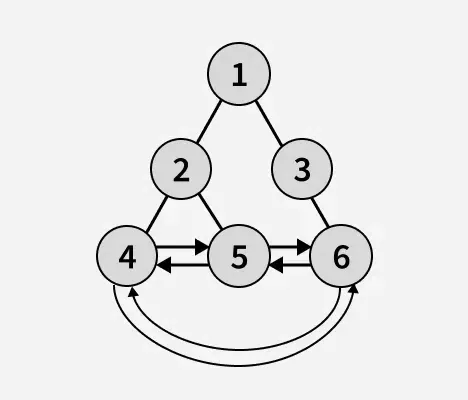
Input : points[] = {(0 0) (0 2) (2 2) (4 2) (1 4) (3 4)} Output : 2 Two Parallelograms are possible by choosing above given point as vertices which are shown in below diagram. Putem rezolva această problemă utilizând o proprietate specială a paralelogramelor că diagonalele unui paralelogram se intersectează în mijloc. Deci, dacă obținem un astfel de punct de mijloc care este punctul de mijloc al mai multor segmente de linie, atunci putem concluziona că un paralelogram există mai precis dacă un punct de mijloc apare de x ori, atunci diagonalele posibilelor paralelograme pot fi alese în x C 2 moduri, adică vor exista x*(x-1)/2 paralelograme corespunzătoare acestui punct de mijloc particular cu o frecvență x. Deci repetăm peste toate perechile de puncte și calculăm punctul lor de mijloc și creștem frecvența punctului de mijloc cu 1. La sfârșit, numărăm numărul de paralelograme în funcție de frecvența fiecărui punct mijlociu distinct, așa cum este explicat mai sus. Deoarece avem nevoie doar de frecvența divizării punctului de mijloc cu 2, este ignorată în timpul calculării punctului de mijloc pentru simplitate.
CPP // C++ program to get number of Parallelograms we // can make by given points of the plane #include using namespace std ; // Returns count of Parallelograms possible // from given points int countOfParallelograms ( int x [] int y [] int N ) { // Map to store frequency of mid points map < pair < int int > int > cnt ; for ( int i = 0 ; i < N ; i ++ ) { for ( int j = i + 1 ; j < N ; j ++ ) { // division by 2 is ignored to get // rid of doubles int midX = x [ i ] + x [ j ]; int midY = y [ i ] + y [ j ]; // increase the frequency of mid point cnt [ make_pair ( midX midY )] ++ ; } } // Iterating through all mid points int res = 0 ; for ( auto it = cnt . begin (); it != cnt . end (); it ++ ) { int freq = it -> second ; // Increase the count of Parallelograms by // applying function on frequency of mid point res += freq * ( freq - 1 ) / 2 ; } return res ; } // Driver code to test above methods int main () { int x [] = { 0 0 2 4 1 3 }; int y [] = { 0 2 2 2 4 4 }; int N = sizeof ( x ) / sizeof ( int ); cout < < countOfParallelograms ( x y N ) < < endl ; return 0 ; }
Java /*package whatever //do not write package name here */ import java.io.* ; import java.util.* ; public class GFG { // Returns count of Parallelograms possible // from given points public static int countOfParallelograms ( int [] x int [] y int N ) { // Map to store frequency of mid points HashMap < String Integer > cnt = new HashMap <> (); for ( int i = 0 ; i < N ; i ++ ) { for ( int j = i + 1 ; j < N ; j ++ ) { // division by 2 is ignored to get // rid of doubles int midX = x [ i ] + x [ j ] ; int midY = y [ i ] + y [ j ] ; // increase the frequency of mid point String temp = String . join ( ' ' String . valueOf ( midX ) String . valueOf ( midY )); if ( cnt . containsKey ( temp )){ cnt . put ( temp cnt . get ( temp ) + 1 ); } else { cnt . put ( temp 1 ); } } } // Iterating through all mid points int res = 0 ; for ( Map . Entry < String Integer > it : cnt . entrySet ()) { int freq = it . getValue (); // Increase the count of Parallelograms by // applying function on frequency of mid point res = res + freq * ( freq - 1 ) / 2 ; } return res ; } public static void main ( String [] args ) { int [] x = { 0 0 2 4 1 3 }; int [] y = { 0 2 2 2 4 4 }; int N = x . length ; System . out . println ( countOfParallelograms ( x y N )); } } // The code is contributed by Nidhi goel.
Python3 # python program to get number of Parallelograms we # can make by given points of the plane # Returns count of Parallelograms possible # from given points def countOfParallelograms ( x y N ): # Map to store frequency of mid points cnt = {} for i in range ( N ): for j in range ( i + 1 N ): # division by 2 is ignored to get # rid of doubles midX = x [ i ] + x [ j ]; midY = y [ i ] + y [ j ]; # increase the frequency of mid point if (( midX midY ) in cnt ): cnt [( midX midY )] += 1 else : cnt [( midX midY )] = 1 # Iterating through all mid points res = 0 for key in cnt : freq = cnt [ key ] # Increase the count of Parallelograms by # applying function on frequency of mid point res += freq * ( freq - 1 ) / 2 return res # Driver code to test above methods x = [ 0 0 2 4 1 3 ] y = [ 0 2 2 2 4 4 ] N = len ( x ); print ( int ( countOfParallelograms ( x y N ))) # The code is contributed by Gautam goel.
C# using System ; using System.Collections.Generic ; public class GFG { // Returns count of Parallelograms possible // from given points public static int CountOfParallelograms ( int [] x int [] y int N ) { // Map to store frequency of mid points Dictionary < string int > cnt = new Dictionary < string int > (); for ( int i = 0 ; i < N ; i ++ ) { for ( int j = i + 1 ; j < N ; j ++ ) { // division by 2 is ignored to get // rid of doubles int midX = x [ i ] + x [ j ]; int midY = y [ i ] + y [ j ]; // increase the frequency of mid point string temp = string . Join ( ' ' midX . ToString () midY . ToString ()); if ( cnt . ContainsKey ( temp )) { cnt [ temp ] ++ ; } else { cnt . Add ( temp 1 ); } } } // Iterating through all mid points int res = 0 ; foreach ( KeyValuePair < string int > it in cnt ) { int freq = it . Value ; // Increase the count of Parallelograms by // applying function on frequency of mid point res += freq * ( freq - 1 ) / 2 ; } return res ; } public static void Main ( string [] args ) { int [] x = { 0 0 2 4 1 3 }; int [] y = { 0 2 2 2 4 4 }; int N = x . Length ; Console . WriteLine ( CountOfParallelograms ( x y N )); } }
JavaScript // JavaScript program to get number of Parallelograms we // can make by given points of the plane // Returns count of Parallelograms possible // from given points function countOfParallelograms ( x y N ) { // Map to store frequency of mid points // map int> cnt; let cnt = new Map (); for ( let i = 0 ; i < N ; i ++ ) { for ( let j = i + 1 ; j < N ; j ++ ) { // division by 2 is ignored to get // rid of doubles let midX = x [ i ] + x [ j ]; let midY = y [ i ] + y [ j ]; // increase the frequency of mid point let make_pair = [ midX midY ]; if ( cnt . has ( make_pair . join ( '' ))){ cnt . set ( make_pair . join ( '' ) cnt . get ( make_pair . join ( '' )) + 1 ); } else { cnt . set ( make_pair . join ( '' ) 1 ); } } } // Iterating through all mid points let res = 0 ; for ( const [ key value ] of cnt ) { let freq = value ; // Increase the count of Parallelograms by // applying function on frequency of mid point res = res + Math . floor ( freq * ( freq - 1 ) / 2 ); } return res ; } // Driver code to test above methods let x = [ 0 0 2 4 1 3 ]; let y = [ 0 2 2 2 4 4 ]; let N = x . length ; console . log ( countOfParallelograms ( x y N )); // The code is contributed by Gautam goel (gautamgoel962)
Ieșire
2
Complexitatea timpului: Pe 2 logn), deoarece iterăm prin două bucle până la n și utilizăm și o hartă care ia logn.
Spațiu auxiliar: Pe)
Creați un test