Encontre todas as sequências binárias de comprimento par com a mesma soma dos bits da primeira e da segunda metade
Dado um número n, encontre todas as sequências binárias de comprimento 2n tais que a soma dos primeiros n bits seja igual à soma dos últimos n bits.
Exemplos:
Input: N = 2 Output: 0101 1111 1001 0110 0000 1010 Input: N = 3 Output: 011011 001001 011101 010001 101011 111111 110011 101101 100001 110101 001010 011110 010010 001100 000000 010100 101110 100010 110110 100100
A ideia é corrigir o primeiro e o último bits e depois recorrer aos 2*(n-1) bits restantes. Existem quatro possibilidades quando corrigimos o primeiro e o último bits -
- O primeiro e o último bits são 1 n - 1 bits restantes em ambos os lados também devem ter a mesma soma.
- O primeiro e o último bits são 0 restantes n - 1 bits em ambos os lados também devem ter a mesma soma.
- O primeiro bit é 1 e o último bit é 0. A soma dos n-1 bits restantes no lado esquerdo deve ser 1 a menos que a soma dos n-1 bits no lado direito.
- O primeiro bit é 0 e o último bit é 1. A soma dos n-1 bits restantes no lado esquerdo deve ser 1 a mais que a soma dos n-1 bits no lado direito.
Abaixo está a implementação da ideia acima –
// C++ program to print even length binary sequences // whose sum of first and second half bits is same #include using namespace std ; // Function to print even length binary sequences // whose sum of first and second half bits is same // diff --> difference between sums of first n bits // and last n bits // out --> output array // start --> starting index // end --> ending index void findAllSequences ( int diff char * out int start int end ) { // We can't cover difference of more than n with 2n bits if ( abs ( diff ) > ( end - start + 1 ) / 2 ) return ; // if all bits are filled if ( start > end ) { // if sum of first n bits and last n bits are same if ( diff == 0 ) cout < < out < < ' ' ; return ; } // fill first bit as 0 and last bit as 1 out [ start ] = '0' out [ end ] = '1' ; findAllSequences ( diff + 1 out start + 1 end - 1 ); // fill first and last bits as 1 out [ start ] = out [ end ] = '1' ; findAllSequences ( diff out start + 1 end - 1 ); // fill first and last bits as 0 out [ start ] = out [ end ] = '0' ; findAllSequences ( diff out start + 1 end - 1 ); // fill first bit as 1 and last bit as 0 out [ start ] = '1' out [ end ] = '0' ; findAllSequences ( diff - 1 out start + 1 end - 1 ); } // Driver program int main () { // input number int n = 2 ; // allocate string containing 2*n characters char out [ 2 * n + 1 ]; // null terminate output array out [ 2 * n ] = '' ; findAllSequences ( 0 out 0 2 * n - 1 ); return 0 ; }
Java // Java program to print even length binary // sequences whose sum of first and second // half bits is same import java.io.* ; import java.util.* ; class GFG { // Function to print even length binary sequences // whose sum of first and second half bits is same // diff --> difference between sums of first n bits // and last n bits // out --> output array // start --> starting index // end --> ending index static void findAllSequences ( int diff char out [] int start int end ) { // We can't cover difference of more // than n with 2n bits if ( Math . abs ( diff ) > ( end - start + 1 ) / 2 ) return ; // if all bits are filled if ( start > end ) { // if sum of first n bits and // last n bits are same if ( diff == 0 ) { System . out . print ( out ); System . out . print ( ' ' ); } return ; } // fill first bit as 0 and last bit as 1 out [ start ] = '0' ; out [ end ] = '1' ; findAllSequences ( diff + 1 out start + 1 end - 1 ); // fill first and last bits as 1 out [ start ] = out [ end ] = '1' ; findAllSequences ( diff out start + 1 end - 1 ); // fill first and last bits as 0 out [ start ] = out [ end ] = '0' ; findAllSequences ( diff out start + 1 end - 1 ); // fill first bit as 1 and last bit as 0 out [ start ] = '1' ; out [ end ] = '0' ; findAllSequences ( diff - 1 out start + 1 end - 1 ); } // Driver program public static void main ( String [] args ) { // input number int n = 2 ; // allocate string containing 2*n characters char [] out = new char [ 2 * n + 1 ] ; // null terminate output array out [ 2 * n ] = '' ; findAllSequences ( 0 out 0 2 * n - 1 ); } } // This code is contributed by Pramod Kumar
Python3 # Python3 program to print even length binary sequences # whose sum of first and second half bits is same # Function to print even length binary sequences # whose sum of first and second half bits is same # diff --> difference between sums of first n bits # and last n bits # out --> output array # start --> starting index # end --> ending index def findAllSequences ( diff out start end ): # We can't cover difference of more than n with 2n bits if ( abs ( diff ) > ( end - start + 1 ) // 2 ): return ; # if all bits are filled if ( start > end ): # if sum of first n bits and last n bits are same if ( diff == 0 ): print ( '' . join ( list ( out )) end = ' ' ); return ; # fill first bit as 0 and last bit as 1 out [ start ] = '0' ; out [ end ] = '1' ; findAllSequences ( diff + 1 out start + 1 end - 1 ); # fill first and last bits as 1 out [ start ] = out [ end ] = '1' ; findAllSequences ( diff out start + 1 end - 1 ); # fill first and last bits as 0 out [ start ] = out [ end ] = '0' ; findAllSequences ( diff out start + 1 end - 1 ); # fill first bit as 1 and last bit as 0 out [ start ] = '1' ; out [ end ] = '0' ; findAllSequences ( diff - 1 out start + 1 end - 1 ); # Driver program # input number n = 2 ; # allocate string containing 2*n characters out = [ '' ] * ( 2 * n ); findAllSequences ( 0 out 0 2 * n - 1 ); # This code is contributed by mits
C# // C# program to print even length binary // sequences whose sum of first and second // half bits is same using System ; class GFG { // Function to print even length binary // sequences whose sum of first and // second half bits is same // diff --> difference between sums of // first n bits // and last n bits // out --> output array // start --> starting index // end --> ending index static void findAllSequences ( int diff char [] outt int start int end ) { // We can't cover difference of // more than n with 2n bits if ( Math . Abs ( diff ) > ( end - start + 1 ) / 2 ) return ; // if all bits are filled if ( start > end ) { // if sum of first n bits and // last n bits are same if ( diff == 0 ) { Console . Write ( outt ); Console . Write ( ' ' ); } return ; } // fill first bit as 0 and last bit // as 1 outt [ start ] = '0' ; outt [ end ] = '1' ; findAllSequences ( diff + 1 outt start + 1 end - 1 ); // fill first and last bits as 1 outt [ start ] = outt [ end ] = '1' ; findAllSequences ( diff outt start + 1 end - 1 ); // fill first and last bits as 0 outt [ start ] = outt [ end ] = '0' ; findAllSequences ( diff outt start + 1 end - 1 ); // fill first bit as 1 and last // bit as 0 outt [ start ] = '1' ; outt [ end ] = '0' ; findAllSequences ( diff - 1 outt start + 1 end - 1 ); } // Driver program public static void Main () { // input number int n = 2 ; // allocate string containing 2*n // characters char [] outt = new char [ 2 * n + 1 ]; // null terminate output array outt [ 2 * n ] = '' ; findAllSequences ( 0 outt 0 2 * n - 1 ); } } // This code is contributed by nitin mittal.
PHP // PHP program to print even length binary sequences // whose sum of first and second half bits is same // Function to print even length binary sequences // whose sum of first and second half bits is same // diff --> difference between sums of first n bits // and last n bits // out --> output array // start --> starting index // end --> ending index function findAllSequences ( $diff $out $start $end ) { // We can't cover difference of more than n with 2n bits if ( abs ( $diff ) > ( int )(( $end - $start + 1 ) / 2 )) return ; // if all bits are filled if ( $start > $end ) { // if sum of first n bits and last n bits are same if ( $diff == 0 ) print ( implode ( '' $out ) . ' ' ); return ; } // fill first bit as 0 and last bit as 1 $out [ $start ] = '0' ; $out [ $end ] = '1' ; findAllSequences ( $diff + 1 $out $start + 1 $end - 1 ); // fill first and last bits as 1 $out [ $start ] = $out [ $end ] = '1' ; findAllSequences ( $diff $out $start + 1 $end - 1 ); // fill first and last bits as 0 $out [ $start ] = $out [ $end ] = '0' ; findAllSequences ( $diff $out $start + 1 $end - 1 ); // fill first bit as 1 and last bit as 0 $out [ $start ] = '1' ; $out [ $end ] = '0' ; findAllSequences ( $diff - 1 $out $start + 1 $end - 1 ); } // Driver program // input number $n = 2 ; // allocate string containing 2*n characters $out = array_fill ( 0 2 * $n '' ); findAllSequences ( 0 $out 0 2 * $n - 1 ); // This code is contributed by chandan_jnu ?>
JavaScript < script > // JavaScript program to print even length binary // sequences whose sum of first and second // half bits is same // Function to print even length binary // sequences whose sum of first and // second half bits is same // diff --> difference between sums of // first n bits // and last n bits // out --> output array // start --> starting index // end --> ending index function findAllSequences ( diff outt start end ) { // We can't cover difference of // more than n with 2n bits if ( Math . abs ( diff ) > parseInt (( end - start + 1 ) / 2 10 )) return ; // if all bits are filled if ( start > end ) { // if sum of first n bits and // last n bits are same if ( diff == 0 ) { document . write ( outt . join ( '' )); document . write ( ' ' ); } return ; } // fill first bit as 0 and last bit // as 1 outt [ start ] = '0' ; outt [ end ] = '1' ; findAllSequences ( diff + 1 outt start + 1 end - 1 ); // fill first and last bits as 1 outt [ start ] = outt [ end ] = '1' ; findAllSequences ( diff outt start + 1 end - 1 ); // fill first and last bits as 0 outt [ start ] = outt [ end ] = '0' ; findAllSequences ( diff outt start + 1 end - 1 ); // fill first bit as 1 and last // bit as 0 outt [ start ] = '1' ; outt [ end ] = '0' ; findAllSequences ( diff - 1 outt start + 1 end - 1 ); } // input number let n = 2 ; // allocate string containing 2*n // characters let outt = new Array ( 2 * n + 1 ); // null terminate output array outt [ 2 * n ] = '' ; findAllSequences ( 0 outt 0 2 * n - 1 ); < /script>
Saída
0101 1111 1001 0110 0000 1010
Complexidade de tempo: O((4 ^ N )* N)
4 ^ N por causa de 4 chamadas recursivas e N (simplificado de 2N) pelo tempo gasto na impressão de strings de tamanho 2N
Espaço Auxiliar: SOBRE)
Existe outra abordagem pela qual geramos todas as strings possíveis de comprimento n e as armazenamos em uma lista em um índice que representa sua soma. Em seguida, iteramos por cada lista e geramos as strings de tamanho 2n, imprimindo cada string com todas as outras strings da lista somando o mesmo valor.
C++ // C++ program to implement the approach #include using namespace std ; //function that generates the sequence void generateSequencesWithSum ( int n vector < vector < string > >& sumToString vector < string > sequence int sumSoFar ) { // Base case if there are no more binary digits to // include if ( n == 0 ) { // add permutation to list of sequences with sum // corresponding to index string seq = '' ; for ( int i = 0 ; i < sequence . size (); i ++ ) { seq = seq + sequence [ i ]; } vector < string > x = sumToString [ sumSoFar ]; x . push_back ( seq ); sumToString [ sumSoFar ] = x ; return ; } // Generate sequence +0 sequence . push_back ( '0' ); generateSequencesWithSum ( n - 1 sumToString sequence sumSoFar ); sequence . erase ( sequence . begin ()); // Generate sequence +1 sequence . push_back ( '1' ); generateSequencesWithSum ( n - 1 sumToString sequence sumSoFar + 1 ); sequence . erase ( sequence . begin ()); } // function to form permutations of the sequences void permuteSequences ( vector < vector < string > > sumToString ) { // There are 2^n substring in this list of lists for ( int sumIndexArr = 0 ; sumIndexArr < sumToString . size (); sumIndexArr ++ ) { // Append for ( int sequence1 = 0 ; sequence1 < sumToString [ sumIndexArr ]. size (); sequence1 ++ ) { for ( int sequence2 = 0 ; sequence2 < sumToString [ sumIndexArr ]. size (); sequence2 ++ ) { if ( sumIndexArr == sumToString . size () - 1 && sequence1 == sumToString [ sumIndexArr ] . size () - 1 && sequence2 == sumToString [ sumIndexArr ] . size () - 1 ) { cout < < '1111 ' ; } else { cout < < sumToString [ sumIndexArr ] [ sequence1 ] + sumToString [ sumIndexArr ] [ sequence2 ] < < ' ' ; } } } } } // function that finds all the subsequences void findAllSequences ( int n ) { vector < vector < string > > sumToString ; for ( int i = 0 ; i < n + 1 ; i ++ ) { sumToString . push_back ( vector < string > ()); // list of strings // where index // represents sum } generateSequencesWithSum ( n sumToString vector < string > () 0 ); permuteSequences ( sumToString ); } // Driver Code int main () { // Function Call findAllSequences ( 2 ); return 0 ; } // this code is contributed by phasing17
Java // Java program to implement the approach import java.util.* ; class GFG { // function that finds all the subsequences static void findAllSequences ( int n ) { ArrayList < ArrayList < String > > sumToString = new ArrayList < ArrayList < String > > (); for ( int i = 0 ; i < n + 1 ; i ++ ) { sumToString . add ( new ArrayList < String > ()); // list of strings // where index // represents sum } generateSequencesWithSum ( n sumToString new ArrayList < String > () 0 ); permuteSequences ( sumToString ); } static void generateSequencesWithSum ( int n ArrayList < ArrayList < String > > sumToString ArrayList < String > sequence int sumSoFar ) { // Base case if there are no more binary digits to // include if ( n == 0 ) { // add permutation to list of sequences with sum // corresponding to index String seq = '' ; for ( int i = 0 ; i < sequence . size (); i ++ ) { seq = seq + sequence . get ( i ); } ArrayList < String > x = sumToString . get ( sumSoFar ); x . add ( seq ); sumToString . set ( sumSoFar x ); return ; } // Generate sequence +0 sequence . add ( '0' ); generateSequencesWithSum ( n - 1 sumToString sequence sumSoFar ); sequence . remove ( 0 ); // Generate sequence +1 sequence . add ( '1' ); generateSequencesWithSum ( n - 1 sumToString sequence sumSoFar + 1 ); sequence . remove ( 0 ); } // function to form permutations of the sequences static void permuteSequences ( ArrayList < ArrayList < String > > sumToString ) { // There are 2^n substring in this list of lists for ( int sumIndexArr = 0 ; sumIndexArr < sumToString . size (); sumIndexArr ++ ) { // Append for ( int sequence1 = 0 ; sequence1 < sumToString . get ( sumIndexArr ). size (); sequence1 ++ ) { for ( int sequence2 = 0 ; sequence2 < sumToString . get ( sumIndexArr ). size (); sequence2 ++ ) { if ( sumIndexArr == sumToString . size () - 1 && sequence1 == sumToString . get ( sumIndexArr ) . size () - 1 && sequence2 == sumToString . get ( sumIndexArr ) . size () - 1 ) { System . out . print ( '1111' ); } else { System . out . println ( sumToString . get ( sumIndexArr ) . get ( sequence1 ) + sumToString . get ( sumIndexArr ) . get ( sequence2 )); } } } } } // Driver Code public static void main ( String [] args ) { // Function Call findAllSequences ( 2 ); } // this code is contributed by phasing17 }
Python3 def findAllSequences ( n ): sumToString = [[] for x in range ( n + 1 )] # list of strings where index represents sum generateSequencesWithSum ( n sumToString [] 0 ) permuteSequences ( sumToString ) def generateSequencesWithSum ( n sumToString sequence sumSoFar ): #Base case if there are no more binary digits to include if n == 0 : sumToString [ sumSoFar ] . append ( '' . join ( sequence )) #add permutation to list of sequences with sum corresponding to index return #Generate sequence +0 sequence . append ( '0' ) generateSequencesWithSum ( n - 1 sumToString sequence sumSoFar ) sequence . pop () #Generate sequence +1 sequence . append ( '1' ) generateSequencesWithSum ( n - 1 sumToString sequence sumSoFar + 1 ) sequence . pop () def permuteSequences ( sumToString ): #There are 2^n substring in this list of lists for sumIndexArr in sumToString : # Append for sequence1 in sumIndexArr : for sequence2 in sumIndexArr : print ( sequence1 + sequence2 ) findAllSequences ( 2 ) #Contribution by Xavier Jean Baptiste
C# using System ; using System.Collections.Generic ; class GFG { static void findAllSequences ( int n ) { List < List < string >> sumToString = new List < List < string >> (); for ( int i = 0 ; i < n + 1 ; i ++ ) { sumToString . Add ( new List < string > ()); // list of strings where index represents sum } generateSequencesWithSum ( n sumToString new List < string > () 0 ); permuteSequences ( sumToString ); } static void generateSequencesWithSum ( int n List < List < string >> sumToString List < string > sequence int sumSoFar ) { // Base case if there are no more binary digits to include if ( n == 0 ) { //add permutation to list of sequences with sum corresponding to index string seq = '' ; for ( int i = 0 ; i < sequence . Count ; i ++ ) { seq = seq + sequence [ i ]; } sumToString [ sumSoFar ]. Add ( seq ); return ; } // Generate sequence +0 sequence . Add ( '0' ); generateSequencesWithSum ( n - 1 sumToString sequence sumSoFar ); sequence . RemoveAt ( 0 ); // Generate sequence +1 sequence . Add ( '1' ); generateSequencesWithSum ( n - 1 sumToString sequence sumSoFar + 1 ); sequence . RemoveAt ( 0 ); } static void permuteSequences ( List < List < string >> sumToString ) { // There are 2^n substring in this list of lists for ( int sumIndexArr = 0 ; sumIndexArr < sumToString . Count ; sumIndexArr ++ ) { // Append for ( int sequence1 = 0 ; sequence1 < sumToString [ sumIndexArr ]. Count ; sequence1 ++ ) { for ( int sequence2 = 0 ; sequence2 < sumToString [ sumIndexArr ]. Count ; sequence2 ++ ) { if ( sumIndexArr == sumToString . Count - 1 && sequence1 == sumToString [ sumIndexArr ]. Count - 1 && sequence2 == sumToString [ sumIndexArr ]. Count - 1 ) { Console . Write ( '1111' ); } else { Console . WriteLine ( sumToString [ sumIndexArr ][ sequence1 ] + sumToString [ sumIndexArr ][ sequence2 ]); } } } } } static void Main () { findAllSequences ( 2 ); } } // This code is contributed by divyesh072019.
JavaScript < script > function findAllSequences ( n ) { let sumToString = []; for ( let i = 0 ; i < n + 1 ; i ++ ) { sumToString . push ([]); // list of strings where index represents sum } generateSequencesWithSum ( n sumToString [] 0 ); permuteSequences ( sumToString ); } function generateSequencesWithSum ( n sumToString sequence sumSoFar ) { // Base case if there are no more binary digits to include if ( n == 0 ) { //add permutation to list of sequences with sum corresponding to index sumToString [ sumSoFar ]. push ( sequence . join ( '' )); return ; } // Generate sequence +0 sequence . push ( '0' ); generateSequencesWithSum ( n - 1 sumToString sequence sumSoFar ); sequence . shift (); // Generate sequence +1 sequence . push ( '1' ); generateSequencesWithSum ( n - 1 sumToString sequence sumSoFar + 1 ); sequence . shift (); } function permuteSequences ( sumToString ) { // There are 2^n substring in this list of lists for ( let sumIndexArr = 0 ; sumIndexArr < sumToString . length ; sumIndexArr ++ ) { // Append for ( let sequence1 = 0 ; sequence1 < sumToString [ sumIndexArr ]. length ; sequence1 ++ ) { for ( let sequence2 = 0 ; sequence2 < sumToString [ sumIndexArr ]. length ; sequence2 ++ ) { if ( sumIndexArr == sumToString . length - 1 && sequence1 == sumToString [ sumIndexArr ]. length - 1 && sequence2 == sumToString [ sumIndexArr ]. length - 1 ) { document . write ( '1111' ); } else { document . write ( sumToString [ sumIndexArr ][ sequence1 ] + sumToString [ sumIndexArr ][ sequence2 ] + ' ' ); } } } } } findAllSequences ( 2 ); // This code is contributed by decode2207. < /script>
Saída
0000 0101 0110 1001 1010 1111
Análise de complexidade de tempo:
gerarSequencesWithSum = O((2 N )*N)
- 2 N : geramos todas as permutações de strings binárias de tamanho N
- N: converte a lista de caracteres em uma string e armazena em array. Isso é feito no caso base.
permutarSequências = O((2 N ) *N!/(N/2)! 2 *N)
- 2 N : iteramos por toda a string gerada de tamanho n
- N!/(N/2)! 2 : Este é um pouco difícil de explicar
vamos tomar N = 2 como exemplo. Nossa matriz de sequência possível de tamanho n seria:
| índice de matriz | 1 | 2 | |
| lista de cordas | 00 | 0110 | 11 |
Na lista de strings cujo índice representa a soma, obtemos a contagem de strings de tamanho 2n usando a fórmula 'n escolhe k'. No nosso caso seria nCk *nCk onde k representa o número de 1s em cada metade da string de tamanho 2n:
k = 0 temos (2C0)^2 = 1 string (0000)
k = 1 temos (2C1)^2 string = 4 strings (0101 0110 1001 1010)
k = 2 temos (2c2) ^ 2 = 1 string (1111)
Obtemos nossa lista mais longa de strings quando k = N/2 portanto N C N/2 =N!/[(N/2)! * (N - N/2)!] que simplifica para N C N/2 =N!/(N/2)! 2
Portanto, para cada elemento, devemos iterar no máximo N C N/2 para formar cordas de comprimento 2N
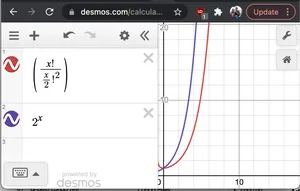
Sem prova formal, se representarmos graficamente 2^N e N!/(N/2)! 2 vemos que 2 N tem uma taxa de crescimento mais rápida do que o último. Portanto O(2 N *N!/(N/2) 2 ) < O(2 N *2 N ) = O(2 2n ) = O(4 N )
 Gráfico de 2^x e nC(n/2)
 - N: devemos imprimir cada string de tamanho 2N
Finalmente, podemos ignorar a complexidade de tempo de generateSequencesWithSum porque permuteSequence é o termo principal
Complexidade de tempo: O(2 N *N!/(N/2)! 2 * N) (melhor que a primeira solução de O((4^N) * N veja a explicação acima para mais detalhes)
Espaço auxiliar : O(2 N ) porque armazenamos todas as permutações de strings binárias de tamanho N
#include using namespace std ; class FirstHalf { public : string data ; int sum ; FirstHalf ( string data int sum ) { this -> data = data ; this -> sum = sum ; } }; // MAP: Key -> sum of bits; Value -> All possible permutation with respective sum map < int vector < string >> mp ; // first N-half bits vector < FirstHalf > firstHalf ; // function to find sum of the bits from a String int sumOfString ( string s ) { int sum = 0 ; // ex: converts '1' to 1 -> (ASCII('1') - ASCII('0') = 1) for ( auto c : s ) { sum += ( c - '0' ); } return sum ; } void perm ( string p char * bin int level int n ) { // p: processed string(processed permutation at current level) // bin: {'0' '1'} // l: current level of recursion tree (leaf/solution level = 0) // n: total levels if ( level == 0 ) { // at solution level find sum of the current permutation int sum = sumOfString ( p ); // store current permutation to firstHalf list firstHalf . push_back ( FirstHalf ( p sum )); // put current permutation to its respective sum value mp [ sum ]. push_back ( p ); return ; } // generate calls for permutation // working: first solution with all 0s // then replacing last 0 with 1 and so on... for ( int i = 0 ; i < n ; i ++ ) { char c = bin [ i ]; perm ( p + c bin level -1 n ); } } void result () { int i = 0 ; for ( auto first : firstHalf ) { // for each firstHalf string // find sum of the bits of current string int sum = first . sum ; // retrieve respective secondHalf from map based on sum key vector < string > secondHalf = mp [ sum ]; for ( auto second : secondHalf ) { // append first and second half and print cout < < first . data + second < < ' ' ; // after every 6 solution line is changed in output // only for formatting below lines could be removed i ++ ; if ( i % 6 == 0 ) cout < < endl ; } } } int main (){ char up [ 2 ] = { '0' '1' }; int n = 2 ; string x = '' ; perm ( x up n n ); result (); return 0 ; } // This code is contributed by Nidhi goel.
Java import java.util.* ; class GFG { static class FirstHalf { String data ; int sum ; FirstHalf ( String data int sum ) { this . data = data ; this . sum = sum ; } } //MAP: Key -> sum of bits; Value -> All possible permutation with respective sum static Map < Integer ArrayList < String >> map = new HashMap <> (); //first N-half bits static List < FirstHalf > firstHalf = new ArrayList <> (); //function to find sum of the bits from a String public static int sumOfString ( String s ) { int sum = 0 ; //ex: converts '1' to 1 -> (ASCII('1') - ASCII('0') = 1) for ( char c : s . toCharArray ()) { sum += c - '0' ; } return sum ; } public static void perm ( String p char [] bin int level int n ) { //p: processed string(processed permutation at current level) //bin: {'0' '1'} //l: current level of recursion tree (leaf/solution level = 0) //n: total levels if ( level == 0 ) { //at solution level find sum of the current permutation int sum = sumOfString ( p ); //store current permutation to firstHalf list firstHalf . add ( new FirstHalf ( p sum )); //put current permutation to its respective sum value map . putIfAbsent ( sum new ArrayList < String > ()); map . get ( sum ). add ( p ); return ; } //generate calls for permutation //working: first solution with all 0s then replacing last 0 with 1 and so on... for ( char c : bin ) { perm ( p + c bin level - 1 n ); } } public static void result () { int i = 0 ; for ( FirstHalf first : firstHalf ) { //for each firstHalf string //find sum of the bits of current string int sum = first . sum ; //retrieve respective secondHalf from map based on sum key ArrayList < String > secondHalf = map . get ( sum ); for ( String second : secondHalf ) { //append first and second half and print System . out . print ( first . data + second + ' ' ); //after every 6 solution line is changed in output //only for formatting below lines could be removed i ++ ; if ( i % 6 == 0 ) System . out . println (); } } } public static void main ( String [] args ) { char [] up = { '0' '1' }; int n = 2 ; perm ( '' up n n ); result (); } } //Code contributed by Animesh Singh
Python3 # Python code implementation class FirstHalf : def __init__ ( self data sum ): self . data = data self . sum = sum # MAP: Key -> sum of bits; Value -> All possible permutation with respective sum map = {} # first N-half bits firstHalf = [] # function to find sum of the bits from a String def sumOfString ( s ): sum = 0 # ex: converts '1' to 1 -> (ASCII('1') - ASCII('0') = 1) for i in range ( len ( s )): sum += ord ( s [ i ]) - ord ( '0' ) return sum def perm ( p bin level n ): # p: processed string(processed permutation at current level) # bin: ['0' '1'] # l: current level of recursion tree (leaf/solution level = 0) # n: total levels if level == 0 : # at solution level find sum of the current permutation sum = sumOfString ( p ) # store current permutation to firstHalf list firstHalf . append ( FirstHalf ( p sum )) # put current permutation to its respective sum value if sum not in map : map [ sum ] = [] map [ sum ] . append ( p ) return # generate calls for permutation # working: first solution with all 0s then replacing last 0 with 1 and so on... for i in range ( len ( bin )): perm ( p + bin [ i ] bin level - 1 n ) def result (): i = 0 for j in range ( len ( firstHalf )): # for each firstHalf string # find sum of the bits of current string sum = firstHalf [ j ] . sum # retrieve respective secondHalf from map based on sum key secondHalf = map [ sum ] for k in range ( len ( secondHalf )): # append first and second half and print print ( firstHalf [ j ] . data + secondHalf [ k ] + ' ' end = '' ) # after every 6 solution line is changed in output # only for formatting below lines could be removed i = i + 1 if ( i % 6 == 0 ): print ( ' n ' ) up = [ '0' '1' ] n = 2 perm ( '' up n n ) result () # The code is contributed by Nidhi goel.
C# using System ; using System.Collections.Generic ; class FirstHalf { public string data ; public int sum ; public FirstHalf ( string data int sum ) { this . data = data ; this . sum = sum ; } } class Gfg { // MAP: Key -> sum of bits; Value -> All possible permutation with respective sum static Dictionary < int List < string >> mp = new Dictionary < int List < string >> (); // first N-half bits static List < FirstHalf > firstHalf = new List < FirstHalf > (); // function to find sum of the bits from a String static int sumOfString ( string s ) { int sum = 0 ; // ex: converts '1' to 1 -> (ASCII('1') - ASCII('0') = 1) foreach ( char c in s ) { sum += ( c - '0' ); } return sum ; } static void perm ( string p char [] bin int level int n ) { // p: processed string(processed permutation at current level) // bin: {'0' '1'} // l: current level of recursion tree (leaf/solution level = 0) // n: total levels if ( level == 0 ) { // at solution level find sum of the current permutation int sum = sumOfString ( p ); // store current permutation to firstHalf list firstHalf . Add ( new FirstHalf ( p sum )); // put current permutation to its respective sum value if ( mp . ContainsKey ( sum )) { mp [ sum ]. Add ( p ); } else { mp . Add ( sum new List < string > { p }); } return ; } // generate calls for permutation // working: first solution with all 0s // then replacing last 0 with 1 and so on... for ( int i = 0 ; i < n ; i ++ ) { char c = bin [ i ]; perm ( p + c bin level - 1 n ); } } static void result () { int i = 0 ; foreach ( FirstHalf first in firstHalf ) { // for each firstHalf string // find sum of the bits of current string int sum = first . sum ; // retrieve respective secondHalf from map based on sum key List < string > secondHalf = mp [ sum ]; foreach ( string second in secondHalf ) { // append first and second half and print Console . Write ( first . data + second + ' ' ); // after every 6 solution line is changed in output // only for formatting below lines could be removed i ++ ; if ( i % 6 == 0 ) Console . WriteLine (); } } } static void Main ( string [] args ) { char [] up = { '0' '1' }; int n = 2 ; string x = '' ; perm ( x up n n ); result (); } }
JavaScript class FirstHalf { constructor ( data sum ) { this . data = data ; this . sum = sum ; } } // MAP: Key -> sum of bits; Value -> All possible permutation with respective sum const map = new Map (); // first N-half bits const firstHalf = []; // function to find sum of the bits from a String function sumOfString ( s ) { let sum = 0 ; //ex: converts '1' to 1 -> (ASCII('1') - ASCII('0') = 1) for ( let i = 0 ; i < s . length ; i ++ ) { sum += s . charCodeAt ( i ) - '0' . charCodeAt ( 0 ); } return sum ; } function perm ( p bin level n ) { // p: processed string(processed permutation at current level) // bin: ['0' '1'] // l: current level of recursion tree (leaf/solution level = 0) // n: total levels if ( level == 0 ) { // at solution level find sum of the current permutation let sum = sumOfString ( p ); // store current permutation to firstHalf list firstHalf . push ( new FirstHalf ( p sum )); // put current permutation to its respective sum value if ( ! map . has ( sum )) map . set ( sum []); map . get ( sum ). push ( p ); return ; } // generate calls for permutation // working: first solution with all 0s then replacing last 0 with 1 and so on... for ( let i = 0 ; i < bin . length ; i ++ ) { perm ( p + bin [ i ] bin level - 1 n ); } } function result () { let i = 0 ; for ( let j = 0 ; j < firstHalf . length ; j ++ ) { // for each firstHalf string // find sum of the bits of current string let sum = firstHalf [ j ]. sum ; // retrieve respective secondHalf from map based on sum key let secondHalf = map . get ( sum ); for ( let k = 0 ; k < secondHalf . length ; k ++ ) { // append first and second half and print process . stdout . write ( firstHalf [ j ]. data + secondHalf [ k ] + ' ' ); // after every 6 solution line is changed in output // only for formatting below lines could be removed i ++ ; if ( i % 6 == 0 ) process . stdout . write ( 'n' ); } } } const up = [ '0' '1' ]; const n = 2 ; perm ( '' up n n ); result ();
Saída
0000 0101 0110 1001 1010 1111
Algoritmo:
1. Gere todas as permutações binárias de tamanho n
2. Calcule a soma dos bits de cada permutação e lembre-se disso para a segunda metade
[por exemplo: para n=2 lembre-se que existem duas strings com soma = 1, ou seja, '01' '10' ]
3. Itere todas as permutações geradas e para cada uma delas anexe a segunda metade de acordo com a soma dos bits
Análise de complexidade de tempo:
somaOfString() = O (N): percorre cada bit e adiciona-o à soma
permanente() = O(2 N *N)
2N * N: geramos todas as permutações de bits binários de tamanho N e encontramos a soma dos bits para cada permutação
resultado() = O((2 N ) * (N!/(N/2)!)2)
2 N : iteramos por todas as permutações possíveis de tamanho N (primeira metade)
NCN/2 = N!/(N/2)! 2 : (tamanho máximo da segunda metade): explicação abaixo:
vamos tomar N = 4 como exemplo.:
//Hash-Map parece
0 -> [0000] ................................(tamanho da lista: 4C0 = 1)
1 -> [0001 0010 0100 1000] ................................(tamanho da lista: 4C1 = 4)
2 -> [0011 0101 0110 1001 1010 1100] ................................(tamanho da lista: 4C2 = 6)
3 -> [0111 1011 1101 1110] ................................(tamanho da lista: 4C3 = 4)
4 -> [1111] ................................(tamanho da lista: 4C4 = 1)
Observamos aqui que cada lista tem um tamanho de N escolha Chave que será máximo em N escolha N/2
Como estamos iterando todos os 2 N permutações e anexação da segunda metade do mapa. O mapa possui a lista de tamanho máximo na posição N/2.
O pior caso ocorre na posição N/2 onde temos que percorrer NCN/2 = N!/(N/2)! 2 permutações.
Complexidade de tempo: O(2 N *N!/(N/2)! 2 )
Espaço auxiliar: O(2 N ) porque armazenamos todas as permutações de strings binárias de tamanho N