 Vamzdžiai
 IO suteikia ryšį tarp dviejų gijų, veikiančių JVM tuo pačiu metu. Taigi vamzdžiai naudojami ir kaip šaltinis, ir kaip paskirties vieta.
- „PipedInputStream“ taip pat perduodama naudojant „PipedOutputStream“. Taigi duomenys gali būti rašomi naudojant PipedOutputStream ir gali būti rašomi naudojant PipedInputStream. Tačiau naudojant abi gijas vienu metu atsiras aklavietė.
- Sakoma, kad vamzdis nutrūksta, jei gija, kuri teikė duomenų baitus prijungtam vamzdžių išvesties srautui, nebėra gyva.
Deklaracija: public class PipedInputStream extends InputStream
Konstruktorius: | PipedInputStream() : | sukuria PipedInputStream, kad jis nėra prijungtas.
| PipedInputStream(int pSize) : | sukuria PipedInputStream, kad jis nėra prijungtas prie nurodyto vamzdžio dydžio.
| PipedInputStream (PipedOutputStream outStream) : | sukuria PipedInputStream, kuris yra prijungtas prie PipedOutputStream – „outStream“.
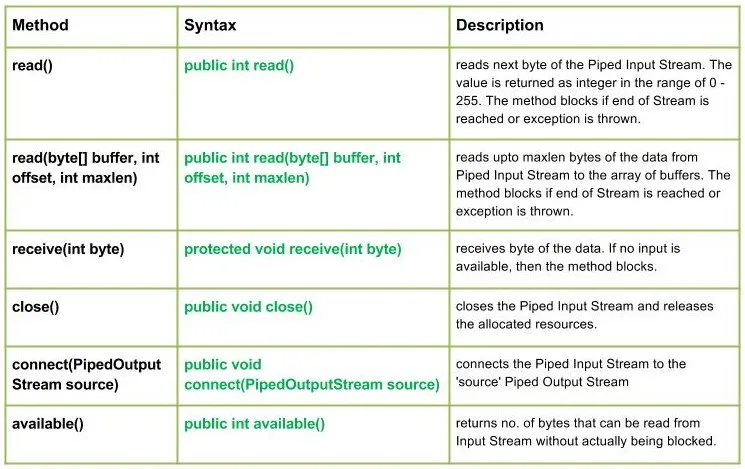
| PipedInputStream(PipedOutputStream outStream int pSize) : | sukuria vamzdžių įvesties srautą, kuris yra prijungtas prie vamzdžių išvesties srauto su nurodytu vamzdžio dydžiu. Metodai: | int read (): | Reads the next byte of data from this piped input stream.The value byte is returned as an int in the range 0 to 255. This method blocks until input data is available the end of the stream is detected or an exception is thrown. Java // Java program illustrating the working of read() method import java.io.* ; public class NewClass { public static void main ( String [] args ) throws IOException { PipedInputStream geek_input = new PipedInputStream (); PipedOutputStream geek_output = new PipedOutputStream (); try { // Use of connect() : connecting geek_input with geek_output geek_input . connect ( geek_output ); // Use of read() method : geek_output . write ( 71 ); System . out . println ( 'using read() : ' + ( char ) geek_input . read ()); geek_output . write ( 69 ); System . out . println ( 'using read() : ' + ( char ) geek_input . read ()); geek_output . write ( 75 ); System . out . println ( 'using read() : ' + ( char ) geek_input . read ()); } catch ( IOException except ) { except . printStackTrace (); } } } Išvestis: using read() : G using read() : E using read() : K
| read(byte[] buferis int offset int maxlen): | java.io.PipedInputStream.read(baitas[] buferis int offset int maxlen) nuskaito iki didžiausių baitų duomenų iš Piped Input Stream į buferių masyvą. Metodas blokuoja, jei pasiekiamas srauto pabaiga arba taikoma išimtis. Sintaksė: public int read(byte[] buffer int offset int maxlen) Parameters : buffer : the destination buffer into which the data is to be read offset : starting in the destination array - 'buffer'. maxlen : maximum length of array to be read Return : next 'maxlen' bytes of the data as an integer value return -1 is end of stream is reached Exception : -> IOException : if in case IO error occurs. -> NullPointerException : if buffer is null. -> IndexOutOfBoundsException : if offset is -ve or maxlen is -ve or maxlen > buffer.length - offset.
| gauti (int byte): | java.io.PipedInputStream.receive(int byte) gauna duomenų baitus. Jei nėra įvesties, metodas blokuojamas. Sintaksė: protected void receive(int byte) Parameters : byte : the bytes of the data received Return : void Exception : -> IOException : if in case IO error occurs or pipe is broken.
| uždaryti () : | java.io.PipedInputStream.close() uždaro vamzdžių įvesties srautą ir išleidžia paskirtus išteklius. Sintaksė: public void close() Parameters : -------------- Return : void Exception : -> IOException : if in case IO error occurs.
| prisijungti (PipedOutputStream šaltinis): | java.io.PipedInputStream.connect (PipedOutputStream šaltinis) sujungia vamzdžių įvesties srautą su "šaltiniu" vamzdžių išvesties srautu ir tuo atveju, jei "šaltinis" yra vamzdžiai su kita srauto IO išimtimi Sintaksė: public void connect(PipedOutputStream source) Parameters : source : the Piped Output Stream to be connected to Return : void Exception : -> IOException : if in case IO error occurs.
| prieinama () : | java.io.PipedInputStream.available() grąžina Nr. baitų, kuriuos galima nuskaityti iš įvesties srauto iš tikrųjų neužblokavus. Sintaksė: public int available() Parameters : ------------- Return : no. of bytes that can be read from Input Stream without actually being blocked. 0 if the stream is already closed but by invoking close() method Exception : -> IOException : if in case IO error occurs.
Java programa, paaiškinanti PipedInputStream klasės metodų veikimą: Java // Java program illustrating the working of PipedInputStream // connect() read(byte[] buffer int offset int maxlen) // close() available() import java.io.* ; public class NewClass { public static void main ( String [] args ) throws IOException { PipedInputStream geek_input = new PipedInputStream (); PipedOutputStream geek_output = new PipedOutputStream (); try { // Use of connect() : connecting geek_input with geek_output geek_input . connect ( geek_output ); geek_output . write ( 71 ); geek_output . write ( 69 ); geek_output . write ( 69 ); geek_output . write ( 75 ); geek_output . write ( 83 ); // Use of available() : System . out . println ( 'Use of available() : ' + geek_input . available ()); // Use of read(byte[] buffer int offset int maxlen) : byte [] buffer = new byte [ 5 ] ; // destination 'buffer' geek_input . read ( buffer 0 5 ); String str = new String ( buffer ); System . out . println ( 'Using read(buffer offset maxlen) : ' + str ); // USe of close() method : System . out . println ( 'Closing the stream' ); geek_input . close (); } catch ( IOException except ) { except . printStackTrace (); } } } Išvestis: Use of available() : 5 Using read(buffer offset maxlen) : GEEKS Closing the stream
Next Article: Java.io.PipedOutputStream klasė Java Sukurti viktoriną
Top Straipsniai
Kategorija


 Vamzdžiai IO suteikia ryšį tarp dviejų gijų, veikiančių JVM tuo pačiu metu. Taigi vamzdžiai naudojami ir kaip šaltinis, ir kaip paskirties vieta.