Euklido algoritmai (pagrindinis ir išplėstinis)
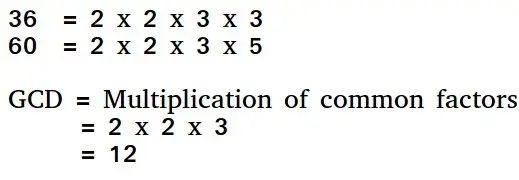
Euklido algoritmas yra būdas rasti didžiausią bendrą dviejų teigiamų sveikųjų skaičių daliklį. Dviejų skaičių GCD yra didžiausias skaičius, dalijantis juos abu. Paprastas būdas rasti GCD – padalyti skaičius ir padauginti bendruosius pirminius veiksnius.
Pagrindinis Euklido algoritmas GCD:
Algoritmas pagrįstas toliau pateiktais faktais.
- Jei iš didesnio atimame mažesnį skaičių (didesnį skaičių sumažiname), GCD nesikeičia. Taigi, jei nuolat atimame didesnį iš dviejų, gauname GCD.
- Dabar vietoj atimties, jei padaliname mažesnį skaičių, algoritmas sustoja, kai randame likutį 0.
Žemiau yra rekursinė funkcija, skirta įvertinti gcd naudojant Euklido algoritmą:
C
// C program to demonstrate Basic Euclidean Algorithm> #include> // Function to return gcd of a and b> int> gcd(> int> a,> int> b)> {> > if> (a == 0)> > return> b;> > return> gcd(b % a, a);> }> // Driver code> int> main()> {> > int> a = 10, b = 15;> > > // Function call> > printf> (> 'GCD(%d, %d) = %d
'> , a, b, gcd(a, b));> > a = 35, b = 10;> > printf> (> 'GCD(%d, %d) = %d
'> , a, b, gcd(a, b));> > a = 31, b = 2;> > printf> (> 'GCD(%d, %d) = %d
'> , a, b, gcd(a, b));> > return> 0;> }> |
CPP
// C++ program to demonstrate> // Basic Euclidean Algorithm> #include> using> namespace> std;> // Function to return> // gcd of a and b> int> gcd(> int> a,> int> b)> {> > if> (a == 0)> > return> b;> > return> gcd(b % a, a);> }> // Driver Code> int> main()> {> > int> a = 10, b = 15;> > > // Function call> > cout < <> 'GCD('> < < a < <> ', '> < < b < <> ') = '> < < gcd(a, b)> > < < endl;> > a = 35, b = 10;> > cout < <> 'GCD('> < < a < <> ', '> < < b < <> ') = '> < < gcd(a, b)> > < < endl;> > a = 31, b = 2;> > cout < <> 'GCD('> < < a < <> ', '> < < b < <> ') = '> < < gcd(a, b)> > < < endl;> > return> 0;> }> |
Java
// Java program to demonstrate Basic Euclidean Algorithm> import> java.lang.*;> import> java.util.*;> class> GFG {> > // extended Euclidean Algorithm> > public> static> int> gcd(> int> a,> int> b)> > {> > if> (a ==> 0> )> > return> b;> > return> gcd(b % a, a);> > }> > // Driver code> > public> static> void> main(String[] args)> > {> > int> a => 10> , b => 15> , g;> > > // Function call> > g = gcd(a, b);> > System.out.println(> 'GCD('> + a +> ' , '> + b> > +> ') = '> + g);> > a => 35> ;> > b => 10> ;> > g = gcd(a, b);> > System.out.println(> 'GCD('> + a +> ' , '> + b> > +> ') = '> + g);> > a => 31> ;> > b => 2> ;> > g = gcd(a, b);> > System.out.println(> 'GCD('> + a +> ' , '> + b> > +> ') = '> + g);> > }> }> // Code Contributed by Mohit Gupta_OMG> |
Python3
# Python3 program to demonstrate Basic Euclidean Algorithm> # Function to return gcd of a and b> def> gcd(a, b):> > if> a> => => 0> :> > return> b> > return> gcd(b> %> a, a)> # Driver code> if> __name__> => => '__main__'> :> > a> => 10> > b> => 15> > print> (> 'gcd('> , a,> ','> , b,> ') = '> , gcd(a, b))> > a> => 35> > b> => 10> > print> (> 'gcd('> , a,> ','> , b,> ') = '> , gcd(a, b))> > a> => 31> > b> => 2> > print> (> 'gcd('> , a,> ','> , b,> ') = '> , gcd(a, b))> # Code Contributed By Mohit Gupta_OMG> |
C#
// C# program to demonstrate Basic Euclidean Algorithm> using> System;> class> GFG {> > public> static> int> gcd(> int> a,> int> b)> > {> > if> (a == 0)> > return> b;> > return> gcd(b % a, a);> > }> > // Driver Code> > static> public> void> Main()> > {> > int> a = 10, b = 15, g;> > g = gcd(a, b);> > Console.WriteLine(> 'GCD('> + a +> ' , '> + b> > +> ') = '> + g);> > a = 35;> > b = 10;> > g = gcd(a, b);> > Console.WriteLine(> 'GCD('> + a +> ' , '> + b> > +> ') = '> + g);> > a = 31;> > b = 2;> > g = gcd(a, b);> > Console.WriteLine(> 'GCD('> + a +> ' , '> + b> > +> ') = '> + g);> > }> }> // This code is contributed by ajit> |
PHP
// php program to demonstrate Basic Euclidean Algorithm> // PHP program to demonstrate // Basic Euclidean Algorithm // Function to return // gcd of a and b function gcd($a, $b) { if ($a == 0) return $b; return gcd($b % $a, $a); } // Driver Code $a = 10; $b = 15; // Function call echo 'GCD(',$a,',' , $b,') = ', gcd($a, $b); echo '
'; $a = 35; $b = 10; echo 'GCD(',$a ,',',$b,') = ', gcd($a, $b); echo '
'; $a = 31; $b = 2; echo 'GCD(',$a ,',', $b,') = ', gcd($a, $b); // This code is contributed by m_kit ?>>> |
>
// JavaScript program to demonstrate>// Basic Euclidean Algorithm>// Function to return>// gcd of a and b>function>gcd( a, b)>{>>if>(a == 0)>>return>b;>>return>gcd(b % a, a);>}>// Driver Code>>let a = 10, b = 15;>>document.write(>'GCD('>+ a +>', '>>+ b +>') = '>+ gcd(a, b) +>' '>);>>>a = 35, b = 10;>>document.write(>'GCD('>+ a +>', '>>+ b +>') = '>+ gcd(a, b) +>' '>);>>>a = 31, b = 2;>>document.write(>'GCD('>+ a +>', '>>+ b +>') = '>+ gcd(a, b) +>' '>);>// This code contributed by aashish1995>
Išvestis
GCD(10, 15) = 5 GCD(35, 10) = 5 GCD(31, 2) = 1Laiko sudėtingumas: O (min. žurnalo (a, b))
Pagalbinė erdvė: O(Žurnalas (min(a,b))Išplėstinis euklido algoritmas:
Išplėstinis Euklido algoritmas taip pat randa sveikųjų skaičių koeficientus x ir y, kad: ax + by = gcd(a, b)
Pavyzdžiai:
Įvestis: a = 30, b = 20
Išvestis: gcd = 10, x = 1, y = -1
(Atkreipkite dėmesį, kad 30*1 + 20*(-1) = 10)Įvestis: a = 35, b = 15
Išvestis: gcd = 5, x = 1, y = -2
(Atkreipkite dėmesį, kad 35*1 + 15*(-2) = 5)Išplėstinis Euklido algoritmas atnaujina gcd(a, b) rezultatus, naudodamas rezultatus, apskaičiuotus rekursiniu skambučiu gcd(b%a, a). Tegul x ir y reikšmės, apskaičiuotos rekursiniu skambučiu, yra x 1 ir y 1 . x ir y atnaujinami naudojant toliau pateiktas išraiškas.
Rekomenduojamos praktikos išplėstinis euklido algoritmas Išbandykite!ax + by = gcd(a, b)
gcd(a, b) = gcd(b%a, a)
gcd(b%a, a) = (b%a)x 1 + yra 1
ax + by = (b%a)x 1 + yra 1
ax + by = (b – [b/a] * a)x 1 + yra 1
ax + by = a(y 1 – [b/a] * x 1 ) + bx 1Lyginant LHS ir RHS,
x = y 1 – ?b/a? *x 1
y = x 1Žemiau pateikiamas pirmiau minėto metodo įgyvendinimas:
C++
// C++ program to demonstrate working of>// extended Euclidean Algorithm>#include>using>namespace>std;>// Function for extended Euclidean Algorithm>int>gcdExtended(>int>a,>int>b,>int>*x,>int>*y)>{>>// Base Case>>if>(a == 0)>>{>>*x = 0;>>*y = 1;>>return>b;>>}>>int>x1, y1;>// To store results of recursive call>>int>gcd = gcdExtended(b%a, a, &x1, &y1);>>// Update x and y using results of>>// recursive call>>*x = y1 - (b/a) * x1;>>*y = x1;>>return>gcd;>}>// Driver Code>int>main()>{>>int>x, y, a = 35, b = 15;>>int>g = gcdExtended(a, b, &x, &y);>>cout < <>'GCD('>< < a < <>', '>< < b>>< <>') = '>< < g < < endl;>>return>0;>}>
C
// C program to demonstrate working of extended>// Euclidean Algorithm>#include>// C function for extended Euclidean Algorithm>int>gcdExtended(>int>a,>int>b,>int>*x,>int>*y)>{>>// Base Case>>if>(a == 0)>>{>>*x = 0;>>*y = 1;>>return>b;>>}>>int>x1, y1;>// To store results of recursive call>>int>gcd = gcdExtended(b%a, a, &x1, &y1);>>// Update x and y using results of recursive>>// call>>*x = y1 - (b/a) * x1;>>*y = x1;>>return>gcd;>}>// Driver Program>int>main()>{>>int>x, y;>>int>a = 35, b = 15;>>int>g = gcdExtended(a, b, &x, &y);>>printf>(>'gcd(%d, %d) = %d'>, a, b, g);>>return>0;>}>
Java
// Java program to demonstrate working of extended>// Euclidean Algorithm>import>java.lang.*;>import>java.util.*;>class>GFG {>>// extended Euclidean Algorithm>>public>static>int>gcdExtended(>int>a,>int>b,>int>x,>>int>y)>>{>>// Base Case>>if>(a ==>0>) {>>x =>0>;>>y =>1>;>>return>b;>>}>>int>x1 =>1>,>>y1 =>1>;>// To store results of recursive call>>int>gcd = gcdExtended(b % a, a, x1, y1);>>// Update x and y using results of recursive>>// call>>x = y1 - (b / a) * x1;>>y = x1;>>return>gcd;>>}>>// Driver Program>>public>static>void>main(String[] args)>>{>>int>x =>1>, y =>1>;>>int>a =>35>, b =>15>;>>int>g = gcdExtended(a, b, x, y);>>System.out.print(>'gcd('>+ a +>' , '>+ b>>+>') = '>+ g);>>}>}>
Python3
# Python program to demonstrate working of extended># Euclidean Algorithm># function for extended Euclidean Algorithm>def>gcdExtended(a, b):>># Base Case>>if>a>=>=>0>:>>return>b,>0>,>1>>gcd, x1, y1>=>gcdExtended(b>%>a, a)>># Update x and y using results of recursive>># call>>x>=>y1>->(b>/>/>a)>*>x1>>y>=>x1>>return>gcd, x, y># Driver code>a, b>=>35>,>15>g, x, y>=>gcdExtended(a, b)>print>(>'gcd('>, a,>','>, b,>') = '>, g)>
C#
// C# program to demonstrate working>// of extended Euclidean Algorithm>using>System;>class>GFG>{>>>// extended Euclidean Algorithm>>public>static>int>gcdExtended(>int>a,>int>b,>>int>x,>int>y)>>{>>// Base Case>>if>(a == 0)>>{>>x = 0;>>y = 1;>>return>b;>>}>>// To store results of>>// recursive call>>int>x1 = 1, y1 = 1;>>int>gcd = gcdExtended(b % a, a, x1, y1);>>// Update x and y using>>// results of recursive call>>x = y1 - (b / a) * x1;>>y = x1;>>return>gcd;>>}>>>// Driver Code>>static>public>void>Main ()>>{>>int>x = 1, y = 1;>>int>a = 35, b = 15;>>int>g = gcdExtended(a, b, x, y);>>Console.WriteLine(>'gcd('>+ a +>' , '>+>>b +>') = '>+ g);>>}>}>
PHP
// PHP program to demonstrate // working of extended // Euclidean Algorithm // PHP function for // extended Euclidean // Algorithm function gcdExtended($a, $b, $x, $y) { // Base Case if ($a == 0) { $x = 0; $y = 1; return $b; } // To store results // of recursive call $gcd = gcdExtended($b % $a, $a, $x, $y); // Update x and y using // results of recursive // call $x = $y - floor($b / $a) * $x; $y = $x; return $gcd; } // Driver Code $x = 0; $y = 0; $a = 35; $b = 15; $g = gcdExtended($a, $b, $x, $y); echo 'gcd(',$a; echo ', ' , $b, ')'; echo ' = ' , $g; ?>>>
>
>// Javascript program to demonstrate>// working of extended>// Euclidean Algorithm>// Javascript function for>// extended Euclidean>// Algorithm>function>gcdExtended(a, b,>>x, y)>{>>// Base Case>>if>(a == 0)>>{>>x = 0;>>y = 1;>>return>b;>>}>>// To store results>>// of recursive call>>let gcd = gcdExtended(b % a,>>a, x, y);>>// Update x and y using>>// results of recursive>>// call>>x = y - (b / a) * x;>>y = x;>>return>gcd;>}>// Driver Code>let x = 0;>let y = 0;>let a = 35;>let b = 15;>let g = gcdExtended(a, b, x, y);>document.write(>'gcd('>+ a);>document.write(>', '>+ b +>')'>);>document.write(>' = '>+ g);>>
Išvestis:
gcd(35, 15) = 5Laiko sudėtingumas: O(log N)
Pagalbinė erdvė: O(log N)Kaip veikia išplėstinis algoritmas?
Kaip matyti aukščiau, x ir y yra įvesties a ir b rezultatai,
a.x + b.y = gcd —-(1)
Ir x 1 ir y 1 yra įvesties b%a ir a rezultatai
(b%a).x 1 + a.y 1 = gcd
Kai aukščiau įdedame b%a = (b – (?b/a?).a),
mes sekame. Atkreipkite dėmesį, kad ?b/a? yra aukštas (b/a)(b – (?b/a?).a).x 1 + a.y 1 = gcd
Aukščiau pateiktą lygtį taip pat galima parašyti taip, kaip nurodyta toliau
b.x 1 + a.(ir 1 – (?b/a?).x 1 ) = gcd — (2)
Palyginę „a“ ir „b“ koeficientus (1) ir
(2), gauname taip,
x = y 1 – ?b/a? *x 1
y = x 1Kuo naudingas išplėstinis algoritmas?
Išplėstinis Euklido algoritmas yra ypač naudingas, kai a ir b yra pirminiai (arba gcd yra 1). Kadangi x yra modulinis dauginamasis atvirkštinis modulis b, o y yra modulinis dauginamasis atvirkštinis modulis modulis a. Visų pirma, modulinio multiplikacinio atvirkštinio skaičiavimas yra esminis RSA viešojo rakto šifravimo metodo žingsnis.