Java.io.PipedOutputStream Class ב-Java
מחלקה Java.io.PipedInputStream ב-Java
צינורות ב-IO מספקים קישור בין שני שרשורים הפועלים ב-JVM בו-זמנית. אז צינורות משמשים הן כמקור או כיעד.
- PipedInputStream מועבר גם עם PipedOutputStream. כך שניתן לכתוב נתונים באמצעות PipedOutputStream וניתן לכתוב אותם באמצעות PipedInputStream. אבל שימוש בשני השרשורים בו זמנית ייצור מבוי סתום עבור השרשורים.
- PipedOutputStream שולח את קצה הצינור. הנתונים נכתבים ל- PipedOutputStream. אומרים שהצינור נשבר אם ה-PipedInputStream שקרא את הנתונים אינו עוד.
הַצהָרָה:
 public class PipedOutputStream
  extends OutputStream
     בַּנַאִי:
- PipedOutputStream() : יוצר PipedOutputStream שהוא לא מחובר.
- PipedOutputStream(PipedOutputStream inStream): יוצר PipedOutputStream שזה
מחובר ל-PipedInputStream - 'inStream'.
שיטות:
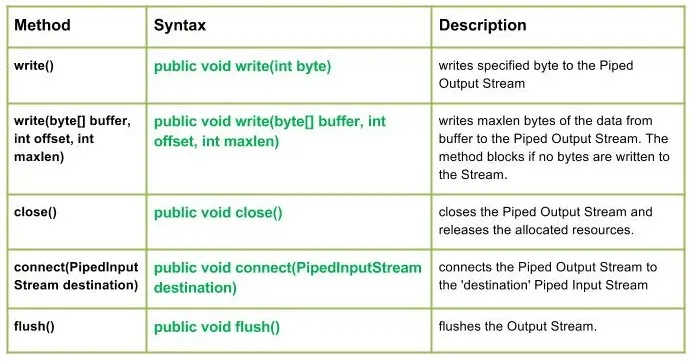
write() : java.io.PipedOutputStream.write(int byte) כותב בייט שצוין לזרם הפלט Piped.
תחביר:
public void write(int byte)
Parameters :
byte : byte to be written
Return : void
Exception :
-> IOException : if in case IO error occurs.write(byte[] buffer int offset int maxlen) : java.io.PipedOutputStream.write(byte[] buffer int offset int maxlen) כותב maxlen bytes של הנתונים מהמאגר ל-Piped Output Stream. השיטה חוסמת אם לא נכתבים בתים לזרם.
תחביר:
public void write(byte[] buffer int offset int maxlen)
Parameters :
buffer : data of the buffer
offset : starting in the destination array - 'buffer'.
maxlen : maximum length of array to be read
Return : void
Exception :
-> IOException : if in case IO error occurs. Javaתְפוּקָה:
Use of write(buffer offset maxlen) : J A V A
- close() : java.io.PipedOutputStream.close() סוגר את זרם הפלט Piped ומשחרר את המשאבים שהוקצו.
תחביר:
 public void close()
    Parameters :
 --------------
    Return :
 void
    Exception :
 ->      IOException :     if in case IO error occurs.
- connect(PipedInputStream יעד) : java.io.PipedOutputStream.connect(יעד PipedInputStream מחבר את ה-Piped Output Stream ל-'destination' Piped Input Stream ובמקרה ש'יעד' הוא צינורות עם חריג אחר של זרם IO נזרק
תחביר:
 public void connect(PipedInputStream destination)
    Parameters :
 destination : the Piped Input Stream to be connected to
    Return :
 void
    Exception :
 ->      IOException :     if in case IO error occurs.
- flush() : java.io.PipedOutputStream.flush() שוטף את זרם הפלט.
תחביר:
public void flush()
Parameters :
------------
Return :
void
Exception :
-> IOException : if in case IO error occurs.
קוד Java הממחיש את פעולתן של שיטות מחלקה PipedOutputStream:
Javaתְפוּקָה:
Use of flush() method :
G E E K S
Closing the Output stream
צור חידון