 צינורות
 ב-IO מספק קישור בין שני שרשורים הפועלים ב-JVM בו-זמנית. אז צינורות משמשים הן כמקור או כיעד.
- PipedInputStream מועבר גם עם PipedOutputStream. כך שניתן לכתוב נתונים באמצעות PipedOutputStream וניתן לכתוב אותם באמצעות PipedInputStream. אבל שימוש בשני השרשורים בו זמנית ייצור מבוי סתום עבור השרשורים.
- אומרים שצינור נשבר אם חוט שסיפק בתים של נתונים לזרם הפלט המחובר אינו חי עוד.
הַצהָרָה: public class PipedInputStream extends InputStream
קונסטרוקטור: | PipedInputStream() : | יוצר PipedInputStream שהוא לא מחובר.
| PipedInputStream(int pSize): | יוצר PipedInputStream שאינו מחובר לגודל הצינור שצוין.
| PipedInputStream(PipedOutputStream OutStream): | יוצר PipedInputStream שהוא מחובר ל- PipedOutputStream - 'outStream'.
| PipedInputStream(PipedOutputStream outStream int pSize): | יוצר זרם קלט צינור המחובר לזרם פלט צינור עם גודל הצינור שצוין. שיטות: | int read(): | Reads the next byte of data from this piped input stream.The value byte is returned as an int in the range 0 to 255. This method blocks until input data is available the end of the stream is detected or an exception is thrown. Java // Java program illustrating the working of read() method import java.io.* ; public class NewClass { public static void main ( String [] args ) throws IOException { PipedInputStream geek_input = new PipedInputStream (); PipedOutputStream geek_output = new PipedOutputStream (); try { // Use of connect() : connecting geek_input with geek_output geek_input . connect ( geek_output ); // Use of read() method : geek_output . write ( 71 ); System . out . println ( 'using read() : ' + ( char ) geek_input . read ()); geek_output . write ( 69 ); System . out . println ( 'using read() : ' + ( char ) geek_input . read ()); geek_output . write ( 75 ); System . out . println ( 'using read() : ' + ( char ) geek_input . read ()); } catch ( IOException except ) { except . printStackTrace (); } } } פלט: using read() : G using read() : E using read() : K
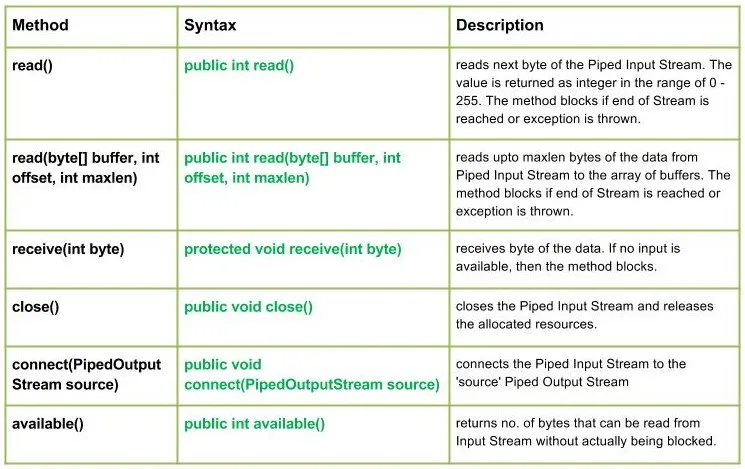
| read(byte[] buffer int offset int maxlen): | java.io.PipedInputStream.read(byte[] buffer int offset int maxlen) קורא עד מקסימום בתים של הנתונים מ-Piped Input Stream למערך המאגרים. השיטה חוסמת אם מגיעים לסוף הזרם או נזרק חריג. תחביר: public int read(byte[] buffer int offset int maxlen) Parameters : buffer : the destination buffer into which the data is to be read offset : starting in the destination array - 'buffer'. maxlen : maximum length of array to be read Return : next 'maxlen' bytes of the data as an integer value return -1 is end of stream is reached Exception : -> IOException : if in case IO error occurs. -> NullPointerException : if buffer is null. -> IndexOutOfBoundsException : if offset is -ve or maxlen is -ve or maxlen > buffer.length - offset.
| receive(int byte) : | java.io.PipedInputStream.receive(int byte) מקבל בייט של הנתונים. אם אין קלט זמין, השיטה חוסמת. תחביר: protected void receive(int byte) Parameters : byte : the bytes of the data received Return : void Exception : -> IOException : if in case IO error occurs or pipe is broken.
| close() : | java.io.PipedInputStream.close() סוגר את זרם הקלט בצינור ומשחרר את המשאבים שהוקצו. תחביר: public void close() Parameters : -------------- Return : void Exception : -> IOException : if in case IO error occurs.
| connect(מקור PipedOutputStream): | java.io.PipedInputStream.connect(מקור PipedOutputStream) מחבר את זרם הקלט בצינור לזרם פלט צינור 'מקור' ובמקרה ש'מקור' הוא צינורות עם חריג אחר של זרם IO נזרק תחביר: public void connect(PipedOutputStream source) Parameters : source : the Piped Output Stream to be connected to Return : void Exception : -> IOException : if in case IO error occurs.
| זמין() : | java.io.PipedInputStream.available() מחזיר לא. של בתים שניתן לקרוא מ-Input Stream מבלי להיחסם בפועל. תחביר: public int available() Parameters : ------------- Return : no. of bytes that can be read from Input Stream without actually being blocked. 0 if the stream is already closed but by invoking close() method Exception : -> IOException : if in case IO error occurs.
תוכנית Java המסבירה את פעולתן של שיטות מחלקה PipedInputStream: Java // Java program illustrating the working of PipedInputStream // connect() read(byte[] buffer int offset int maxlen) // close() available() import java.io.* ; public class NewClass { public static void main ( String [] args ) throws IOException { PipedInputStream geek_input = new PipedInputStream (); PipedOutputStream geek_output = new PipedOutputStream (); try { // Use of connect() : connecting geek_input with geek_output geek_input . connect ( geek_output ); geek_output . write ( 71 ); geek_output . write ( 69 ); geek_output . write ( 69 ); geek_output . write ( 75 ); geek_output . write ( 83 ); // Use of available() : System . out . println ( 'Use of available() : ' + geek_input . available ()); // Use of read(byte[] buffer int offset int maxlen) : byte [] buffer = new byte [ 5 ] ; // destination 'buffer' geek_input . read ( buffer 0 5 ); String str = new String ( buffer ); System . out . println ( 'Using read(buffer offset maxlen) : ' + str ); // USe of close() method : System . out . println ( 'Closing the stream' ); geek_input . close (); } catch ( IOException except ) { except . printStackTrace (); } } } תְפוּקָה: Use of available() : 5 Using read(buffer offset maxlen) : GEEKS Closing the stream
Next Article: מחלקה Java.io.PipedOutputStream ב-Java צור חידון


 צינורות ב-IO מספק קישור בין שני שרשורים הפועלים ב-JVM בו-זמנית. אז צינורות משמשים הן כמקור או כיעד.