ניתוח אסימפטוטי והשוואה של אלגוריתמי מיון
עובדה מבוססת היא שמיון מיזוג פועל מהר יותר ממיון הכנסה. באמצעות ניתוח אסימפטוטי . אנו יכולים להוכיח שמיון מיזוג פועל בזמן O(nlogn) ומיון ההכנסה לוקח O(n^2). זה ברור כי מיון מיזוג משתמש בגישת חלוקה-וכבש על-ידי פתרון רקורסיבי של הבעיות, כאשר מיון ההוספה עוקב אחר גישה מצטברת. אם נבדוק עוד יותר את ניתוח מורכבות הזמן, נכיר שמיון ההחדרה אינו כל כך גרוע. באופן מפתיע פעימות מיון הכנסה מתמזגות מיון בגודל קלט קטן יותר. הסיבה לכך היא שיש מעט קבועים שאנו מתעלמים מהם תוך הפקת מורכבות הזמן. בגדלים גדולים יותר של קלט בסדר גודל 10^4 זה לא משפיע על התנהגות הפונקציה שלנו. אבל כאשר גדלי הקלט יורדים מתחת נגיד פחות מ-40 אז הקבועים במשוואה שולטים בגודל הקלט 'n'. עד כאן הכל טוב. אבל לא הייתי מרוצה מניתוח מתמטי כזה. כתואר ראשון במדעי המחשב עלינו להאמין בכתיבת קוד. כתבתי תוכנית C כדי לקבל תחושה כיצד האלגוריתמים מתחרים זה בזה על גדלי קלט שונים. וגם מדוע נעשה ניתוח מתמטי קפדני כל כך על ביסוס מורכבות זמן הריצה של אלגוריתמי המיון הללו.
יישום:
CPP #include #include #include #include #define MAX_ELEMENT_IN_ARRAY 1000000001 int cmpfunc ( const void * a const void * b ) { // Compare function used by qsort return ( * ( int * ) a - * ( int * ) b ); } int * generate_random_array ( int n ) { srand ( time ( NULL )); int * a = malloc ( sizeof ( int ) * n ); int i ; for ( i = 0 ; i < n ; ++ i ) a [ i ] = rand () % MAX_ELEMENT_IN_ARRAY ; return a ; } int * copy_array ( int a [] int n ) { int * arr = malloc ( sizeof ( int ) * n ); int i ; for ( i = 0 ; i < n ; ++ i ) arr [ i ] = a [ i ]; return arr ; } // Code for Insertion Sort void insertion_sort_asc ( int a [] int start int end ) { int i ; for ( i = start + 1 ; i <= end ; ++ i ) { int key = a [ i ]; int j = i - 1 ; while ( j >= start && a [ j ] > key ) { a [ j + 1 ] = a [ j ]; -- j ; } a [ j + 1 ] = key ; } } // Code for Merge Sort void merge ( int a [] int start int end int mid ) { int i = start j = mid + 1 k = 0 ; int * aux = malloc ( sizeof ( int ) * ( end - start + 1 )); while ( i <= mid && j <= end ) { if ( a [ i ] <= a [ j ]) aux [ k ++ ] = a [ i ++ ]; else aux [ k ++ ] = a [ j ++ ]; } while ( i <= mid ) aux [ k ++ ] = a [ i ++ ]; while ( j <= end ) aux [ k ++ ] = a [ j ++ ]; j = 0 ; for ( i = start ; i <= end ; ++ i ) a [ i ] = aux [ j ++ ]; free ( aux ); } void _merge_sort ( int a [] int start int end ) { if ( start < end ) { int mid = start + ( end - start ) / 2 ; _merge_sort ( a start mid ); _merge_sort ( a mid + 1 end ); merge ( a start end mid ); } } void merge_sort ( int a [] int n ) { return _merge_sort ( a 0 n - 1 ); } void insertion_and_merge_sort_combine ( int a [] int start int end int k ) { // Performs insertion sort if size of array is less than or equal to k // Otherwise uses mergesort if ( start < end ) { int size = end - start + 1 ; if ( size <= k ) { return insertion_sort_asc ( a start end ); } int mid = start + ( end - start ) / 2 ; insertion_and_merge_sort_combine ( a start mid k ); insertion_and_merge_sort_combine ( a mid + 1 end k ); merge ( a start end mid ); } } void test_sorting_runtimes ( int size int num_of_times ) { // Measuring the runtime of the sorting algorithms int number_of_times = num_of_times ; int t = number_of_times ; int n = size ; double insertion_sort_time = 0 merge_sort_time = 0 ; double merge_sort_and_insertion_sort_mix_time = 0 qsort_time = 0 ; while ( t -- ) { clock_t start end ; int * a = generate_random_array ( n ); int * b = copy_array ( a n ); start = clock (); insertion_sort_asc ( b 0 n - 1 ); end = clock (); insertion_sort_time += (( double )( end - start )) / CLOCKS_PER_SEC ; free ( b ); int * c = copy_array ( a n ); start = clock (); merge_sort ( c n ); end = clock (); merge_sort_time += (( double )( end - start )) / CLOCKS_PER_SEC ; free ( c ); int * d = copy_array ( a n ); start = clock (); insertion_and_merge_sort_combine ( d 0 n - 1 40 ); end = clock (); merge_sort_and_insertion_sort_mix_time += (( double )( end - start )) / CLOCKS_PER_SEC ; free ( d ); start = clock (); qsort ( a n sizeof ( int ) cmpfunc ); end = clock (); qsort_time += (( double )( end - start )) / CLOCKS_PER_SEC ; free ( a ); } insertion_sort_time /= number_of_times ; merge_sort_time /= number_of_times ; merge_sort_and_insertion_sort_mix_time /= number_of_times ; qsort_time /= number_of_times ; printf ( ' n Time taken to sort: n ' '%-35s %f n ' '%-35s %f n ' '%-35s %f n ' '%-35s %f nn ' '(i)Insertion sort: ' insertion_sort_time '(ii)Merge sort: ' merge_sort_time '(iii)Insertion-mergesort-hybrid: ' merge_sort_and_insertion_sort_mix_time '(iv)Qsort library function: ' qsort_time ); } int main ( int argc char const * argv []) { int t ; scanf ( '%d' & t ); while ( t -- ) { int size num_of_times ; scanf ( '%d %d' & size & num_of_times ); test_sorting_runtimes ( size num_of_times ); } return 0 ; }
Java import java.util.Scanner ; import java.util.Arrays ; import java.util.Random ; public class SortingAlgorithms { // Maximum element in array static final int MAX_ELEMENT_IN_ARRAY = 1000000001 ; public static void main ( String [] args ) { Scanner scanner = new Scanner ( System . in ); int t = scanner . nextInt (); for ( int i = 0 ; i < t ; i ++ ) { int size = scanner . nextInt (); int num_of_times = scanner . nextInt (); testSortingRuntimes ( size num_of_times ); } scanner . close (); } static int [] generateRandomArray ( int n ) { // Generate an array of n random integers. int [] arr = new int [ n ] ; Random random = new Random (); for ( int i = 0 ; i < n ; i ++ ) { arr [ i ] = random . nextInt ( MAX_ELEMENT_IN_ARRAY ); } return arr ; } static void insertionSortAsc ( int [] a int start int end ) { // Perform an in-place insertion sort on a from start to end. for ( int i = start + 1 ; i <= end ; i ++ ) { int key = a [ i ] ; int j = i - 1 ; while ( j >= start && a [ j ] > key ) { a [ j + 1 ] = a [ j ] ; j -- ; } a [ j + 1 ] = key ; } } static void merge ( int [] a int start int end int mid ) { // Merge two sorted sublists of a. // The first sublist is a[start:mid+1] and the second sublist is a[mid+1:end+1]. int [] aux = new int [ end - start + 1 ] ; int i = start j = mid + 1 k = 0 ; while ( i <= mid && j <= end ) { if ( a [ i ] <= a [ j ] ) { aux [ k ++] = a [ i ++] ; } else { aux [ k ++] = a [ j ++] ; } } while ( i <= mid ) { aux [ k ++] = a [ i ++] ; } while ( j <= end ) { aux [ k ++] = a [ j ++] ; } System . arraycopy ( aux 0 a start aux . length ); } static void mergeSort ( int [] a ) { // Perform an in-place merge sort on a. mergeSortHelper ( a 0 a . length - 1 ); } static void mergeSortHelper ( int [] a int start int end ) { // Recursive merge sort function. if ( start < end ) { int mid = start + ( end - start ) / 2 ; mergeSortHelper ( a start mid ); mergeSortHelper ( a mid + 1 end ); merge ( a start end mid ); } } static void insertionAndMergeSortCombine ( int [] a int start int end int k ) { /* Perform an in-place sort on a from start to end. If the size of the list is less than or equal to k use insertion sort. Otherwise use merge sort. */ if ( start < end ) { int size = end - start + 1 ; if ( size <= k ) { insertionSortAsc ( a start end ); } else { int mid = start + ( end - start ) / 2 ; insertionAndMergeSortCombine ( a start mid k ); insertionAndMergeSortCombine ( a mid + 1 end k ); merge ( a start end mid ); } } } static void testSortingRuntimes ( int size int num_of_times ) { // Test the runtime of the sorting algorithms. double insertionSortTime = 0 ; double mergeSortTime = 0 ; double mergeSortAndInsertionSortMixTime = 0 ; double qsortTime = 0 ; for ( int i = 0 ; i < num_of_times ; i ++ ) { int [] a = generateRandomArray ( size ); int [] b = Arrays . copyOf ( a a . length ); long start = System . currentTimeMillis (); insertionSortAsc ( b 0 b . length - 1 ); long end = System . currentTimeMillis (); insertionSortTime += end - start ; int [] c = Arrays . copyOf ( a a . length ); start = System . currentTimeMillis (); mergeSort ( c ); end = System . currentTimeMillis (); mergeSortTime += end - start ; int [] d = Arrays . copyOf ( a a . length ); start = System . currentTimeMillis (); insertionAndMergeSortCombine ( d 0 d . length - 1 40 ); end = System . currentTimeMillis (); mergeSortAndInsertionSortMixTime += end - start ; int [] e = Arrays . copyOf ( a a . length ); start = System . currentTimeMillis (); Arrays . sort ( e ); end = System . currentTimeMillis (); qsortTime += end - start ; } insertionSortTime /= num_of_times ; mergeSortTime /= num_of_times ; mergeSortAndInsertionSortMixTime /= num_of_times ; qsortTime /= num_of_times ; System . out . println ( 'nTime taken to sort:n' + '(i) Insertion sort: ' + insertionSortTime + 'n' + '(ii) Merge sort: ' + mergeSortTime + 'n' + '(iii) Insertion-mergesort-hybrid: ' + mergeSortAndInsertionSortMixTime + 'n' + '(iv) Qsort library function: ' + qsortTime + 'n' ); } }
Python3 import time import random import copy from typing import List # Maximum element in array MAX_ELEMENT_IN_ARRAY = 1000000001 def generate_random_array ( n : int ) -> List [ int ]: #Generate a list of n random integers. return [ random . randint ( 0 MAX_ELEMENT_IN_ARRAY ) for _ in range ( n )] def insertion_sort_asc ( a : List [ int ] start : int end : int ) -> None : #Perform an in-place insertion sort on a from start to end. for i in range ( start + 1 end + 1 ): key = a [ i ] j = i - 1 while j >= start and a [ j ] > key : a [ j + 1 ] = a [ j ] j -= 1 a [ j + 1 ] = key def merge ( a : List [ int ] start : int end : int mid : int ) -> None : #Merge two sorted sublists of a. #The first sublist is a[start:mid+1] and the second sublist is a[mid+1:end+1]. aux = [] i = start j = mid + 1 while i <= mid and j <= end : if a [ i ] <= a [ j ]: aux . append ( a [ i ]) i += 1 else : aux . append ( a [ j ]) j += 1 while i <= mid : aux . append ( a [ i ]) i += 1 while j <= end : aux . append ( a [ j ]) j += 1 a [ start : end + 1 ] = aux def _merge_sort ( a : List [ int ] start : int end : int ) -> None : #Recursive merge sort function. if start < end : mid = start + ( end - start ) // 2 _merge_sort ( a start mid ) _merge_sort ( a mid + 1 end ) merge ( a start end mid ) def merge_sort ( a : List [ int ]) -> None : #Perform an in-place merge sort on a. _merge_sort ( a 0 len ( a ) - 1 ) def insertion_and_merge_sort_combine ( a : List [ int ] start : int end : int k : int ) -> None : ''' Perform an in-place sort on a from start to end. If the size of the list is less than or equal to k use insertion sort. Otherwise use merge sort. ''' if start < end : size = end - start + 1 if size <= k : insertion_sort_asc ( a start end ) else : mid = start + ( end - start ) // 2 insertion_and_merge_sort_combine ( a start mid k ) insertion_and_merge_sort_combine ( a mid + 1 end k ) merge ( a start end mid ) def test_sorting_runtimes ( size : int num_of_times : int ) -> None : #Test the runtime of the sorting algorithms. insertion_sort_time = 0 merge_sort_time = 0 merge_sort_and_insertion_sort_mix_time = 0 qsort_time = 0 for _ in range ( num_of_times ): a = generate_random_array ( size ) b = copy . deepcopy ( a ) start = time . time () insertion_sort_asc ( b 0 len ( b ) - 1 ) end = time . time () insertion_sort_time += end - start c = copy . deepcopy ( a ) start = time . time () merge_sort ( c ) end = time . time () merge_sort_time += end - start d = copy . deepcopy ( a ) start = time . time () insertion_and_merge_sort_combine ( d 0 len ( d ) - 1 40 ) end = time . time () merge_sort_and_insertion_sort_mix_time += end - start start = time . time () a . sort () end = time . time () qsort_time += end - start insertion_sort_time /= num_of_times merge_sort_time /= num_of_times merge_sort_and_insertion_sort_mix_time /= num_of_times qsort_time /= num_of_times print ( f ' n Time taken to sort: n ' f '(i)Insertion sort: { insertion_sort_time } n ' f '(ii)Merge sort: { merge_sort_time } n ' f '(iii)Insertion-mergesort-hybrid: { merge_sort_and_insertion_sort_mix_time } n ' f '(iv)Qsort library function: { qsort_time } n ' ) def main () -> None : t = int ( input ()) for _ in range ( t ): size num_of_times = map ( int input () . split ()) test_sorting_runtimes ( size num_of_times ) if __name__ == '__main__' : main ()
JavaScript // Importing required modules const { performance } = require ( 'perf_hooks' ); // Maximum element in array const MAX_ELEMENT_IN_ARRAY = 1000000001 ; // Function to generate a list of n random integers function generateRandomArray ( n ) { return Array . from ({ length : n } () => Math . floor ( Math . random () * MAX_ELEMENT_IN_ARRAY )); } // Function to perform an in-place insertion sort on a from start to end function insertionSortAsc ( a start end ) { for ( let i = start + 1 ; i <= end ; i ++ ) { let key = a [ i ]; let j = i - 1 ; while ( j >= start && a [ j ] > key ) { a [ j + 1 ] = a [ j ]; j -= 1 ; } a [ j + 1 ] = key ; } } // Function to merge two sorted sublists of a function merge ( a start end mid ) { let aux = []; let i = start ; let j = mid + 1 ; while ( i <= mid && j <= end ) { if ( a [ i ] <= a [ j ]) { aux . push ( a [ i ]); i += 1 ; } else { aux . push ( a [ j ]); j += 1 ; } } while ( i <= mid ) { aux . push ( a [ i ]); i += 1 ; } while ( j <= end ) { aux . push ( a [ j ]); j += 1 ; } for ( let i = start ; i <= end ; i ++ ) { a [ i ] = aux [ i - start ]; } } // Recursive merge sort function function _mergeSort ( a start end ) { if ( start < end ) { let mid = start + Math . floor (( end - start ) / 2 ); _mergeSort ( a start mid ); _mergeSort ( a mid + 1 end ); merge ( a start end mid ); } } // Function to perform an in-place merge sort on a function mergeSort ( a ) { _mergeSort ( a 0 a . length - 1 ); } // Function to perform an in-place sort on a from start to end function insertionAndMergeSortCombine ( a start end k ) { if ( start < end ) { let size = end - start + 1 ; if ( size <= k ) { insertionSortAsc ( a start end ); } else { let mid = start + Math . floor (( end - start ) / 2 ); insertionAndMergeSortCombine ( a start mid k ); insertionAndMergeSortCombine ( a mid + 1 end k ); merge ( a start end mid ); } } } // Function to test the runtime of the sorting algorithms function testSortingRuntimes ( size numOfTimes ) { let insertionSortTime = 0 ; let mergeSortTime = 0 ; let mergeSortAndInsertionSortMixTime = 0 ; let qsortTime = 0 ; for ( let _ = 0 ; _ < numOfTimes ; _ ++ ) { let a = generateRandomArray ( size ); let b = [... a ]; let start = performance . now (); insertionSortAsc ( b 0 b . length - 1 ); let end = performance . now (); insertionSortTime += end - start ; let c = [... a ]; start = performance . now (); mergeSort ( c ); end = performance . now (); mergeSortTime += end - start ; let d = [... a ]; start = performance . now (); insertionAndMergeSortCombine ( d 0 d . length - 1 40 ); end = performance . now (); mergeSortAndInsertionSortMixTime += end - start ; start = performance . now (); a . sort (( a b ) => a - b ); end = performance . now (); qsortTime += end - start ; } insertionSortTime /= numOfTimes ; mergeSortTime /= numOfTimes ; mergeSortAndInsertionSortMixTime /= numOfTimes ; qsortTime /= numOfTimes ; console . log ( `nTime taken to sort:n(i)Insertion sort: ${ insertionSortTime } n(ii)Merge sort: ${ mergeSortTime } n(iii)Insertion-mergesort-hybrid: ${ mergeSortAndInsertionSortMixTime } n(iv)Qsort library function: ${ qsortTime } n` ); } // Main function function main () { let t = parseInt ( prompt ( 'Enter the number of test cases: ' )); for ( let _ = 0 ; _ < t ; _ ++ ) { let size = parseInt ( prompt ( 'Enter the size of the array: ' )); let numOfTimes = parseInt ( prompt ( 'Enter the number of times to run the test: ' )); testSortingRuntimes ( size numOfTimes ); } } // Call the main function main ();
השוויתי את זמני הריצה של האלגוריתמים הבאים:
- מיון הכנסה : האלגוריתם המסורתי ללא שינויים/אופטימיזציה. זה מתפקד טוב מאוד עבור גדלי קלט קטנים יותר. וכן זה כן היכה מיזוג מיון
- הולך גורל : עוקב אחר גישת הפרד-וכבש. עבור גדלי קלט בסדר גודל 10^5 אלגוריתם זה הוא הבחירה הנכונה. זה הופך את מיון ההכנסה לבלתי מעשי עבור גדלי קלט כה גדולים.
- גרסה משולבת של מיון הכנסה ומיון מיזוג: שיניתי מעט את ההיגיון של מיון המיזוג כדי להשיג זמן ריצה טוב בהרבה עבור גדלי קלט קטנים יותר. כידוע מיזוג מיון מפצל את הקלט שלו לשני חצאים עד שהוא טריוויאלי מספיק כדי למיין את האלמנטים. אבל כאן כאשר גודל הקלט נופל מתחת לסף כגון 'n' < 40 then this hybrid algorithm makes a call to traditional insertion sort procedure. From the fact that insertion sort runs faster on smaller inputs and merge sort runs faster on larger inputs this algorithm makes best use both the worlds.
- מיון מהיר: לא יישמתי נוהל זה. זוהי פונקציית הספרייה qsort() הזמינה ב. שקלתי את האלגוריתם הזה כדי לדעת את משמעות היישום. זה דורש מומחיות רבה בתכנות כדי למזער את מספר השלבים ולעשות לכל היותר שימוש בפרימיטיבים של השפה הבסיסית כדי ליישם אלגוריתם בצורה הטובה ביותר. זו הסיבה העיקרית לכך שמומלץ להשתמש בפונקציות של ספרייה. הם כתובים כדי לטפל בכל דבר. הם מייעלים במידה המרבית האפשרית. ולפני שאשכח מהניתוח שלי, qsort() פועל מהר להפליא כמעט בכל גודל קלט!
הניתוח:
- קֶלֶט: המשתמש צריך לספק את מספר הפעמים שהוא/היא רוצה לבדוק את האלגוריתם המתאים למספר מקרי הבדיקה. עבור כל מקרה מבחן המשתמש חייב להזין שני מספרים שלמים מופרדים מרווחים המציינים את גודל הקלט 'n' ואת 'מספר_פעמים' המציינים את מספר הפעמים שהוא/היא רוצה להריץ את הניתוח ולקחת ממוצע. (הבהרה: אם 'מספר_פעמים' הוא 10 אז כל אחד מהאלגוריתמים שצוינו לעיל פועל 10 פעמים והממוצע נלקח. זה נעשה מכיוון שמערך הקלט נוצר באופן אקראי המתאים לגודל הקלט שאתה מציין. מערך הקלט יכול להיות ממוין כולו. זה יכול להתאים למקרה הגרוע ביותר .כלומר. סדר הזמנים היורד של הקלט כדי הימנעות מסדר ריצה כזה. האלגוריתם מופעל 'מספר_of_פעמים' והממוצע נלקח.) שגרת clock() ומאקרו CLOCKS_PER_SEC from משמש למדידת הזמן שנלקח. קומפילציה: כתבתי את הקוד לעיל בסביבת לינוקס (Ubuntu 16.04 LTS). העתק את קטע הקוד למעלה. הידור אותו באמצעות מקש gcc בכניסות כפי שצוין והתפעל מהכוח של אלגוריתמי מיון!
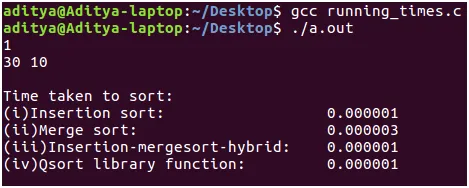
- תוצאות: כפי שניתן לראות עבור גדלי קלט קטנים, הוספת פעימות מיון מיזוג מיון לפי 2 * 10^-6 שניות. אבל הבדל זה בזמן אינו כה משמעותי. מצד שני, האלגוריתם ההיברידי ופונקציית ספריית qsort() פועלים שניהם טובים כמו מיון הכנסה.
 גודל הקלט גדל כעת בערך פי 100 ל-n = 1000 מ-n = 30. ההבדל כעת מוחשי. מיון מיזוג פועל פי 10 מהר יותר ממיון הכנסה. שוב יש קשר בין הביצועים של האלגוריתם ההיברידי לשגרת qsort() . זה מצביע על כך שה-qsort() מיושם באופן שדומה פחות או יותר לאלגוריתם ההיברידי שלנו, כלומר מעבר בין אלגוריתמים שונים כדי להפיק מהם את המיטב.
  לבסוף גודל הקלט גדל ל-10^5 (1 לאך!) שהוא ככל הנראה הגודל האידיאלי בשימוש בתרחישים מעשיים. בהשוואה לקלט הקודם n = 1000 שבו מיזוג מיון פעימות החדרת מיון על ידי ריצה מהירה פי 10 כאן ההבדל הוא אפילו יותר משמעותי. מיזוג מיון פעימות מיון הכנסת פי 100! האלגוריתם ההיברידי שכתבנו למעשה מבצע את מיון המיזוג המסורתי על ידי ריצה של 0.01 שניות מהר יותר. ולבסוף qsort() פונקציית הספרייה מוכיחה לנו סוף סוף שהיישום משחק תפקיד מכריע תוך מדידת זמני הריצה בקפדנות על ידי ריצה של 3 אלפיות שניות מהר יותר! :D


הערה: אל תפעיל את התוכנית שלמעלה עם n >= 10^6 מכיוון שהיא דורשת כוח מחשוב רב. תודה וקידוד שמח! :)
צור חידון