shared_ptr in C++
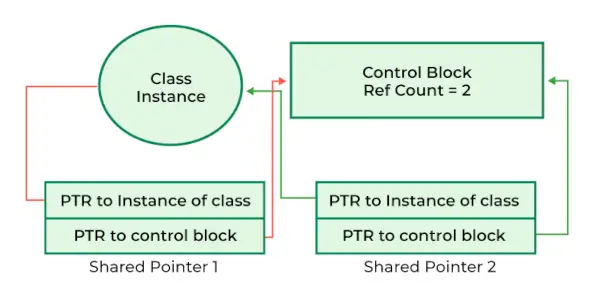
std::shared_ptr è uno dei puntatori intelligenti introdotti in C++11. A differenza di un semplice puntatore, ha un blocco di controllo associato che tiene traccia del conteggio dei riferimenti per l'oggetto gestito. Questo conteggio dei riferimenti è condiviso tra tutte le copie delle istanze shared_ptr che puntano allo stesso oggetto, garantendo la corretta gestione ed eliminazione della memoria.
Prerequisiti: Puntatori in C++ , Puntatori intelligenti in C++ .
Puntatore condiviso in C++
Sintassi di std::shared_ptr
Il shared_ptr di tipo T può essere dichiarato come:
std::shared_ptr ptr_name;
Inizializzazione degli oggetti shared_ptr
Possiamo inizializzare shared_ptr utilizzando i seguenti metodi:
1. Inizializzazione utilizzando un nuovo puntatore
shared_ptr ptr (new T()); shared_ptr ptr = make_shared (new T());
2. Inizializzazione utilizzando il puntatore esistente
shared_ptr ptr(already_existing_pointer); shared_ptr ptr = make_shared(already_existing_pointer);
Metodi membro di shared_ptr
Di seguito sono riportati alcuni membri associati a shared_ptr:
| Metodo | Descrizione |
|---|---|
| Ripristina() | Reimposta std::shared_ptr su vuoto, rilasciando la proprietà dell'oggetto gestito. |
| use_count() | Restituisce il conteggio dei riferimenti corrente, indicando quante istanze std::shared_ptr condividono la proprietà. |
| unico() | Controlla se c'è un solo std::shared_ptr che possiede l'oggetto (il conteggio dei riferimenti è 1). |
| Ottenere() | Restituisce un puntatore non elaborato all'oggetto gestito. Sii cauto quando usi questo metodo. |
| scambia(shr_ptr2) | scambia il contenuto (proprietà) di due istanze std::shared_ptr. |
Esempi di std::shared_ptr
Esempio 1:
C++
Produzione
0x1365c20 A::show() A::show() 0x1365c20 0x1365c20 2 2 0 1 0x1365c20
Esempio 2:
C++
// C++ program to illustrate the use of make_shared> #include> #include> using> namespace> std;> int> main()> {> > // Creating shared pointers using std::make_shared> > shared_ptr <> int> >shr_ptr1 = make_shared <> int> >(42);> > shared_ptr <> int> >shr_ptr2 = make_shared <> int> >(24);> > // Accessing the values using the dereference operator> > // (*)> > cout < < 'Value 1: ' < < *shr_ptr1 < < endl;> > cout < < 'Value 2: ' < < *shr_ptr2 < < endl;> > // Using the assignment operator (=) to share ownership> > shared_ptr <> int> >shr_ptr3 = shr_ptr1;> > // Checking if shared pointer 1 and shared pointer 3> > // point to the same object> > if> (shr_ptr1 == shr_ptr3) {> > cout < < 'shared pointer 1 and shared pointer 3 '> > 'point to the same object.'> > < < endl;> > }> > // Swapping the contents of shared pointer 2 and shared> > // pointer 3> > shr_ptr2.swap(shr_ptr3);> > // Checking the values after the swap> > cout < < 'Value 2 (after swap): ' < < *shr_ptr2 < < endl;> > cout < < 'Value 3 (after swap): ' < < *shr_ptr3 < < endl;> > // Using logical operators to check if shared pointers> > // are valid> > if> (shr_ptr1 && shr_ptr2) {> > cout < < 'Both shared pointer 1 and shared pointer '> > '2 are valid.'> > < < endl;> > }> > // Resetting a shared pointer> > shr_ptr1.reset();> }> |
Produzione
Value 1: 42 Value 2: 24 shared pointer 1 and shared pointer 3 point to the same object. Value 2 (after swap): 42 Value 3 (after swap): 24 Both shared pointer 1 and shared pointer 2 are valid.
Esempio 3: implementazione di un elenco collegato utilizzando std::shared_ptr
C++
#include> #include> using> namespace> std;> // Define a singly linked list node> struct> Node {> > int> data;> > shared_ptr next;> > Node(> int> val)> > : data(val)> > , next(NULL)> > {> > }> };> class> LinkedList {> public> :> > LinkedList()> > : head(NULL)> > {> > }> > // Insert a new node at the end of the linked list> > void> insert(> int> val)> > {> > shared_ptr newNode = make_shared(val);> > if> (!head) {> > head = newNode;> > }> > else> {> > shared_ptr current = head;> > while> (current->successivo) {> > current = current->successivo;> > }> > current->next = nuovoNodo;> > }> > }> > // Delete a node with a given value from the linked list> > void> del(> int> val)> > {> > if> (!head) {> > return> ;> > }> > if> (head->dati == val) {> > head = head->successivo;> > return> ;> > }> > shared_ptr current = head;> > while> (current->successivo> > && current->successivo->dati != val) {> > current = current->successivo;> > }> > if> (current->successivo && corrente->successivo->data == val) {> > current->successivo = corrente->successivo->successivo;> > }> > }> > // Traverse and print the linked list> > void> Print()> > {> > shared_ptr current = head;> > while> (current) {> > cout current = current->Prossimo; } cout < < 'NULL' < < endl; } private: shared_ptr head; }; int main() { LinkedList linkedList; // Insert nodes into the linked list linkedList.insert(1); linkedList.insert(2); linkedList.insert(3); // Print the linked list cout < < 'Linked List: '; linkedList.Print(); // Delete a node and print the updated linked list linkedList.del(2); cout < < 'Linked List after deleting 2: '; linkedList.Print(); return 0; }> |
Produzione
Linked List: 1 ->2 -> 3 -> Elenco collegato NULL dopo l'eliminazione 2: 1 -> 3 -> NULL