A lehető leghosszabb útvonal egy mátrixban akadályokkal


Adott egy 2D bináris mátrix együtt [][] ahol egyes cellák akadályok (jelölése 0 ), a többi szabad cella (jelölése 1 ) az Ön feladata, hogy megkeresse a forráscellából a lehető leghosszabb útvonal hosszát (xs ys) egy célcellába (xd yd) .
- Csak a szomszédos cellákba léphet (balról le jobbra).
- Az átlós mozgás nem megengedett.
- Egy útvonalon egyszer meglátogatott cella nem látogatható újra ugyanazon az útvonalon.
- Ha lehetetlen elérni a célt, vissza
-1.
Példák:
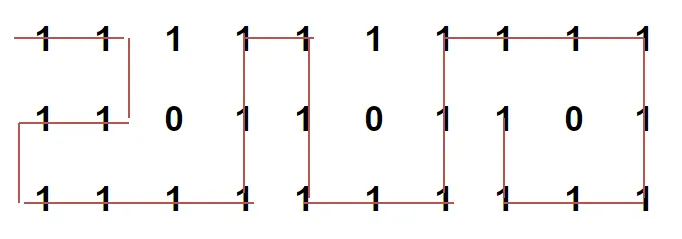
Bemenet: xs = 0 ys = 0 xd = 1 yd = 7
with[][] = [ [1 1 1 1 1 1 1 1 1 1]
[1 1 0 1 1 0 1 1 0 1]
[1 1 1 1 1 1 1 1 1 1] ]
Kimenet: 24
Magyarázat:
Bemenet: xs = 0 ys = 3 xd = 2 yd = 2
with[][] =[ [1 0 0 1 0]
[0 0 0 1 0]
[0 1 1 0 0] ]
Kimenet: -1
Magyarázat:
Láthatjuk, hogy ez lehetetlen
elérje a (03) cellát (22).
Tartalomjegyzék
- [Megközelítés] Visszalépés használata a látogatott mátrixszal
- [Optimalizált megközelítés] Extra hely használata nélkül
[Megközelítés] Visszalépés használata a látogatott mátrixszal
CPPAz ötlet az, hogy használjuk Visszalépés . A mátrix forráscellájából indulva haladunk előre mind a négy megengedett irányban, és rekurzív módon ellenőrizzük, hogy ezek a megoldáshoz vezetnek-e vagy sem. Ha a cél megtalálható, frissítjük a leghosszabb út értékét, ha pedig a fenti megoldások egyike sem működik, függvényünkből false értéket adunk vissza.
#include #include #include #include using namespace std ; // Function to find the longest path using backtracking int dfs ( vector < vector < int >> & mat vector < vector < bool >> & visited int i int j int x int y ) { int m = mat . size (); int n = mat [ 0 ]. size (); // If destination is reached if ( i == x && j == y ) { return 0 ; } // If cell is invalid blocked or already visited if ( i < 0 || i >= m || j < 0 || j >= n || mat [ i ][ j ] == 0 || visited [ i ][ j ]) { return -1 ; } // Mark current cell as visited visited [ i ][ j ] = true ; int maxPath = -1 ; // Four possible moves: up down left right int row [] = { -1 1 0 0 }; int col [] = { 0 0 -1 1 }; for ( int k = 0 ; k < 4 ; k ++ ) { int ni = i + row [ k ]; int nj = j + col [ k ]; int pathLength = dfs ( mat visited ni nj x y ); // If a valid path is found from this direction if ( pathLength != -1 ) { maxPath = max ( maxPath 1 + pathLength ); } } // Backtrack - unmark current cell visited [ i ][ j ] = false ; return maxPath ; } int findLongestPath ( vector < vector < int >> & mat int xs int ys int xd int yd ) { int m = mat . size (); int n = mat [ 0 ]. size (); // Check if source or destination is blocked if ( mat [ xs ][ ys ] == 0 || mat [ xd ][ yd ] == 0 ) { return -1 ; } vector < vector < bool >> visited ( m vector < bool > ( n false )); return dfs ( mat visited xs ys xd yd ); } int main () { vector < vector < int >> mat = { { 1 1 1 1 1 1 1 1 1 1 } { 1 1 0 1 1 0 1 1 0 1 } { 1 1 1 1 1 1 1 1 1 1 } }; int xs = 0 ys = 0 ; int xd = 1 yd = 7 ; int result = findLongestPath ( mat xs ys xd yd ); if ( result != -1 ) cout < < result < < endl ; else cout < < -1 < < endl ; return 0 ; }
Java import java.util.Arrays ; public class GFG { // Function to find the longest path using backtracking public static int dfs ( int [][] mat boolean [][] visited int i int j int x int y ) { int m = mat . length ; int n = mat [ 0 ] . length ; // If destination is reached if ( i == x && j == y ) { return 0 ; } // If cell is invalid blocked or already visited if ( i < 0 || i >= m || j < 0 || j >= n || mat [ i ][ j ] == 0 || visited [ i ][ j ] ) { return - 1 ; // Invalid path } // Mark current cell as visited visited [ i ][ j ] = true ; int maxPath = - 1 ; // Four possible moves: up down left right int [] row = { - 1 1 0 0 }; int [] col = { 0 0 - 1 1 }; for ( int k = 0 ; k < 4 ; k ++ ) { int ni = i + row [ k ] ; int nj = j + col [ k ] ; int pathLength = dfs ( mat visited ni nj x y ); // If a valid path is found from this direction if ( pathLength != - 1 ) { maxPath = Math . max ( maxPath 1 + pathLength ); } } // Backtrack - unmark current cell visited [ i ][ j ] = false ; return maxPath ; } public static int findLongestPath ( int [][] mat int xs int ys int xd int yd ) { int m = mat . length ; int n = mat [ 0 ] . length ; // Check if source or destination is blocked if ( mat [ xs ][ ys ] == 0 || mat [ xd ][ yd ] == 0 ) { return - 1 ; } boolean [][] visited = new boolean [ m ][ n ] ; return dfs ( mat visited xs ys xd yd ); } public static void main ( String [] args ) { int [][] mat = { { 1 1 1 1 1 1 1 1 1 1 } { 1 1 0 1 1 0 1 1 0 1 } { 1 1 1 1 1 1 1 1 1 1 } }; int xs = 0 ys = 0 ; int xd = 1 yd = 7 ; int result = findLongestPath ( mat xs ys xd yd ); if ( result != - 1 ) System . out . println ( result ); else System . out . println ( - 1 ); } }
Python # Function to find the longest path using backtracking def dfs ( mat visited i j x y ): m = len ( mat ) n = len ( mat [ 0 ]) # If destination is reached if i == x and j == y : return 0 # If cell is invalid blocked or already visited if i < 0 or i >= m or j < 0 or j >= n or mat [ i ][ j ] == 0 or visited [ i ][ j ]: return - 1 # Invalid path # Mark current cell as visited visited [ i ][ j ] = True maxPath = - 1 # Four possible moves: up down left right row = [ - 1 1 0 0 ] col = [ 0 0 - 1 1 ] for k in range ( 4 ): ni = i + row [ k ] nj = j + col [ k ] pathLength = dfs ( mat visited ni nj x y ) # If a valid path is found from this direction if pathLength != - 1 : maxPath = max ( maxPath 1 + pathLength ) # Backtrack - unmark current cell visited [ i ][ j ] = False return maxPath def findLongestPath ( mat xs ys xd yd ): m = len ( mat ) n = len ( mat [ 0 ]) # Check if source or destination is blocked if mat [ xs ][ ys ] == 0 or mat [ xd ][ yd ] == 0 : return - 1 visited = [[ False for _ in range ( n )] for _ in range ( m )] return dfs ( mat visited xs ys xd yd ) def main (): mat = [ [ 1 1 1 1 1 1 1 1 1 1 ] [ 1 1 0 1 1 0 1 1 0 1 ] [ 1 1 1 1 1 1 1 1 1 1 ] ] xs ys = 0 0 xd yd = 1 7 result = findLongestPath ( mat xs ys xd yd ) if result != - 1 : print ( result ) else : print ( - 1 ) if __name__ == '__main__' : main ()
C# using System ; class GFG { // Function to find the longest path using backtracking static int dfs ( int [] mat bool [] visited int i int j int x int y ) { int m = mat . GetLength ( 0 ); int n = mat . GetLength ( 1 ); // If destination is reached if ( i == x && j == y ) { return 0 ; } // If cell is invalid blocked or already visited if ( i < 0 || i >= m || j < 0 || j >= n || mat [ i j ] == 0 || visited [ i j ]) { return - 1 ; // Invalid path } // Mark current cell as visited visited [ i j ] = true ; int maxPath = - 1 ; // Four possible moves: up down left right int [] row = { - 1 1 0 0 }; int [] col = { 0 0 - 1 1 }; for ( int k = 0 ; k < 4 ; k ++ ) { int ni = i + row [ k ]; int nj = j + col [ k ]; int pathLength = dfs ( mat visited ni nj x y ); // If a valid path is found from this direction if ( pathLength != - 1 ) { maxPath = Math . Max ( maxPath 1 + pathLength ); } } // Backtrack - unmark current cell visited [ i j ] = false ; return maxPath ; } static int FindLongestPath ( int [] mat int xs int ys int xd int yd ) { int m = mat . GetLength ( 0 ); int n = mat . GetLength ( 1 ); // Check if source or destination is blocked if ( mat [ xs ys ] == 0 || mat [ xd yd ] == 0 ) { return - 1 ; } bool [] visited = new bool [ m n ]; return dfs ( mat visited xs ys xd yd ); } static void Main () { int [] mat = { { 1 1 1 1 1 1 1 1 1 1 } { 1 1 0 1 1 0 1 1 0 1 } { 1 1 1 1 1 1 1 1 1 1 } }; int xs = 0 ys = 0 ; int xd = 1 yd = 7 ; int result = FindLongestPath ( mat xs ys xd yd ); if ( result != - 1 ) Console . WriteLine ( result ); else Console . WriteLine ( - 1 ); } }
JavaScript // Function to find the longest path using backtracking function dfs ( mat visited i j x y ) { const m = mat . length ; const n = mat [ 0 ]. length ; // If destination is reached if ( i === x && j === y ) { return 0 ; } // If cell is invalid blocked or already visited if ( i < 0 || i >= m || j < 0 || j >= n || mat [ i ][ j ] === 0 || visited [ i ][ j ]) { return - 1 ; } // Mark current cell as visited visited [ i ][ j ] = true ; let maxPath = - 1 ; // Four possible moves: up down left right const row = [ - 1 1 0 0 ]; const col = [ 0 0 - 1 1 ]; for ( let k = 0 ; k < 4 ; k ++ ) { const ni = i + row [ k ]; const nj = j + col [ k ]; const pathLength = dfs ( mat visited ni nj x y ); // If a valid path is found from this direction if ( pathLength !== - 1 ) { maxPath = Math . max ( maxPath 1 + pathLength ); } } // Backtrack - unmark current cell visited [ i ][ j ] = false ; return maxPath ; } function findLongestPath ( mat xs ys xd yd ) { const m = mat . length ; const n = mat [ 0 ]. length ; // Check if source or destination is blocked if ( mat [ xs ][ ys ] === 0 || mat [ xd ][ yd ] === 0 ) { return - 1 ; } const visited = Array ( m ). fill (). map (() => Array ( n ). fill ( false )); return dfs ( mat visited xs ys xd yd ); } const mat = [ [ 1 1 1 1 1 1 1 1 1 1 ] [ 1 1 0 1 1 0 1 1 0 1 ] [ 1 1 1 1 1 1 1 1 1 1 ] ]; const xs = 0 ys = 0 ; const xd = 1 yd = 7 ; const result = findLongestPath ( mat xs ys xd yd ); if ( result !== - 1 ) console . log ( result ); else console . log ( - 1 );
Kimenet
24
Időbeli összetettség: O(4^(m*n)) Az m x n mátrix minden egyes cellájára az algoritmus négy lehetséges irányt tár fel (balról jobbra fel le), ami exponenciális számú útvonalhoz vezet. A legrosszabb esetben minden lehetséges utat feltérképez, ami 4^(m*n) időbonyolultságot eredményez.
Kiegészítő tér: O(m*n) Az algoritmus egy m x n látogatott mátrixot használ a meglátogatott cellák nyomon követésére és egy rekurziós verem segítségével, amely a legrosszabb esetben m * n mélységig nőhet (pl. az összes cellát lefedő útvonal feltárásakor). Így a segédtér O(m*n).
[Optimalizált megközelítés] Extra hely használata nélkül
Külön látogatott mátrix fenntartása helyett megtehetjük használja újra a bemeneti mátrixot megjelölni a meglátogatott cellákat a bejárás során. Ez extra helyet takarít meg, és továbbra is biztosítja, hogy ne keressük fel újra ugyanazt a cellát az útvonalon.
Az alábbiakban bemutatjuk a lépésről lépésre történő megközelítést:
- Kezdje a forráscellától
(xs ys). - Minden lépésnél fedezze fel mind a négy lehetséges irányt (jobbra le balra fel).
- Minden érvényes lépésnél:
- Ellenőrizze a határokat, és győződjön meg arról, hogy a cellának van értéke
1(szabad cella). - Jelölje meg a cellát látogatottként úgy, hogy ideiglenesen erre állítja be
0. - Visszatérés a következő cellába, és növelje az útvonal hosszát.
- Ellenőrizze a határokat, és győződjön meg arról, hogy a cellának van értéke
- Ha a célcella
(xd yd)elérte, hasonlítsa össze az aktuális úthosszt az eddigi maximummal, és frissítse a választ. - Visszalépés: visszaállítja a cella eredeti értékét (
1), mielőtt visszatérne, hogy más utak is felfedezhessék azt. - Folytassa a felfedezést, amíg minden lehetséges utat meg nem látogat.
- Adja vissza a maximális útvonalhosszt. Ha a cél elérhetetlen, térjen vissza
-1
#include #include #include #include using namespace std ; // Function to find the longest path using backtracking without extra space int dfs ( vector < vector < int >> & mat int i int j int x int y ) { int m = mat . size (); int n = mat [ 0 ]. size (); // If destination is reached if ( i == x && j == y ) { return 0 ; } // If cell is invalid or blocked (0 means blocked or visited) if ( i < 0 || i >= m || j < 0 || j >= n || mat [ i ][ j ] == 0 ) { return -1 ; } // Mark current cell as visited by temporarily setting it to 0 mat [ i ][ j ] = 0 ; int maxPath = -1 ; // Four possible moves: up down left right int row [] = { -1 1 0 0 }; int col [] = { 0 0 -1 1 }; for ( int k = 0 ; k < 4 ; k ++ ) { int ni = i + row [ k ]; int nj = j + col [ k ]; int pathLength = dfs ( mat ni nj x y ); // If a valid path is found from this direction if ( pathLength != -1 ) { maxPath = max ( maxPath 1 + pathLength ); } } // Backtrack - restore the cell's original value (1) mat [ i ][ j ] = 1 ; return maxPath ; } int findLongestPath ( vector < vector < int >> & mat int xs int ys int xd int yd ) { int m = mat . size (); int n = mat [ 0 ]. size (); // Check if source or destination is blocked if ( mat [ xs ][ ys ] == 0 || mat [ xd ][ yd ] == 0 ) { return -1 ; } return dfs ( mat xs ys xd yd ); } int main () { vector < vector < int >> mat = { { 1 1 1 1 1 1 1 1 1 1 } { 1 1 0 1 1 0 1 1 0 1 } { 1 1 1 1 1 1 1 1 1 1 } }; int xs = 0 ys = 0 ; int xd = 1 yd = 7 ; int result = findLongestPath ( mat xs ys xd yd ); if ( result != -1 ) cout < < result < < endl ; else cout < < -1 < < endl ; return 0 ; }
Java public class GFG { // Function to find the longest path using backtracking without extra space public static int dfs ( int [][] mat int i int j int x int y ) { int m = mat . length ; int n = mat [ 0 ] . length ; // If destination is reached if ( i == x && j == y ) { return 0 ; } // If cell is invalid or blocked (0 means blocked or visited) if ( i < 0 || i >= m || j < 0 || j >= n || mat [ i ][ j ] == 0 ) { return - 1 ; } // Mark current cell as visited by temporarily setting it to 0 mat [ i ][ j ] = 0 ; int maxPath = - 1 ; // Four possible moves: up down left right int [] row = { - 1 1 0 0 }; int [] col = { 0 0 - 1 1 }; for ( int k = 0 ; k < 4 ; k ++ ) { int ni = i + row [ k ] ; int nj = j + col [ k ] ; int pathLength = dfs ( mat ni nj x y ); // If a valid path is found from this direction if ( pathLength != - 1 ) { maxPath = Math . max ( maxPath 1 + pathLength ); } } // Backtrack - restore the cell's original value (1) mat [ i ][ j ] = 1 ; return maxPath ; } public static int findLongestPath ( int [][] mat int xs int ys int xd int yd ) { int m = mat . length ; int n = mat [ 0 ] . length ; // Check if source or destination is blocked if ( mat [ xs ][ ys ] == 0 || mat [ xd ][ yd ] == 0 ) { return - 1 ; } return dfs ( mat xs ys xd yd ); } public static void main ( String [] args ) { int [][] mat = { { 1 1 1 1 1 1 1 1 1 1 } { 1 1 0 1 1 0 1 1 0 1 } { 1 1 1 1 1 1 1 1 1 1 } }; int xs = 0 ys = 0 ; int xd = 1 yd = 7 ; int result = findLongestPath ( mat xs ys xd yd ); if ( result != - 1 ) System . out . println ( result ); else System . out . println ( - 1 ); } }
Python # Function to find the longest path using backtracking without extra space def dfs ( mat i j x y ): m = len ( mat ) n = len ( mat [ 0 ]) # If destination is reached if i == x and j == y : return 0 # If cell is invalid or blocked (0 means blocked or visited) if i < 0 or i >= m or j < 0 or j >= n or mat [ i ][ j ] == 0 : return - 1 # Mark current cell as visited by temporarily setting it to 0 mat [ i ][ j ] = 0 maxPath = - 1 # Four possible moves: up down left right row = [ - 1 1 0 0 ] col = [ 0 0 - 1 1 ] for k in range ( 4 ): ni = i + row [ k ] nj = j + col [ k ] pathLength = dfs ( mat ni nj x y ) # If a valid path is found from this direction if pathLength != - 1 : maxPath = max ( maxPath 1 + pathLength ) # Backtrack - restore the cell's original value (1) mat [ i ][ j ] = 1 return maxPath def findLongestPath ( mat xs ys xd yd ): m = len ( mat ) n = len ( mat [ 0 ]) # Check if source or destination is blocked if mat [ xs ][ ys ] == 0 or mat [ xd ][ yd ] == 0 : return - 1 return dfs ( mat xs ys xd yd ) def main (): mat = [ [ 1 1 1 1 1 1 1 1 1 1 ] [ 1 1 0 1 1 0 1 1 0 1 ] [ 1 1 1 1 1 1 1 1 1 1 ] ] xs ys = 0 0 xd yd = 1 7 result = findLongestPath ( mat xs ys xd yd ) if result != - 1 : print ( result ) else : print ( - 1 ) if __name__ == '__main__' : main ()
C# using System ; class GFG { // Function to find the longest path using backtracking without extra space static int dfs ( int [] mat int i int j int x int y ) { int m = mat . GetLength ( 0 ); int n = mat . GetLength ( 1 ); // If destination is reached if ( i == x && j == y ) { return 0 ; } // If cell is invalid or blocked (0 means blocked or visited) if ( i < 0 || i >= m || j < 0 || j >= n || mat [ i j ] == 0 ) { return - 1 ; } // Mark current cell as visited by temporarily setting it to 0 mat [ i j ] = 0 ; int maxPath = - 1 ; // Four possible moves: up down left right int [] row = { - 1 1 0 0 }; int [] col = { 0 0 - 1 1 }; for ( int k = 0 ; k < 4 ; k ++ ) { int ni = i + row [ k ]; int nj = j + col [ k ]; int pathLength = dfs ( mat ni nj x y ); // If a valid path is found from this direction if ( pathLength != - 1 ) { maxPath = Math . Max ( maxPath 1 + pathLength ); } } // Backtrack - restore the cell's original value (1) mat [ i j ] = 1 ; return maxPath ; } static int FindLongestPath ( int [] mat int xs int ys int xd int yd ) { // Check if source or destination is blocked if ( mat [ xs ys ] == 0 || mat [ xd yd ] == 0 ) { return - 1 ; } return dfs ( mat xs ys xd yd ); } static void Main () { int [] mat = { { 1 1 1 1 1 1 1 1 1 1 } { 1 1 0 1 1 0 1 1 0 1 } { 1 1 1 1 1 1 1 1 1 1 } }; int xs = 0 ys = 0 ; int xd = 1 yd = 7 ; int result = FindLongestPath ( mat xs ys xd yd ); if ( result != - 1 ) Console . WriteLine ( result ); else Console . WriteLine ( - 1 ); } }
JavaScript // Function to find the longest path using backtracking without extra space function dfs ( mat i j x y ) { const m = mat . length ; const n = mat [ 0 ]. length ; // If destination is reached if ( i === x && j === y ) { return 0 ; } // If cell is invalid or blocked (0 means blocked or visited) if ( i < 0 || i >= m || j < 0 || j >= n || mat [ i ][ j ] === 0 ) { return - 1 ; } // Mark current cell as visited by temporarily setting it to 0 mat [ i ][ j ] = 0 ; let maxPath = - 1 ; // Four possible moves: up down left right const row = [ - 1 1 0 0 ]; const col = [ 0 0 - 1 1 ]; for ( let k = 0 ; k < 4 ; k ++ ) { const ni = i + row [ k ]; const nj = j + col [ k ]; const pathLength = dfs ( mat ni nj x y ); // If a valid path is found from this direction if ( pathLength !== - 1 ) { maxPath = Math . max ( maxPath 1 + pathLength ); } } // Backtrack - restore the cell's original value (1) mat [ i ][ j ] = 1 ; return maxPath ; } function findLongestPath ( mat xs ys xd yd ) { const m = mat . length ; const n = mat [ 0 ]. length ; // Check if source or destination is blocked if ( mat [ xs ][ ys ] === 0 || mat [ xd ][ yd ] === 0 ) { return - 1 ; } return dfs ( mat xs ys xd yd ); } const mat = [ [ 1 1 1 1 1 1 1 1 1 1 ] [ 1 1 0 1 1 0 1 1 0 1 ] [ 1 1 1 1 1 1 1 1 1 1 ] ]; const xs = 0 ys = 0 ; const xd = 1 yd = 7 ; const result = findLongestPath ( mat xs ys xd yd ); if ( result !== - 1 ) console . log ( result ); else console . log ( - 1 );
Kimenet
24
Időbeli összetettség: O(4^(m*n))Az algoritmus cellánként legfeljebb négy irányt vizsgál az m x n mátrixban, ami exponenciális számú utat eredményez. A helyben történő módosítás nem befolyásolja a feltárt utak számát, így az időbonyolultság 4^(m*n) marad.
Kiegészítő tér: O(m*n) Míg a meglátogatott mátrix a bemeneti mátrix helyben történő módosításával megszűnik, a rekurziós verem továbbra is O(m*n) helyet igényel, mivel a maximális rekurziós mélység a legrosszabb esetben m * n lehet (pl. egy olyan útvonal, amely a rács összes celláját meglátogatja, többnyire 1 másodperccel).