Todas las combinaciones de cadenas que se pueden usar para marcar un número
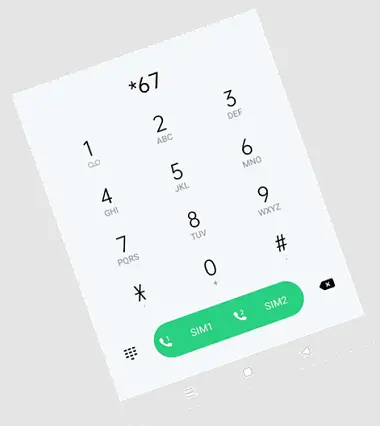
Dado un número impreso todo posible combinaciones de cadenas que se pueden usar para marcar el número dado en un teléfono con las siguientes especificaciones. En el teléfono dado podemos marcar 2 usando a o b o c 3 usando d o e o f ....................... 8 usando t o u o v 9 usando w o x o y o z 1 usando solo 1 0 usando 0. Por ejemplo
La idea es almacenar dígitos a los caracteres mapeo en el mapa hash. El mapa almacena todos los caracteres que se pueden usar marcar un dígito. Colocamos todos los carácter posible para el dígito actual y recurren para los dígitos restantes.
Algoritmo:
- Cree un mapa hash con teclas como dígitos de 0 a 9 y valores como el conjunto de caracteres asociados con cada dígito.
- Definir una función recursiva impresión que toma cuatro argumentos:
a. PHNO: el número de teléfono de entrada
b. I - El índice del dígito actual que se está procesando
do. HM - El mapa hash del dígito a los conjuntos de caracteres
d. str - la cadena de caracteres generados hasta ahora - Dentro de la función PrintStrings:
a. Compruebe si he llegado al final del número de teléfono. En caso afirmativo, imprima la cadena generada y regrese.
b. Obtenga el conjunto de caracteres asociados con el dígito actual del mapa hash.
do. Iterar sobre cada personaje en el set y:
i. Agregue el personaje a la cadena Str.
II. Llame recursivamente a la función PrintStrings para el siguiente dígito.
iii. Retire el último carácter de la cadena Str. - Definir una función printStringFornumber que toma un argumento:
a. PHNO: el número de teléfono de entrada - Dentro de la función PrintStringFornumber Llame a la función PrintStrings con los argumentos Phno 0 Hm y una cadena vacía.
A continuación se muestra la implementación de Java de esta idea.
Implementación:
C++ // C++ program for the above approach #include #include using namespace std ; void printStrings ( string phNo int i unordered_map < char string > hm string str ) { if ( i == phNo . length ()) { cout < < str < < ' ' ; return ; } string s = hm [ phNo [ i ]]; for ( int j = 0 ; j < s . length (); j ++ ) { str . push_back ( s [ j ]); printStrings ( phNo i + 1 hm str ); str . pop_back (); } } void printStringForNumber ( string phNo ) { unordered_map < char string > hm = { { '2' 'ABC' } { '3' 'DEF' } { '4' 'GHI' } { '5' 'JKL' } { '6' 'MNO' } { '7' 'PQRS' } { '8' 'TUV' } { '9' 'WXYZ' } { '1' '1' } { '0' '0' } }; string str ; printStrings ( phNo 0 hm str ); } int main () { printStringForNumber ( '23' ); return 0 ; } // This code is contributed by codebraxnzt
Java // Java program to print all possible key strings // that can be used to dial a phone number. import java.util.HashMap ; class ConvertToString { // A Recursive function to print all combinations // that can be used to dial a given number. // phNo ==> Given Phone Number // i ==> Current digit of phNo to be processed // hm ==> Stores characters that can be used to // to dial a digit. // str ==> Current output string static void printStrings ( String phNo int i HashMap < Character String > hm StringBuilder str ) { // If all digits are processed print output // string if ( i == phNo . length ()) { System . out . print ( str + ' ' ); return ; } // Get current digit of phNo and recur for all // characters that can be used to dial it. String s = hm . get ( phNo . charAt ( i )); for ( int j = 0 ; j < s . length (); j ++ ) { str . append ( s . charAt ( j )); printStrings ( phNo i + 1 hm str ); str . deleteCharAt ( str . length () - 1 ); } } // Prints all possible combinations of strings that // can be used to dial c[]. static void printStringForNumber ( String phNo ) { // Create a HashMap HashMap < Character String > hm = new HashMap < Character String > (); // For every digit store characters that can // be used to dial it. hm . put ( '2' 'ABC' ); hm . put ( '3' 'DEF' ); hm . put ( '4' 'GHI' ); hm . put ( '5' 'JKL' ); hm . put ( '6' 'MNO' ); hm . put ( '7' 'PQRS' ); hm . put ( '8' 'TUV' ); hm . put ( '9' 'WXYZ' ); hm . put ( '1' '1' ); hm . put ( '0' '0' ); // Create a string to store a particular output // string StringBuilder str = new StringBuilder (); // Call recursive function printStrings ( phNo 0 hm str ); } // Driver code to test above methods public static void main ( String args [] ) { // Prints printStringForNumber ( '23' ); } }
Python def print_strings ( ph_no i hm s ): if i == len ( ph_no ): print ( s end = ' ' ) return for c in hm [ ph_no [ i ]]: print_strings ( ph_no i + 1 hm s + c ) def print_string_for_number ( ph_no ): hm = { '2' : 'ABC' '3' : 'DEF' '4' : 'GHI' '5' : 'JKL' '6' : 'MNO' '7' : 'PQRS' '8' : 'TUV' '9' : 'WXYZ' '1' : '1' '0' : '0' } s = '' print_strings ( ph_no 0 hm s ) print_string_for_number ( '23' )
C# using System ; using System.Collections.Generic ; class Program { static void printStrings ( string phNo int i Dictionary < char string > hm string str ) { if ( i == phNo . Length ) { Console . Write ( str + ' ' ); return ; } string s = hm [ phNo [ i ]]; for ( int j = 0 ; j < s . Length ; j ++ ) { str += s [ j ]; printStrings ( phNo i + 1 hm str ); str = str . Remove ( str . Length - 1 ); } } static void printStringForNumber ( string phNo ) { Dictionary < char string > hm = new Dictionary < char string > { { '2' 'ABC' } { '3' 'DEF' } { '4' 'GHI' } { '5' 'JKL' } { '6' 'MNO' } { '7' 'PQRS' } { '8' 'TUV' } { '9' 'WXYZ' } { '1' '1' } { '0' '0' } }; string str = '' ; printStrings ( phNo 0 hm str ); } static void Main ( string [] args ) { printStringForNumber ( '23' ); } }
JavaScript function printStrings ( phNo i hm s ) { if ( i === phNo . length ) { console . log ( s + ' ' ); return ; } for ( let j = 0 ; j < hm [ phNo [ i ]]. length ; j ++ ) { s += hm [ phNo [ i ]][ j ]; printStrings ( phNo i + 1 hm s ); s = s . slice ( 0 - 1 ); } } function printStringForNumber ( phNo ) { let hm = { '2' : 'ABC' '3' : 'DEF' '4' : 'GHI' '5' : 'JKL' '6' : 'MNO' '7' : 'PQRS' '8' : 'TUV' '9' : 'WXYZ' '1' : '1' '0' : '0' }; let s = '' ; printStrings ( phNo 0 hm s ); } printStringForNumber ( '23' );
Producción
AD AE AF BD BE BF CD CE CF
Complejidad del tiempo: O (2^n) Aquí n es longitud de cadena
Espacio auxiliar: o (n)