Úvod do Max-Heap – Výukové programy pro datovou strukturu a algoritmus
A Max-Hroma je definován jako typ Struktura dat haldy je typ binárního stromu, který se běžně používá v informatice pro různé účely, včetně třídění, vyhledávání a organizování dat.
Úvod do datové struktury Max-Heap
Účel a případy použití Max-Heap:
- Prioritní fronta: Jedním z primárních použití datové struktury haldy je implementace prioritních front.
- Řazení haldy: Struktura dat haldy se také používá v třídicích algoritmech.
- Správa paměti: Struktura dat haldy se také používá při správě paměti. Když program potřebuje dynamicky alokovat paměť, používá datovou strukturu haldy ke sledování dostupné paměti.
- Dijkstrův algoritmus nejkratší cesty používá datovou strukturu haldy ke sledování vrcholů s nejkratší cestou ze zdrojového vrcholu.
Struktura dat Max-Heap v různých jazycích:
1. Max-Heap v C++
Maximální haldu lze implementovat pomocí prioritní_fronta kontejner z Standardní knihovna šablon (STL) . The priorita_fronta kontejner je typ adaptéru kontejneru, který poskytuje způsob ukládání prvků do datové struktury podobné frontě, ve které má každý prvek přiřazenou prioritu.
Synt ax: priority_queuemaxH;2. Max-Heap v Javě
V Javě lze maximální haldu implementovat pomocí PriorityQueue třídy od balíček java.util . Třída PriorityQueue je prioritní fronta, která poskytuje způsob ukládání prvků do datové struktury podobné frontě, ve které má každý prvek přiřazenou prioritu.
Syntax : PriorityQueue maxHeap= new PriorityQueue(Comparator.reverseOrder());3. Max-Heap v Pythonu
V Pythonu lze maximální haldu implementovat pomocí heapq modul, který poskytuje funkce pro implementaci hald. Konkrétně modul heapq poskytuje způsob, jak vytvářet a manipulovat s datovými strukturami haldy.
Synt ax: heap = [] heapify(heap)4. Max-Heap v C#
V C# lze maximální haldu implementovat pomocí třídy PriorityQueue z System.Collections.Generic namespace . Třída PriorityQueue je prioritní fronta, která poskytuje způsob ukládání prvků do datové struktury podobné frontě, ve které má každý prvek přiřazenou prioritu.
Syntax: var maxHeap = new PriorityQueue((a, b) =>b - a);5. Max-Heap v JavaScriptu
Maximální halda je binární strom, kde každý uzel má hodnotu větší nebo rovnou jeho potomkům. V JavaScriptu můžete implementovat maximální haldu pomocí pole, kde první prvek představuje kořenový uzel a potomci uzlu na indexu i se nacházejí na indexech 2i+1 a 2i+2.
Syntax: const miaxHeap = new MaxHeap();Rozdíl mezi maximální a minimální haldou
Min. halda Max Heap 1. V Min-Heap musí být klíč přítomný v kořenovém uzlu menší nebo roven mezi klíči přítomnými u všech jeho potomků. V Max-Heap musí být klíč přítomný v kořenovém uzlu větší nebo roven mezi klíči přítomnými u všech jeho potomků. 2. V Min-Heap minimální klíčový prvek přítomný v kořenu. V Max-Heap maximální klíčový prvek přítomný v kořenovém adresáři. 3. Min-Heap používá vzestupnou prioritu. Max-Heap používá sestupnou prioritu. 4. Při konstrukci min-hromady má přednost nejmenší prvek. Při konstrukci Max-Heap má největší prvek přednost. 5. V Min-Heap je nejmenší prvek první, který je vytažen z hromady. V Max-Heap je největší prvek první, který je vytažen z hromady. Interní implementace datové struktury Max-Heap:
A Minimální halda je obvykle reprezentována jako pole .
- Kořenový prvek bude v Arr[0] .
- Pro jakýkoli i-tý uzel Arr[i].
- levé dítě je uloženo v indexu 2i+1
- Pravé dítě je uloženo v indexu 2i+2
- Rodič je uložen v indexovém patře ((i-1)/2)
Interní implementace Max-Heap vyžaduje 3 hlavní kroky:
- Vložení : Chcete-li vložit nový prvek do haldy, je přidán na konec pole a poté probubláván, dokud nesplňuje vlastnost haldy.
- Vymazání : Chcete-li odstranit maximální prvek (kořen haldy), poslední prvek v poli se zamění s kořenem a nový kořen se probublává, dokud nesplňuje vlastnost haldy.
- Heapify : Operaci heapify lze použít k vytvoření maximální haldy z netříděného pole.
Operace na datové struktuře Max-heap a jejich implementace:
Zde jsou některé běžné operace, které lze provádět s datovou strukturou datové struktury haldy,
1. Vložení do datové struktury Max-Heap :
Prvky mohou být vkládány do hromady podobným postupem, jaký byl popsán výše pro mazání. Cílem je:
- Nejprve zvětšete velikost haldy o 1, aby bylo možné uložit nový prvek.
- Vložte nový prvek na konec haldy.
- Tento nově vložený prvek může narušit vlastnosti haldy pro její rodiče. Chcete-li tedy zachovat vlastnosti haldy, navršte tento nově vložený prvek postupem zdola nahoru.
Ilustrace:
Předpokládejme, že halda je maximální halda jako:
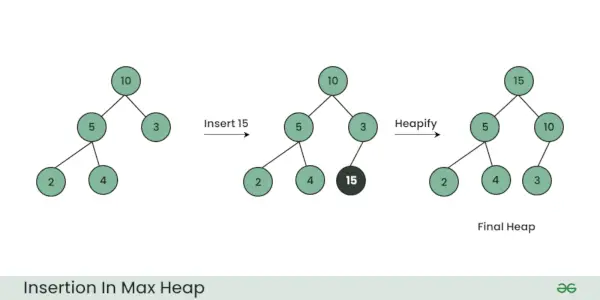
Vložení do maximální haldy
Implementace operace vkládání v Max-Heap:
C++
// C++ program to insert new element to Heap>#include>using>namespace>std;>#define MAX 1000 // Max size of Heap>// Function to heapify ith node in a Heap>// of size n following a Bottom-up approach>void>heapify(>int>arr[],>int>n,>int>i)>{>>// Find parent>>int>parent = (i - 1) / 2;>>if>(arr[parent]>0) {>>// For Max-Heap>>// If current node is greater than its parent>>// Swap both of them and call heapify again>>// for the parent>>if>(arr[i]>arr[rodič]) {>>swap(arr[i], arr[parent]);>>// Recursively heapify the parent node>>heapify(arr, n, parent);>>}>>}>}>// Function to insert a new node to the Heap>void>insertNode(>int>arr[],>int>& n,>int>Key)>{>>// Increase the size of Heap by 1>>n = n + 1;>>// Insert the element at end of Heap>>arr[n - 1] = Key;>>// Heapify the new node following a>>// Bottom-up approach>>heapify(arr, n, n - 1);>}>// A utility function to print array of size n>void>printArray(>int>arr[],>int>n)>{>>for>(>int>i = 0; i cout < < arr[i] < < ' '; cout < < ' '; } // Driver Code int main() { // Array representation of Max-Heap // 10 // / // 5 3 // / // 2 4 int arr[MAX] = { 10, 5, 3, 2, 4 }; int n = 5; int key = 15; insertNode(arr, n, key); printArray(arr, n); // Final Heap will be: // 15 // / // 5 10 // / / // 2 4 3 return 0; }>
Jáva
// Java program for implementing insertion in Heaps>public>class>insertionHeap {>>// Function to heapify ith node in a Heap>>// of size n following a Bottom-up approach>>static>void>heapify(>int>[] arr,>int>n,>int>i)>>{>>// Find parent>>int>parent = (i ->1>) />2>;>>>if>(arr[parent]>>0>) {>>// For Max-Heap>>// If current node is greater than its parent>>// Swap both of them and call heapify again>>// for the parent>>if>(arr[i]>arr[rodič]) {>>>// swap arr[i] and arr[parent]>>int>temp = arr[i];>>arr[i] = arr[parent];>>arr[parent] = temp;>>>// Recursively heapify the parent node>>heapify(arr, n, parent);>>}>>}>>}>>// Function to insert a new node to the heap.>>static>int>insertNode(>int>[] arr,>int>n,>int>Key)>>{>>// Increase the size of Heap by 1>>n = n +>1>;>>>// Insert the element at end of Heap>>arr[n ->1>] = Key;>>>// Heapify the new node following a>>// Bottom-up approach>>heapify(arr, n, n ->1>);>>>// return new size of Heap>>return>n;>>}>>/* A utility function to print array of size n */>>static>void>printArray(>int>[] arr,>int>n)>>{>>for>(>int>i =>0>; i System.out.println(arr[i] + ' '); System.out.println(); } // Driver Code public static void main(String args[]) { // Array representation of Max-Heap // 10 // / // 5 3 // / // 2 4 // maximum size of the array int MAX = 1000; int[] arr = new int[MAX]; // initializing some values arr[0] = 10; arr[1] = 5; arr[2] = 3; arr[3] = 2; arr[4] = 4; // Current size of the array int n = 5; // the element to be inserted int Key = 15; // The function inserts the new element to the heap and // returns the new size of the array n = insertNode(arr, n, Key); printArray(arr, n); // Final Heap will be: // 15 // / // 5 10 // / / // 2 4 3 } } // The code is contributed by Gautam goel>
C#
// C# program for implementing insertion in Heaps>using>System;>public>class>insertionHeap {>>// Function to heapify ith node in a Heap of size n following a Bottom-up approach>>static>void>heapify(>int>[] arr,>int>n,>int>i) {>>// Find parent>>int>parent = (i - 1) / 2;>>if>(arr[parent]>0) {>>// For Max-Heap>>// If current node is greater than its parent>>// Swap both of them and call heapify again>>// for the parent>>if>(arr[i]>arr[rodič]) {>>// swap arr[i] and arr[parent]>>int>temp = arr[i];>>arr[i] = arr[parent];>>arr[parent] = temp;>>// Recursively heapify the parent node>>heapify(arr, n, parent);>>}>>}>>}>>// Function to insert a new node to the heap.>>static>int>insertNode(>int>[] arr,>int>n,>int>Key) {>>// Increase the size of Heap by 1>>n = n + 1;>>// Insert the element at end of Heap>>arr[n - 1] = Key;>>// Heapify the new node following a>>// Bottom-up approach>>heapify(arr, n, n - 1);>>// return new size of Heap>>return>n;>>}>>/* A utility function to print array of size n */>>static>void>printArray(>int>[] arr,>int>n) {>>for>(>int>i = 0; i Console.WriteLine(arr[i] + ' '); Console.WriteLine(''); } public static void Main(string[] args) { // Array representation of Max-Heap // 10 // / // 5 3 // / // 2 4 // maximum size of the array int MAX = 1000; int[] arr = new int[MAX]; // initializing some values arr[0] = 10; arr[1] = 5; arr[2] = 3; arr[3] = 2; arr[4] = 4; // Current size of the array int n = 5; // the element to be inserted int Key = 15; // The function inserts the new element to the heap and // returns the new size of the array n = insertNode(arr, n, Key); printArray(arr, n); // Final Heap will be: // 15 // / // 5 10 // / / // 2 4 3 } } // This code is contributed by ajaymakvana.>
Javascript
// Javascript program for implement insertion in Heaps>// To heapify a subtree rooted with node i which is>// an index in arr[].Nn is size of heap>let MAX = 1000;>// Function to heapify ith node in a Heap of size n following a Bottom-up approach>function>heapify(arr, n, i)>{>>// Find parent>>let parent = Math.floor((i-1)/2);>>if>(arr[parent]>= 0) {>>// For Max-Heap>>// If current node is greater than its parent>>// Swap both of them and call heapify again>>// for the parent>>if>(arr[i]>arr[rodič]) {>>let temp = arr[i];>>arr[i] = arr[parent];>>arr[parent] = temp;>>// Recursively heapify the parent node>>heapify(arr, n, parent);>>}>>}>}>// Function to insert a new node to the Heap>function>insertNode(arr, n, Key)>{>>// Increase the size of Heap by 1>>n = n + 1;>>// Insert the element at end of Heap>>arr[n - 1] = Key;>>// Heapify the new node following a>>// Bottom-up approach>>heapify(arr, n, n - 1);>>>return>n;>}>/* A utility function to print array of size N */>function>printArray(arr, n)>{>>for>(let i = 0; i console.log(arr[i] + ' '); console.log(''); } let arr = [ 10, 5, 3, 2, 4 ]; let n = arr.length; let key = 15; n = insertNode(arr, n, key); printArray(arr, n); // This code is contributed by ajaymakvana>
Python3
# program to insert new element to Heap># Function to heapify ith node in a Heap># of size n following a Bottom-up approach>def>heapify(arr, n, i):>>parent>=>int>(((i>->1>)>/>2>))>># For Max-Heap>># If current node is greater than its parent>># Swap both of them and call heapify again>># for the parent>>if>arr[parent]>>0>:>>if>arr[i]>arr[rodič]:>>arr[i], arr[parent]>=>arr[parent], arr[i]>># Recursively heapify the parent node>>heapify(arr, n, parent)># Function to insert a new node to the Heap>def>insertNode(arr, key):>>global>n>># Increase the size of Heap by 1>>n>+>=>1>># Insert the element at end of Heap>>arr.append(key)>># Heapify the new node following a>># Bottom-up approach>>heapify(arr, n, n>->1>)># A utility function to print array of size n>def>printArr(arr, n):>>for>i>in>range>(n):>>print>(arr[i], end>=>)># Driver Code># Array representation of Max-Heap>'''>>10>>/>>5 3>>/>>2 4>'''>arr>=>[>10>,>5>,>3>,>2>,>4>,>1>,>7>]>n>=>7>key>=>15>insertNode(arr, key)>printArr(arr, n)># Final Heap will be:>'''>>15>>/>5 10>/ />2 4 3>Code is written by Rajat Kumar....>'''>
Výstup
15 5 10 2 4 3Časová složitost: O(log(n)) ( kde n je číslo prvků v hromadě )
Pomocný prostor: Na)2. Odstranění v datové struktuře Max-Heap :
Odstranění prvku na jakékoli mezilehlé pozici v hromadě může být nákladné, takže můžeme jednoduše nahradit prvek, který má být odstraněn, posledním prvkem a smazat poslední prvek hromady.
- Nahraďte kořen nebo prvek, který chcete odstranit, posledním prvkem.
- Odstraňte poslední prvek z haldy.
- Protože poslední prvek je nyní umístěn na pozici kořenového uzlu. Nemusí se tedy řídit vlastností haldy. Proto navraťte poslední uzel umístěný na pozici kořene.
Ilustrace :
Předpokládejme, že halda je maximální halda jako:
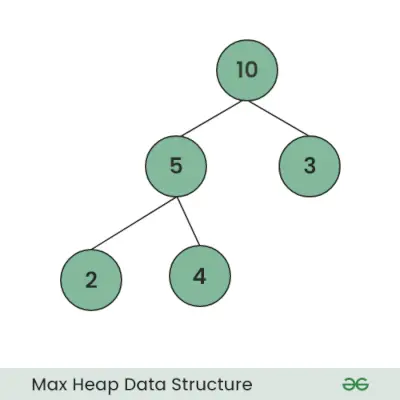
Maximální datová struktura haldy
Prvek, který má být odstraněn, je root, tedy 10.
Proces :
Posledním prvkem je 4.
Krok 1: Nahraďte poslední prvek rootem a odstraňte jej.
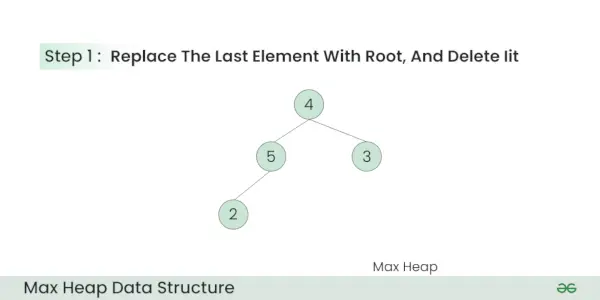
Max Heap
Krok 2 : Heapify root.
Konečná hromada:
Max Heap
Implementace operace mazání v Max-Heap:
C++
// C++ program for implement deletion in Heaps>#include>using>namespace>std;>// To heapify a subtree rooted with node i which is>// an index of arr[] and n is the size of heap>void>heapify(>int>arr[],>int>n,>int>i)>{>>int>largest = i;>// Initialize largest as root>>int>l = 2 * i + 1;>// left = 2*i + 1>>int>r = 2 * i + 2;>// right = 2*i + 2>>// If left child is larger than root>>if>(l arr[largest])>>largest = l;>>// If right child is larger than largest so far>>if>(r arr[largest])>>largest = r;>>// If largest is not root>>if>(largest != i) {>>swap(arr[i], arr[largest]);>>// Recursively heapify the affected sub-tree>>heapify(arr, n, largest);>>}>}>// Function to delete the root from Heap>void>deleteRoot(>int>arr[],>int>& n)>{>>// Get the last element>>int>lastElement = arr[n - 1];>>// Replace root with last element>>arr[0] = lastElement;>>// Decrease size of heap by 1>>n = n - 1;>>// heapify the root node>>heapify(arr, n, 0);>}>/* A utility function to print array of size n */>void>printArray(>int>arr[],>int>n)>{>>for>(>int>i = 0; i cout < < arr[i] < < ' '; cout < < ' '; } // Driver Code int main() { // Array representation of Max-Heap // 10 // / // 5 3 // / // 2 4 int arr[] = { 10, 5, 3, 2, 4 }; int n = sizeof(arr) / sizeof(arr[0]); deleteRoot(arr, n); printArray(arr, n); return 0; }>
Jáva
// Java program for implement deletion in Heaps>public>class>deletionHeap {>>// To heapify a subtree rooted with node i which is>>// an index in arr[].Nn is size of heap>>static>void>heapify(>int>arr[],>int>n,>int>i)>>{>>int>largest = i;>// Initialize largest as root>>int>l =>2>* i +>1>;>// left = 2*i + 1>>int>r =>2>* i +>2>;>// right = 2*i + 2>>// If left child is larger than root>>if>(l arr[largest])>>largest = l;>>// If right child is larger than largest so far>>if>(r arr[largest])>>largest = r;>>// If largest is not root>>if>(largest != i) {>>int>swap = arr[i];>>arr[i] = arr[largest];>>arr[largest] = swap;>>// Recursively heapify the affected sub-tree>>heapify(arr, n, largest);>>}>>}>>// Function to delete the root from Heap>>static>int>deleteRoot(>int>arr[],>int>n)>>{>>// Get the last element>>int>lastElement = arr[n ->1>];>>// Replace root with first element>>arr[>0>] = lastElement;>>// Decrease size of heap by 1>>n = n ->1>;>>// heapify the root node>>heapify(arr, n,>0>);>>// return new size of Heap>>return>n;>>}>>/* A utility function to print array of size N */>>static>void>printArray(>int>arr[],>int>n)>>{>>for>(>int>i =>0>; i System.out.print(arr[i] + ' '); System.out.println(); } // Driver Code public static void main(String args[]) { // Array representation of Max-Heap // 10 // / // 5 3 // / // 2 4 int arr[] = { 10, 5, 3, 2, 4 }; int n = arr.length; n = deleteRoot(arr, n); printArray(arr, n); } }>
C#
// C# program for implement deletion in Heaps>using>System;>public>class>deletionHeap>{>>// To heapify a subtree rooted with node i which is>>// an index in arr[].Nn is size of heap>>static>void>heapify(>int>[]arr,>int>n,>int>i)>>{>>int>largest = i;>// Initialize largest as root>>int>l = 2 * i + 1;>// left = 2*i + 1>>int>r = 2 * i + 2;>// right = 2*i + 2>>// If left child is larger than root>>if>(l arr[largest])>>largest = l;>>// If right child is larger than largest so far>>if>(r arr[largest])>>largest = r;>>// If largest is not root>>if>(largest != i)>>{>>int>swap = arr[i];>>arr[i] = arr[largest];>>arr[largest] = swap;>>// Recursively heapify the affected sub-tree>>heapify(arr, n, largest);>>}>>}>>// Function to delete the root from Heap>>static>int>deleteRoot(>int>[]arr,>int>n)>>{>>// Get the last element>>int>lastElement = arr[n - 1];>>// Replace root with first element>>arr[0] = lastElement;>>// Decrease size of heap by 1>>n = n - 1;>>// heapify the root node>>heapify(arr, n, 0);>>// return new size of Heap>>return>n;>>}>>/* A utility function to print array of size N */>>static>void>printArray(>int>[]arr,>int>n)>>{>>for>(>int>i = 0; i Console.Write(arr[i] + ' '); Console.WriteLine(); } // Driver Code public static void Main() { // Array representation of Max-Heap // 10 // / // 5 3 // / // 2 4 int []arr = { 10, 5, 3, 2, 4 }; int n = arr.Length; n = deleteRoot(arr, n); printArray(arr, n); } } // This code is contributed by Ryuga>
Javascript
>>// Javascript program for implement deletion in Heaps>>>// To heapify a subtree rooted with node i which is>>// an index in arr[].Nn is size of heap>>function>heapify(arr, n, i)>>{>>let largest = i;>// Initialize largest as root>>let l = 2 * i + 1;>// left = 2*i + 1>>let r = 2 * i + 2;>// right = 2*i + 2>>// If left child is larger than root>>if>(l arr[largest])>>largest = l;>>// If right child is larger than largest so far>>if>(r arr[largest])>>largest = r;>>// If largest is not root>>if>(largest != i)>>{>>let swap = arr[i];>>arr[i] = arr[largest];>>arr[largest] = swap;>>// Recursively heapify the affected sub-tree>>heapify(arr, n, largest);>>}>>}>>// Function to delete the root from Heap>>function>deleteRoot(arr, n)>>{>>// Get the last element>>let lastElement = arr[n - 1];>>// Replace root with first element>>arr[0] = lastElement;>>// Decrease size of heap by 1>>n = n - 1;>>// heapify the root node>>heapify(arr, n, 0);>>// return new size of Heap>>return>n;>>}>>/* A utility function to print array of size N */>>function>printArray(arr, n)>>{>>for>(let i = 0; i document.write(arr[i] + ' '); document.write(''); } let arr = [ 10, 5, 3, 2, 4 ]; let n = arr.length; n = deleteRoot(arr, n); printArray(arr, n); // This code is contributed by divyeshrabdiya07.>
Python3
# Python 3 program for implement deletion in Heaps># To heapify a subtree rooted with node i which is># an index of arr[] and n is the size of heap>def>heapify(arr, n, i):>>largest>=>i>#Initialize largest as root>>l>=>2>*>i>+>1># left = 2*i + 1>>r>=>2>*>i>+>2># right = 2*i + 2>>#If left child is larger than root>>if>(l and arr[l]>arr[největší]): největší = l #Pokud je pravý potomek větší než dosud největší if (r a arr[r]> arr[největší]): největší = r # Pokud největší není kořen if (největší != i) : arr[i],arr[největší]=arr[největší],arr[i] #Rekurzivně heapify postižený podstrom heapify(arr, n, největší) #Funkce pro odstranění kořene z haldy def deleteRoot(arr): global n # Získat poslední prvek lastElement = arr[n - 1] # Nahradit kořen posledním prvkem arr[0] = lastElement # Zmenšit velikost haldy o 1 n = n - 1 # heapify kořenový uzel heapify(arr, n, 0) # Obslužná funkce pro tisk pole o velikosti n def printArray(arr, n): pro i v rozsahu (n): print(arr[i],end=' ') print() # Kód ovladače, pokud __name__ == '__main__': # Reprezentace pole Max-Heap # 10 # / # 5 3 # / # 2 4 arr = [ 10, 5, 3, 2, 4 ] n = len(arr) deleteRoot( arr) printArray(arr, n) # Tento kód přispěl Rajat Kumar.>
Výstup
5 4 3 2Časová složitost : O(log n) kde n je číslo prvků v haldě
Pomocný prostor: Na)3. Operace náhledu na datové struktuře Max-heap:
Pro přístup k maximálnímu prvku (tj. kořeni haldy) je vrácena hodnota kořenového uzlu. Časová složitost náhledu v maximální hromadě je O(1).
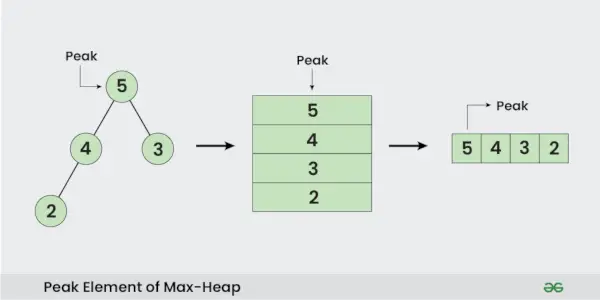
Vrcholový Prvek Max-Hromy
Implementace operace Peek v Max-Heap:
C++
#include>#include>int>main() {>>// Create a max heap with some elements using a priority_queue>>std::priority_queue <>int>>maxHeap;>>maxHeap.push(9);>>maxHeap.push(8);>>maxHeap.push(7);>>maxHeap.push(6);>>maxHeap.push(5);>>maxHeap.push(4);>>maxHeap.push(3);>>maxHeap.push(2);>>maxHeap.push(1);>>// Get the peak element (i.e., the largest element)>>int>peakElement = maxHeap.top();>>// Print the peak element>>std::cout < <>'Peak element: '>< < peakElement < < std::endl;>>return>0;>}>
Jáva
import>java.util.PriorityQueue;>public>class>GFG {>>public>static>void>main(String[] args) {>>// Create a max heap with some elements using a PriorityQueue>>PriorityQueue maxHeap =>new>PriorityQueue((a, b) ->b - a);>>maxHeap.add(>9>);>>maxHeap.add(>8>);>>maxHeap.add(>7>);>>maxHeap.add(>6>);>>maxHeap.add(>5>);>>maxHeap.add(>4>);>>maxHeap.add(>3>);>>maxHeap.add(>2>);>>maxHeap.add(>1>);>>// Get the peak element (i.e., the largest element)>>int>peakElement = maxHeap.peek();>>// Print the peak element>>System.out.println(>'Peak element: '>+ peakElement);>>}>}>
C#
using>System;>using>System.Collections.Generic;>public>class>GFG {>>public>static>void>Main() {>>// Create a min heap with some elements using a PriorityQueue>>var>maxHeap =>new>PriorityQueue <>int>>();>>maxHeap.Enqueue(9);>>maxHeap.Enqueue(8);>>maxHeap.Enqueue(7);>>maxHeap.Enqueue(6);>>maxHeap.Enqueue(5);>>maxHeap.Enqueue(4);>>maxHeap.Enqueue(3);>>maxHeap.Enqueue(2);>>maxHeap.Enqueue(1);>>// Get the peak element (i.e., the smallest element)>>int>peakElement = maxHeap.Peek();>>// Print the peak element>>Console.WriteLine(>'Peak element: '>+ peakElement);>>}>}>// Define a PriorityQueue class that uses a max heap>class>PriorityQueue>where>T : IComparable {>>private>List heap;>>public>PriorityQueue() {>>this>.heap =>new>List();>>}>>public>int>Count {>>get>{>return>this>.heap.Count; }>>}>>public>void>Enqueue(T item) {>>this>.heap.Add(item);>>this>.BubbleUp(>this>.heap.Count - 1);>>}>>public>T Dequeue() {>>T item =>this>.heap[0];>>int>lastIndex =>this>.heap.Count - 1;>>this>.heap[0] =>this>.heap[lastIndex];>>this>.heap.RemoveAt(lastIndex);>>this>.BubbleDown(0);>>return>item;>>}>>public>T Peek() {>>return>this>.heap[0];>>}>>private>void>BubbleUp(>int>index) {>>while>(index>0) {>>int>parentIndex = (index - 1) / 2;>>if>(>this>.heap[parentIndex].CompareTo(>this>.heap[index])>= 0) {>>break>;>>}>>Swap(parentIndex, index);>>index = parentIndex;>>}>>}>>private>void>BubbleDown(>int>index) {>>while>(index <>this>.heap.Count) {>>int>leftChildIndex = index * 2 + 1;>>int>rightChildIndex = index * 2 + 2;>>int>largestChildIndex = index;>>if>(leftChildIndex <>this>.heap.Count &&>this>.heap[leftChildIndex].CompareTo(>this>.heap[largestChildIndex])>0) {>>largestChildIndex = leftChildIndex;>>}>>if>(rightChildIndex <>this>.heap.Count &&>this>.heap[rightChildIndex].CompareTo(>this>.heap[largestChildIndex])>0) {>>largestChildIndex = rightChildIndex;>>}>>if>(largestChildIndex == index) {>>break>;>>}>>Swap(largestChildIndex, index);>>index = largestChildIndex;>>}>>}>>private>void>Swap(>int>i,>int>j) {>>T temp =>this>.heap[i];>>this>.heap[i] =>this>.heap[j];>>this>.heap[j] = temp;>>}>}>
Javascript
// Define a MaxHeap class that uses an array>class MaxHeap {>>constructor() {>>this>.heap = [];>>}>>push(item) {>>this>.heap.push(item);>>this>.bubbleUp(>this>.heap.length - 1);>>}>>pop() {>>let item =>this>.heap[0];>>let lastIndex =>this>.heap.length - 1;>>this>.heap[0] =>this>.heap[lastIndex];>>this>.heap.pop();>>this>.bubbleDown(0);>>return>item;>>}>>peak() {>>return>this>.heap[0];>>}>>bubbleUp(index) {>>while>(index>0) {>>let parentIndex = Math.floor((index - 1) / 2);>>if>(>this>.heap[parentIndex]>=>this>.heap[index]) {>>break>;>>}>>this>.swap(parentIndex, index);>>index = parentIndex;>>}>>}>>bubbleDown(index) {>>while>(index <>this>.heap.length) {>>let leftChildIndex = index * 2 + 1;>>let rightChildIndex = index * 2 + 2;>>let largestChildIndex = index;>>if>(leftChildIndex <>this>.heap.length &&>this>.heap[leftChildIndex]>>this>.heap[largestChildIndex]) {>>largestChildIndex = leftChildIndex;>>}>>if>(rightChildIndex <>this>.heap.length &&>this>.heap[rightChildIndex]>>this>.heap[largestChildIndex]) {>>largestChildIndex = rightChildIndex;>>}>>if>(largestChildIndex === index) {>>break>;>>}>>this>.swap(largestChildIndex, index);>>index = largestChildIndex;>>}>>}>>swap(i, j) {>>let temp =>this>.heap[i];>>this>.heap[i] =>this>.heap[j];>>this>.heap[j] = temp;>>}>}>// Create a max heap with some elements using an array>let maxHeap =>new>MaxHeap();>maxHeap.push(9);>maxHeap.push(8);>maxHeap.push(7);>maxHeap.push(6);>maxHeap.push(5);>maxHeap.push(4);>maxHeap.push(3);>maxHeap.push(2);>maxHeap.push(1);>// Get the peak element (i.e., the largest element)>let peakElement = maxHeap.peak();>// Print the peak element>console.log(>'Peak element: '>+ peakElement);>
Python3
import>heapq># Create a max heap with some elements using a list>max_heap>=>[>1>,>2>,>3>,>4>,>5>,>6>,>7>,>8>,>9>]>heapq.heapify(max_heap)># Get the peak element (i.e., the largest element)>peak_element>=>heapq.nlargest(>1>, max_heap)[>0>]># Print the peak element>print>(>'Peak element:'>, peak_element)>
Výstup
Peak element: 9Časová složitost :
- V maximální hromadě implementované pomocí an pole nebo seznam, může být vrcholový prvek přístupný v konstantním čase, O(1), protože je vždy umístěn v kořenu haldy.
- V maximální hromadě implementované pomocí a binární strom , k vrcholovému prvku lze také přistupovat v čase O(1), protože je vždy umístěn v kořeni stromu.
Pomocný prostor: Na)
4. Operace heapify na datové struktuře Max-heap :
Operaci heapify lze použít k vytvoření maximální haldy z neseřazeného pole. To se provádí tak, že se začne od posledního nelistového uzlu a opakovaně se provádí operace bublina dolů, dokud všechny uzly nesplní vlastnost haldy. Časová složitost heapify v maximální hromadě je O(n).
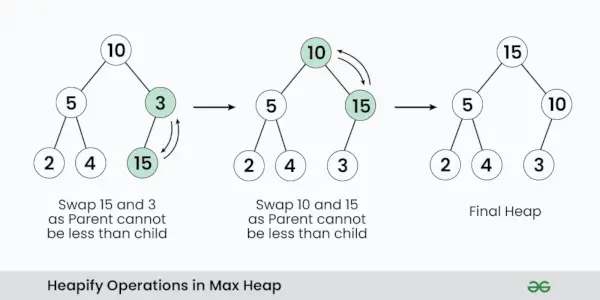
Operace Heapify v Max-Heap
5. Operace vyhledávání na datové struktuře Max-heap :
Chcete-li vyhledat prvek v maximální hromadě, lze provést lineární vyhledávání v poli, které představuje hromadu. Časová složitost lineárního vyhledávání je však O(n), což není efektivní. Hledání proto není běžně používaná operace v maximální hromadě.
Zde je příklad kódu, který ukazuje, jak hledat prvek v maximální hromadě pomocí std::najít() :
C++
#include>#include // for std::priority_queue>using>namespace>std;>int>main() {>>std::priority_queue <>int>>max_heap;>>// example max heap>>>max_heap.push(10);>>max_heap.push(9);>>max_heap.push(8);>>max_heap.push(6);>>max_heap.push(4);>>int>element = 6;>// element to search for>>bool>found =>false>;>>// Copy the max heap to a temporary queue and search for the element>>std::priority_queue <>int>>temp = max_heap;>>while>(!temp.empty()) {>>if>(temp.top() == element) {>>found =>true>;>>break>;>>}>>temp.pop();>>}>>if>(found) {>>std::cout < <>'Element found in the max heap.'>< < std::endl;>>}>else>{>>std::cout < <>'Element not found in the max heap.'>< < std::endl;>>}>>return>0;>}>
Jáva
import>java.util.PriorityQueue;>public>class>GFG {>>public>static>void>main(String[] args) {>>PriorityQueue maxHeap =>new>PriorityQueue((a, b) ->b - a);>>maxHeap.add(>3>);>// insert elements into the priority queue>>maxHeap.offer(>1>);>>maxHeap.offer(>4>);>>maxHeap.offer(>1>);>>maxHeap.offer(>6>);>>int>element =>6>;>// element to search for>>boolean>found =>false>;>>// Copy the max heap to a temporary queue and search for the element>>PriorityQueue temp =>new>PriorityQueue(maxHeap);>>while>(!temp.isEmpty()) {>>if>(temp.poll() == element) {>>found =>true>;>>break>;>>}>>}>>if>(found) {>>System.out.println(>'Element found in the max heap.'>);>>}>else>{>>System.out.println(>'Element not found in the max heap.'>);>>}>>}>}>
C#
using>System;>using>System.Collections.Generic;>class>Program {>>static>void>Main(>string>[] args) {>>// Create a max heap with some elements using a PriorityQueue>>PriorityQueue <>int>>maxHeap =>new>PriorityQueue <>int>>();>>maxHeap.Enqueue(10);>>maxHeap.Enqueue(9);>>maxHeap.Enqueue(8);>>maxHeap.Enqueue(6);>>maxHeap.Enqueue(4);>>int>element = 6;>// element to search for>>bool>found =>false>;>>// Copy the max heap to a temporary queue and search for the element>>PriorityQueue <>int>>teplota =>new>PriorityQueue <>int>>(maxHeap);>>while>(temp.Count>0) {>>if>(temp.Peek() == element) {>>found =>true>;>>break>;>>}>>temp.Dequeue();>>}>>if>(found) {>>Console.WriteLine(>'Element found in the max heap.'>);>>}>else>{>>Console.WriteLine(>'Element not found in the max heap.'>);>>}>>}>}>// PriorityQueue class>class>PriorityQueue>where>T : IComparable {>>private>List heap =>new>List();>>public>void>Enqueue(T item) {>>heap.Add(item);>>int>child = heap.Count - 1;>>while>(child>0) {>>int>parent = (child - 1) / 2;>>if>(heap[child].CompareTo(heap[parent])>0) {>>T tmp = heap[child];>>heap[child] = heap[parent];>>heap[parent] = tmp;>>child = parent;>>}>else>{>>break>;>>}>>}>>}>>public>T Dequeue() {>>int>last = heap.Count - 1;>>T frontItem = heap[0];>>heap[0] = heap[last];>>heap.RemoveAt(last);>>last--;>>int>parent = 0;>>while>(>true>) {>>int>leftChild = parent * 2 + 1;>>if>(leftChild>poslední) {>>break>;>>}>>int>rightChild = leftChild + 1;>>if>(rightChild <= last && heap[leftChild].CompareTo(heap[rightChild]) < 0) {>>leftChild = rightChild;>>}>>if>(heap[parent].CompareTo(heap[leftChild]) <0) {>>T tmp = heap[parent];>>heap[parent] = heap[leftChild];>>heap[leftChild] = tmp;>>parent = leftChild;>>}>else>{>>break>;>>}>>}>>return>frontItem;>>}>>public>T Peek() {>>return>heap[0];>>}>>public>int>Count {>>get>{>>return>heap.Count;>>}>>}>}>
Javascript
const maxHeap =>new>PriorityQueue((a, b) =>b - a);>maxHeap.add(3);>// insert elements into the priority queue>maxHeap.add(1);>maxHeap.add(4);>maxHeap.add(1);>maxHeap.add(6);>const element = 6;>// element to search for>let found =>false>;>// Copy the max heap to a temporary queue and search for the element>const temp =>new>PriorityQueue(maxHeap);>while>(!temp.isEmpty()) {>if>(temp.poll() === element) {>found =>true>;>break>;>}>}>if>(found) {>console.log(>'Element found in the max heap.'>);>}>else>{>console.log(>'Element not found in the max heap.'>);>}>
Python3
import>heapq>max_heap>=>[>10>,>8>,>7>,>6>,>5>,>3>,>2>,>1>]># example max heap>heapq._heapify_max(max_heap)>element>=>6># element to search for>found>=>False># Copy the max heap to a temporary list and search for the element>temp>=>list>(max_heap)>while>temp:>>if>heapq._heappop_max(temp)>=>=>element:>>found>=>True>>break>if>found:>>print>(>'Element found in the max heap.'>)>else>:>>print>(>'Element not found in the max heap.'>)>
Výstup
Element found in the max heap.Časová složitost : O(n), kde n je velikost haldy.
Pomocný prostor : O(n),Aplikace datové struktury Max-Heap:
- Algoritmus Heapsort: Struktura dat haldy je základem pro algoritmus heapsort, což je účinný třídicí algoritmus s časovou složitostí nejhoršího případu O(n log n). Algoritmus heapsort se používá v různých aplikacích, včetně indexování databáze a numerické analýzy.
- Správa paměti: Datová struktura haldy se používá v systémech správy paměti k dynamickému alokaci a uvolnění paměti. Halda se používá k ukládání paměťových bloků a datová struktura haldy se používá k efektivní správě paměťových bloků a jejich přidělování programům podle potřeby.
- Algoritmy grafů: Struktura dat haldy se používá v různých grafových algoritmech, včetně Dijkstrova algoritmu, Primova algoritmu a Kruskalova algoritmu. Tyto algoritmy vyžadují efektivní implementaci prioritní fronty, které lze dosáhnout pomocí datové struktury haldy.
- Plánování práce: Struktura dat haldy se používá v algoritmech plánování úloh, kde jsou úkoly plánovány na základě jejich priority nebo termínu. Struktura dat haldy umožňuje efektivní přístup k úloze s nejvyšší prioritou, což z ní činí užitečnou datovou strukturu pro aplikace pro plánování úloh.
Výhody datové struktury Max-Heap:
- Efektivně udržujte maximální hodnotu: Maximální halda umožňuje neustálý přístup k maximálnímu prvku v haldě, což je užitečné v aplikacích, kde je potřeba rychle najít maximální prvek.
- Efektivní operace vkládání a odstraňování: Operace vložení a odstranění v maximální haldě mají časovou složitost O(log n), což je činí efektivními pro velké kolekce prvků.
- Prioritní fronty: Maximální haldu lze použít k implementaci prioritní fronty, což je užitečné v mnoha aplikacích, jako je plánování úloh, prioritizace úloh a simulace řízená událostmi.
- řazení: Maximální haldu lze použít k implementaci heapsortu, což je účinný třídicí algoritmus, který má v nejhorším případě časovou složitost O(n log n).
- Prostorová efektivita: Maximální haldu lze implementovat jako pole, které vyžaduje méně paměti ve srovnání s jinými datovými strukturami, jako je binární vyhledávací strom nebo propojený seznam.
Struktura dat maximální haldy je užitečným a efektivním nástrojem pro údržbu a manipulaci s kolekcemi prvků, zejména když je třeba rychle získat přístup k maximálnímu prvku nebo když je třeba prvky seřadit nebo upřednostnit.