 Тръби
Тръби в IO осигурява връзка между две нишки, работещи в JVM едновременно. Така че каналите се използват както като източник, така и като дестинация.
- PipedInputStream също се препраща с PipedOutputStream. Така че данните могат да се записват с помощта на PipedOutputStream и могат да се записват с помощта на PipedInputStream. Но използването на двете нишки едновременно ще създаде задънена улица за нишките.
- Твърди се, че една тръба е прекъсната, ако нишка, която е предоставяла байтове данни към свързания канален изходен поток, вече не е жива.
Декларация: public class PipedInputStream extends InputStream
Конструктор: | PipedInputStream() : | създава PipedInputStream, че не е свързан.
| PipedInputStream(int pSize): | създава PipedInputStream, че не е свързан с определен размер на тръбата.
| PipedInputStream(PipedOutputStream outStream) : | създава PipedInputStream, че е свързан с PipedOutputStream - 'outStream'.
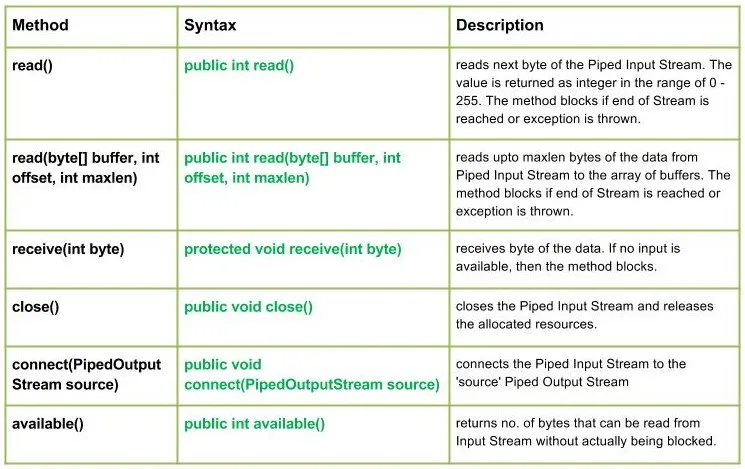
| PipedInputStream(PipedOutputStream outStream int pSize) : | създава Piped Input Stream, който е свързан с Piped Output Stream с посочения размер на тръбата. Методи: | int read(): | Reads the next byte of data from this piped input stream.The value byte is returned as an int in the range 0 to 255. This method blocks until input data is available the end of the stream is detected or an exception is thrown. Java // Java program illustrating the working of read() method import java.io.* ; public class NewClass { public static void main ( String [] args ) throws IOException { PipedInputStream geek_input = new PipedInputStream (); PipedOutputStream geek_output = new PipedOutputStream (); try { // Use of connect() : connecting geek_input with geek_output geek_input . connect ( geek_output ); // Use of read() method : geek_output . write ( 71 ); System . out . println ( 'using read() : ' + ( char ) geek_input . read ()); geek_output . write ( 69 ); System . out . println ( 'using read() : ' + ( char ) geek_input . read ()); geek_output . write ( 75 ); System . out . println ( 'using read() : ' + ( char ) geek_input . read ()); } catch ( IOException except ) { except . printStackTrace (); } } } Изход: using read() : G using read() : E using read() : K
| read(byte[] buffer int offset int maxlen) : | java.io.PipedInputStream.read(byte[] buffer int offset int maxlen) чете до maxlen байта от данните от Piped Input Stream в масива от буфери. Методът блокира, ако бъде достигнат краят на потока или е хвърлено изключение. Синтаксис: public int read(byte[] buffer int offset int maxlen) Parameters : buffer : the destination buffer into which the data is to be read offset : starting in the destination array - 'buffer'. maxlen : maximum length of array to be read Return : next 'maxlen' bytes of the data as an integer value return -1 is end of stream is reached Exception : -> IOException : if in case IO error occurs. -> NullPointerException : if buffer is null. -> IndexOutOfBoundsException : if offset is -ve or maxlen is -ve or maxlen > buffer.length - offset.
| получи (int байт): | java.io.PipedInputStream.receive(int байт) получава байт от данните. Ако няма наличен вход, тогава методът блокира. Синтаксис: protected void receive(int byte) Parameters : byte : the bytes of the data received Return : void Exception : -> IOException : if in case IO error occurs or pipe is broken.
| затвори(): | java.io.PipedInputStream.close() затваря конвейерния входен поток и освобождава разпределените ресурси. Синтаксис: public void close() Parameters : -------------- Return : void Exception : -> IOException : if in case IO error occurs.
| свързване (източник на PipedOutputStream): | java.io.PipedInputStream.connect(източник на PipedOutputStream) свързва Piped Input Stream към 'source' Piped Output Stream и в случай че 'source' е канали с някакъв друг поток, се хвърля IO изключение Синтаксис: public void connect(PipedOutputStream source) Parameters : source : the Piped Output Stream to be connected to Return : void Exception : -> IOException : if in case IO error occurs.
| наличен(): | java.io.PipedInputStream.available() връща не. от байтове, които могат да бъдат прочетени от Input Stream, без всъщност да бъдат блокирани. Синтаксис: public int available() Parameters : ------------- Return : no. of bytes that can be read from Input Stream without actually being blocked. 0 if the stream is already closed but by invoking close() method Exception : -> IOException : if in case IO error occurs.
Java програма, обясняваща работата на методите на клас PipedInputStream: Java // Java program illustrating the working of PipedInputStream // connect() read(byte[] buffer int offset int maxlen) // close() available() import java.io.* ; public class NewClass { public static void main ( String [] args ) throws IOException { PipedInputStream geek_input = new PipedInputStream (); PipedOutputStream geek_output = new PipedOutputStream (); try { // Use of connect() : connecting geek_input with geek_output geek_input . connect ( geek_output ); geek_output . write ( 71 ); geek_output . write ( 69 ); geek_output . write ( 69 ); geek_output . write ( 75 ); geek_output . write ( 83 ); // Use of available() : System . out . println ( 'Use of available() : ' + geek_input . available ()); // Use of read(byte[] buffer int offset int maxlen) : byte [] buffer = new byte [ 5 ] ; // destination 'buffer' geek_input . read ( buffer 0 5 ); String str = new String ( buffer ); System . out . println ( 'Using read(buffer offset maxlen) : ' + str ); // USe of close() method : System . out . println ( 'Closing the stream' ); geek_input . close (); } catch ( IOException except ) { except . printStackTrace (); } } } Изход: Use of available() : 5 Using read(buffer offset maxlen) : GEEKS Closing the stream
Next Article: Клас Java.io.PipedOutputStream в Java Създаване на тест


 Тръби в IO осигурява връзка между две нишки, работещи в JVM едновременно. Така че каналите се използват както като източник, така и като дестинация.